Portable Science Labs
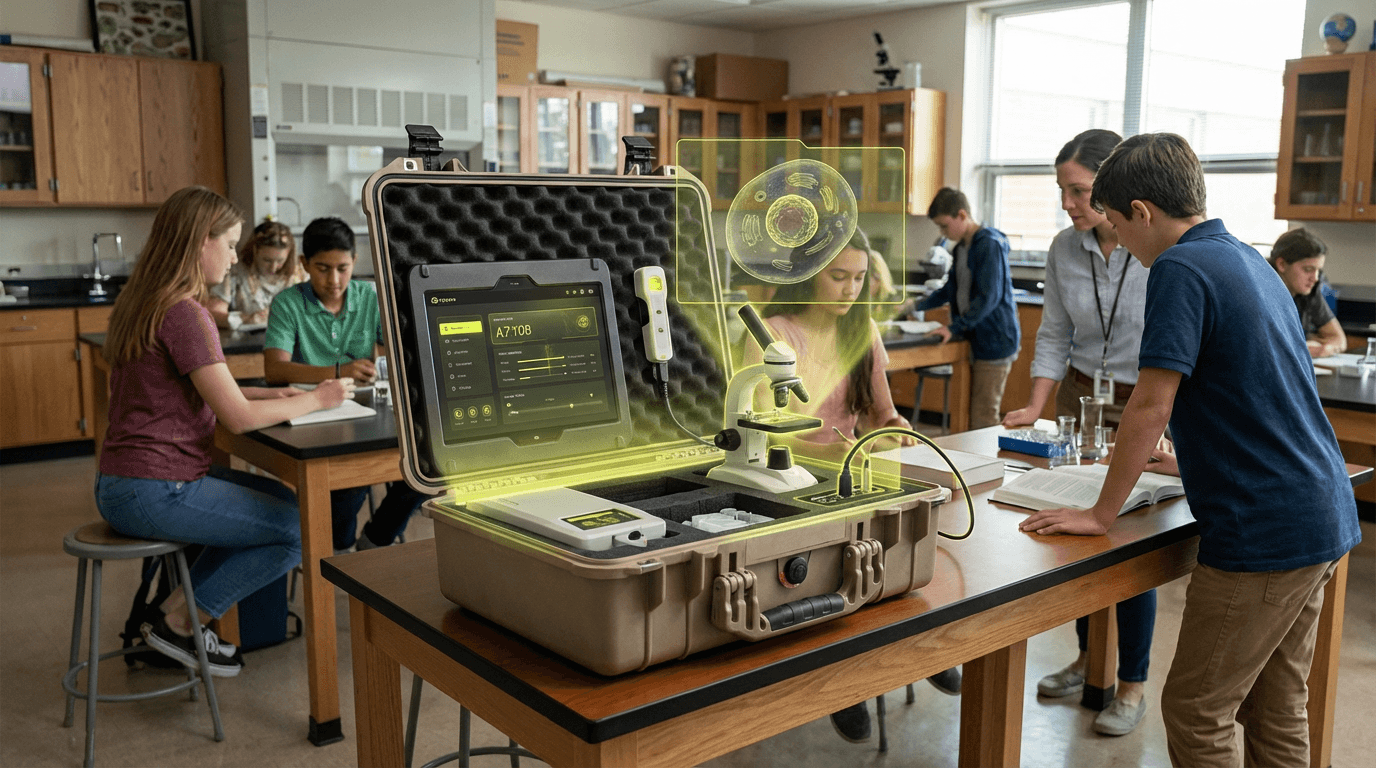
Portable science labs are compact, self-contained laboratory systems packaged in durable cases that include lab-grade sensors, digital microscopes, measurement tools, sample preparation equipment, and tablets or smartphones with augmented reality (AR) software that overlays digital information, instructions, and data visualization onto physical experiments. These systems enable high-quality science education in settings without permanent laboratory infrastructure—rural schools, pop-up classrooms, field trips, or resource-constrained environments—by providing all necessary equipment and digital guidance in portable form. AR overlays can show molecular structures, label biological specimens, provide step-by-step instructions, or visualize invisible phenomena like magnetic fields or chemical reactions, enhancing understanding without requiring expensive equipment or facilities.
This innovation addresses the equity gap in science education, where students in under-resourced schools often lack access to laboratory experiences that are essential for understanding scientific concepts and developing inquiry skills. By providing portable, affordable laboratory capabilities, these systems can democratize access to hands-on science education. Companies and organizations developing these systems include Labster (virtual labs), various educational technology providers, and organizations focused on science education equity.
The technology is particularly significant for improving science education access and quality in resource-constrained settings, where portable labs can provide laboratory experiences that would otherwise be impossible. As sensor technology improves and costs decrease, portable labs could become standard tools for science education. However, ensuring content quality, providing teacher training, managing equipment maintenance, and integrating these tools effectively into curriculum remain challenges. The technology represents an important tool for science education equity, but requires thoughtful implementation to maximize educational benefits.
Related Organizations
A startup democratizing science education by transforming smartphones into science instruments.

Creates wireless sensors for STEM education.

A major provider of scientific hardware and software for education.

Pasco Scientific
United States · Company
A global leader in student lab equipment and science education technology.

Provides project-based learning experiences with connected science labs.
Creates open-source brain-computer interface tools and the Galea headset (integrating with VR) for researching physiological responses.

An open-source hardware and software company that designs single-board microcontrollers and microcontroller kits.
Supporting Evidence
Research this in Signals
Signals turns a topic into a sourced research record you can inspect and rerun. Your first scan is free, and this one starts with Portable Science Labs already loaded, so edit it or scan as is.