Peer Assessment Platforms
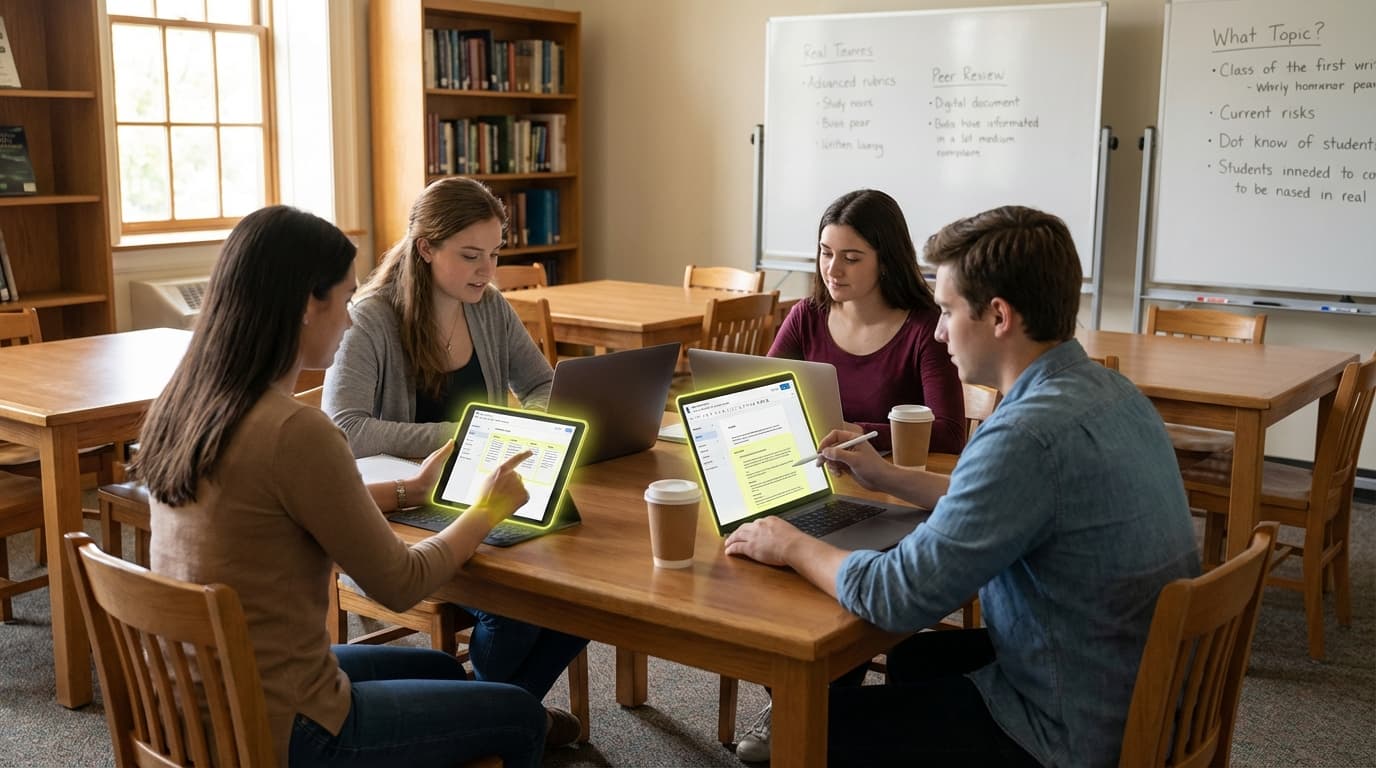
Peer assessment platforms provide structured systems for students to review and provide feedback on each other's work, using guided workflows, rubrics, and calibration exercises to ensure quality and consistency. These platforms enable scalable feedback mechanisms where students can receive multiple perspectives on their work while developing critical evaluation skills through the process of assessing others. By using rubrics and structured guidance, these systems help students provide constructive, focused feedback, while calibration exercises train students to apply assessment criteria consistently. The approach not only scales feedback but also promotes metacognition, as students must understand assessment criteria deeply to evaluate others' work effectively, freeing instructors to focus on higher-order critique and instruction.
This innovation addresses the challenge of providing detailed, timely feedback on student work, where instructor time is limited and providing individual feedback to every student can be time-prohibitive. By enabling peer assessment, these platforms can provide more feedback while developing students' critical thinking and evaluation skills. Educational technology platforms and learning management systems are integrating peer assessment capabilities, with some systems already widely used in higher education and online courses.
The technology is particularly significant for scaling feedback and developing critical thinking skills, where peer assessment can provide multiple perspectives and help students develop metacognitive awareness. As platforms improve and provide better guidance, peer assessment could become more widely adopted. However, ensuring assessment quality, managing student concerns about fairness, providing adequate training, and ensuring that peer feedback is constructive remain challenges. The technology represents an important approach to scaling feedback and developing critical thinking, but requires careful implementation to maximize benefits.
Related Organizations

EdTech scaleup providing a suite of pedagogical tools, primarily focusing on peer review and group member evaluation integrated into LMS.
Peer assessment platform designed to improve critical thinking through calibrated peer grading.

Research-validated peer assessment technology originally developed at the University of Pittsburgh (as SWoRD).

Peer learning app focused on writing instruction, revision, and feedback loops.
Online learning platform offering courses from top universities, widely used for enterprise workforce transformation.


Turnitin
United States · Company
Provider of academic integrity tools, including 'PeerMark', a widely used peer review system.
Online grading and analytics platform that includes collaborative grading and peer review workflows.

Social learning platform that turns reading assignments into social peer interactions and review.

Australian university known for extensive research into active learning and peer assessment methodologies.
Supporting Evidence
Research this in Signals
Signals turns a topic into a sourced research record you can inspect and rerun. Your first scan is free, and this one starts with Peer Assessment Platforms already loaded, so edit it or scan as is.