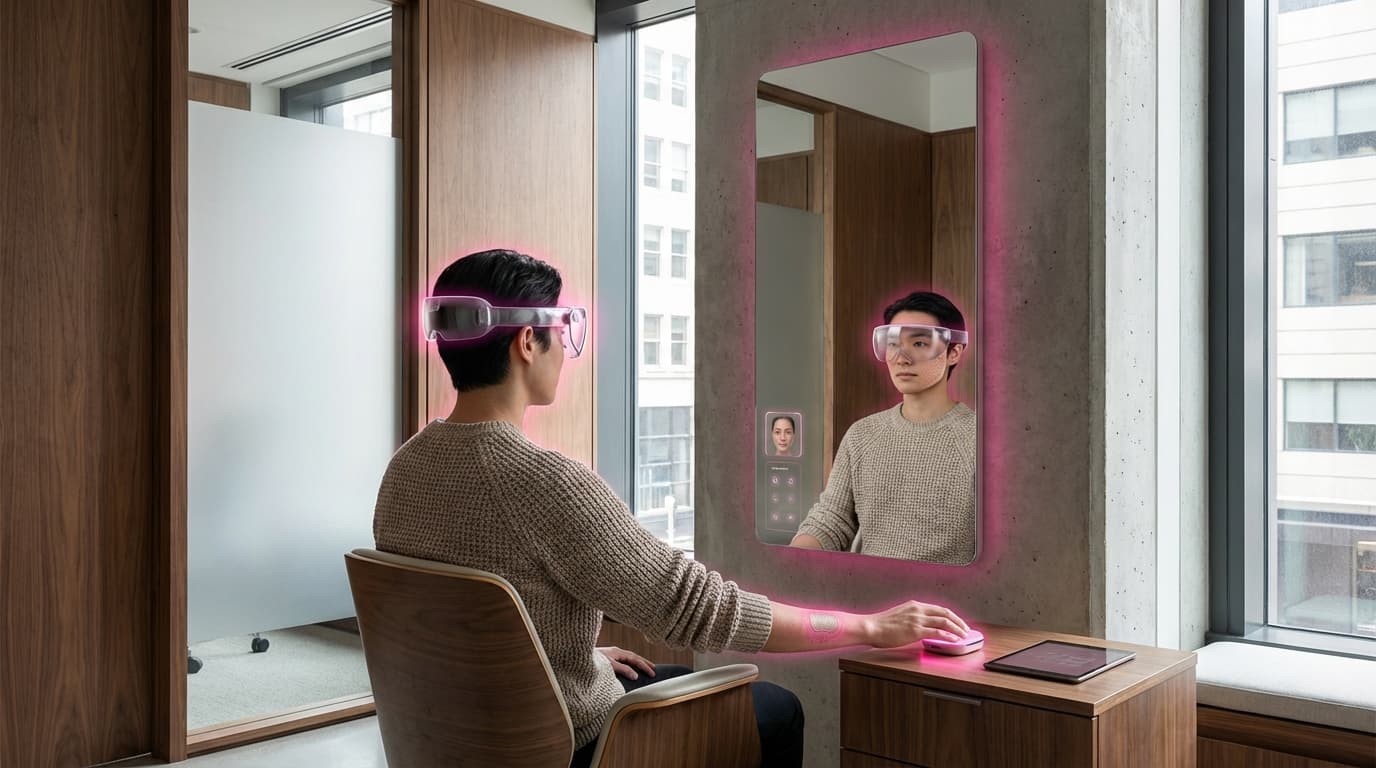
Immersive Self-Perception Models
Immersive self-perception models combine advanced computer vision, 3D rendering, and physiological simulation to create realistic AR/VR representations of how a person's appearance will change based on actual biomarker data, treatment protocols, and lifestyle interventions. Unlike idealized beauty filters that show unrealistic transformations, these systems use real data from skin analysis, body composition scans, genetic profiles, and treatment outcomes to render scientifically-grounded projections of future appearance. By linking digital representations to actual biological processes and treatment effects, these models help users develop realistic expectations, understand the relationship between interventions and outcomes, and maintain motivation through accurate visualization of progress.
This innovation addresses the problem of unrealistic expectations and poor adherence in beauty and wellness, where idealized marketing imagery creates false hopes and users struggle to see gradual improvements. By providing realistic, data-driven visualizations, these models can improve treatment adherence, set appropriate expectations, and help users make informed decisions about interventions. Research institutions and companies developing AR/VR wellness applications are exploring these capabilities, with potential applications in aesthetic medicine, fitness, and lifestyle coaching.
The technology is particularly significant for improving outcomes in aesthetic and wellness interventions, where realistic expectations and sustained motivation are crucial for success. As AR/VR technology becomes more accessible and simulation models improve, immersive self-perception tools could become standard components of treatment planning and progress tracking. However, ensuring model accuracy, managing the psychological impact of appearance visualization, and preventing misuse for body dysmorphia or unrealistic expectations remain important considerations. The technology represents a responsible approach to appearance enhancement technology, but requires careful implementation to maximize benefits while minimizing risks.
Related Organizations
United States · Company
The industry standard for skin imaging systems (VISIA), providing the high-fidelity data required to build accurate digital skin twins.
Taiwan · Company
Developer of the YouCam suite and AgileHand technology, providing enterprise-grade AR try-on solutions for makeup, nails, watches, and jewelry.
Switzerland · Company
A leader in 3D aesthetic simulation, allowing patients to visualize surgical results using VR and 3D modeling.
Estonia · Startup
A leader in generative AI for skincare, creating predictive models that simulate skin aging and the effects of products over time.
Canada · Company
An AR beauty technology provider acquired by L'Oréal to power virtual try-ons across the group's portfolio and partners like Amazon.
Israel · Company
Develops a hand-held 3D scanner for aesthetic medicine to measure volume changes and skin texture.
South Korea · Startup
A Samsung C-Lab spin-off that developed the LUMINI kiosk, an AI skincare assistant that analyzes skin data and recommends solutions.
France · Company
Specializes in 3D imaging systems (LifeViz) for plastic surgery and dermatology simulations.
Finland · Startup
Provides a Digital Health-Beauty-Wellness Platform that combines AI skin analysis with AR try-on capabilities for retailers.
South Korea · Company
Manufacturer of advanced skin and hair diagnostic devices that utilize optical technology and AI for home and clinic use.
Supporting Evidence
Research this in Signals
Signals turns a topic into a sourced research record you can inspect and rerun. Your first scan is free, and this one starts with Immersive Self-Perception Models already loaded, so edit it or scan as is.