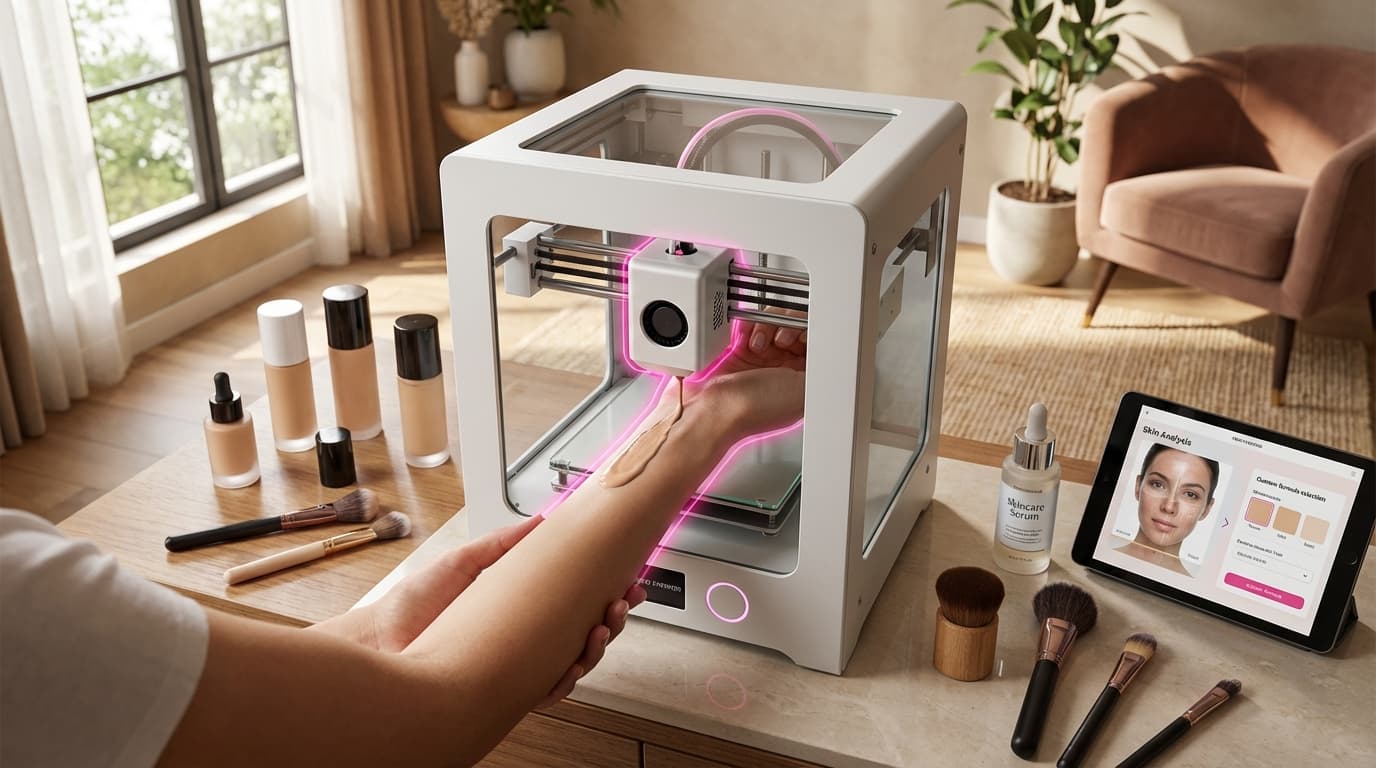
Custom 3D-Printed Cosmetics
Custom 3D-printed cosmetics use specialized printers that scan skin tone, facial features, or nail beds and then deposit precisely matched pigments, textures, and formulations layer by layer to create bespoke makeup or nail art. These systems use color-matching technology to analyze skin undertones and surface characteristics, then mix and apply custom foundation shades, lip colors, or nail designs that perfectly match individual features. The layer-by-layer deposition process enables precise control over color gradients, textures, and finishes, creating custom looks that would be difficult or impossible to achieve with traditional application methods, while eliminating the need for manual skill in color matching and application.
This innovation addresses the challenge of finding perfect color matches in cosmetics, where standard shade ranges often don't accommodate all skin tones and undertones, and where achieving precise, custom looks requires significant skill. By automating color matching and application, 3D printing enables truly personalized cosmetics that are perfectly matched to individual features. Companies like various cosmetic and technology companies are exploring these capabilities, with some systems already available for specific applications like custom foundation or nail art.
The technology is particularly significant for personalized beauty, where custom-printed cosmetics could provide perfect matches and unique designs for every individual. As printing technology improves and becomes more accessible, custom 3D-printed cosmetics could become standard in retail and home settings. However, ensuring color accuracy, managing formulation stability, making systems affordable and user-friendly, and scaling production remain challenges. The technology represents an exciting application of 3D printing to beauty, but requires continued development to achieve widespread adoption.
Related Organizations
United States · Startup
Pioneers of the 3D makeup printer, allowing users to print cosmetics from images.
Preemadonna
United States · Startup
Creators of the Nailbot, a device that prints custom art directly onto fingernails.
Amorepacific
South Korea · Company
South Korean beauty conglomerate that owns 'Vital Beautie', a major brand in the inner beauty and health functional food market.

Developed the Opté Precision Skincare System (wand).
United States · Company
Offers the Skin360 app and previously the SkinScanner tool, enabling at-home analysis of skin health metrics.
United Kingdom · Company
Design and innovation agency that conceptualized the 'Identité' makeup printer.
Lush
United Kingdom · Company
Ethical cosmetics retailer using 3D printing for product molds and solid product concepts.

Leading 3D printing manufacturer focusing on SLA and SLS technology.
Supporting Evidence
Research this in Signals
Signals turns a topic into a sourced research record you can inspect and rerun. Your first scan is free, and this one starts with Custom 3D-Printed Cosmetics already loaded, so edit it or scan as is.