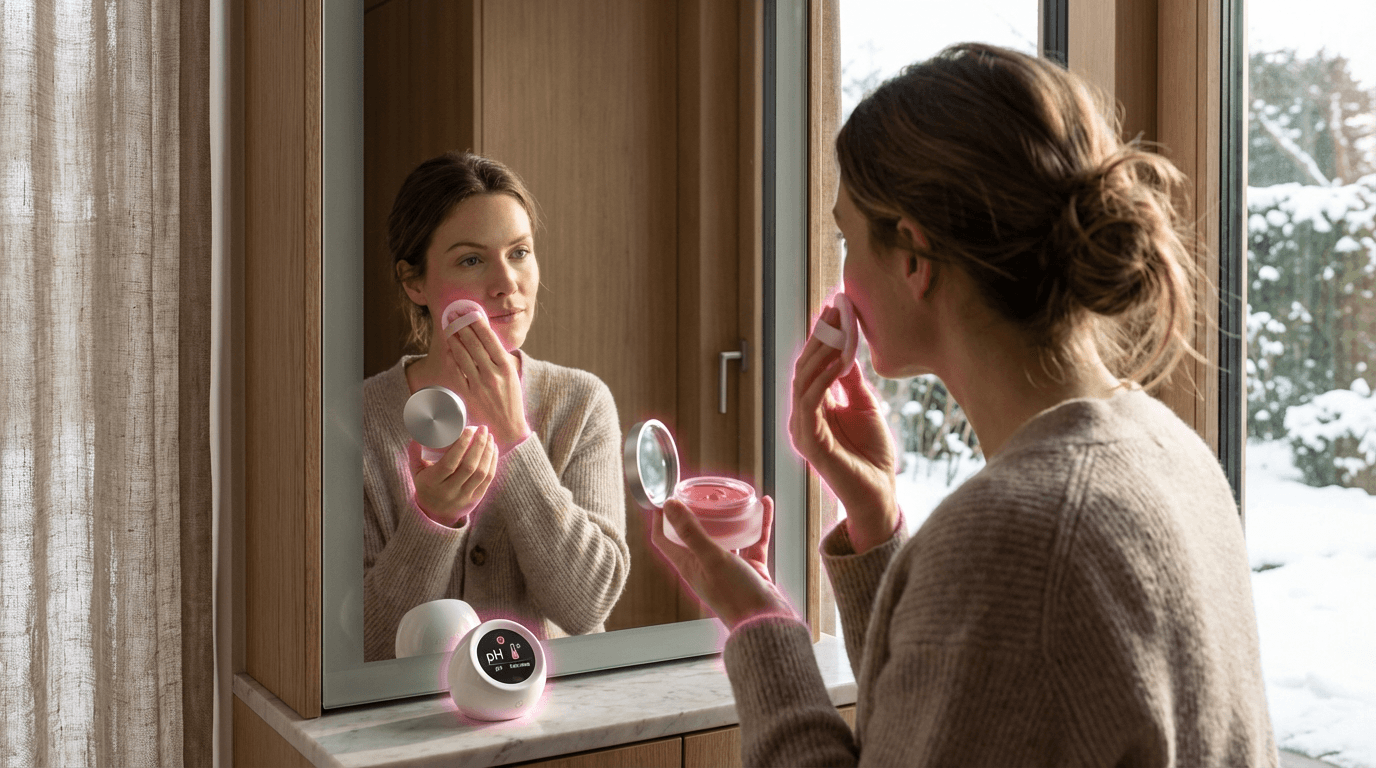
Smart Bio-Makeup
Smart bio-makeup uses responsive formulations that adapt to environmental conditions and skin chemistry in real-time, changing color, finish, or coverage based on pH levels, temperature, humidity, and skin oiliness. These formulations incorporate pH-sensitive pigments that shift color based on skin acidity, thermochromic compounds that respond to temperature changes, and humidity-responsive polymers that adjust texture and coverage. Some advanced systems link pigments to light-responsive compounds that subtly change appearance throughout the day, or use microencapsulated actives that release skincare ingredients based on environmental triggers, blurring the line between makeup and skincare.
This innovation addresses the limitation of static makeup formulations, which don't adapt to changing conditions throughout the day, leading to color shifts, fading, or texture changes. By creating responsive formulations, smart bio-makeup can maintain optimal appearance and performance regardless of environmental conditions or skin state. Companies like L'Oréal, various Korean beauty brands, and cosmetic chemistry startups are exploring these technologies, with some pH-responsive and temperature-adaptive products already available in the market.
The technology is particularly significant for creating more reliable, long-lasting makeup that adapts to individual skin chemistry and environmental conditions. As formulation science advances, smart bio-makeup could become standard, providing personalized color matching and adaptive performance. However, ensuring stability, managing formulation complexity, and achieving reliable responses remain challenges. The technology represents an exciting direction for cosmetic science, but requires continued development to achieve consistent, predictable performance across diverse conditions and skin types.
Related Organizations
Intercos Group
Italy · Company
One of the world's largest B2B cosmetic manufacturers, heavily investing in R&D for innovative textures and reactive formulas.
United States · Startup
A makeup brand famous for its color-changing blush oil that reacts to the wearer's skin pH.
Italy · Company
A leading B2B manufacturer specializing in makeup technologies, including baked powders and innovative color-shifting pigments.
France · Company
Global supplier of pigments and dyes, including specialty dispersions and surface treatments for adaptive cosmetics.
United States · Company
Beauty brand known for the 'Flower Balm', a lip stain that changes color based on the user's pH levels.
Italy · Startup
Italian indie brand known for 'Glassy', a transparent blush that transforms into a pink tint upon contact with skin.

Home of the Affective Computing research group led by Rosalind Picard.
United States · Company
Estée Lauder brand known for 'O-Glow', an early and successful intuitive cheek color reacting to skin chemistry.
United Kingdom · Company
Specialty chemical manufacturer creating smart polymers and temperature-sensitive ingredients for personal care.
Supporting Evidence
Research this in Signals
Signals turns a topic into a sourced research record you can inspect and rerun. Your first scan is free, and this one starts with Smart Bio-Makeup already loaded, so edit it or scan as is.