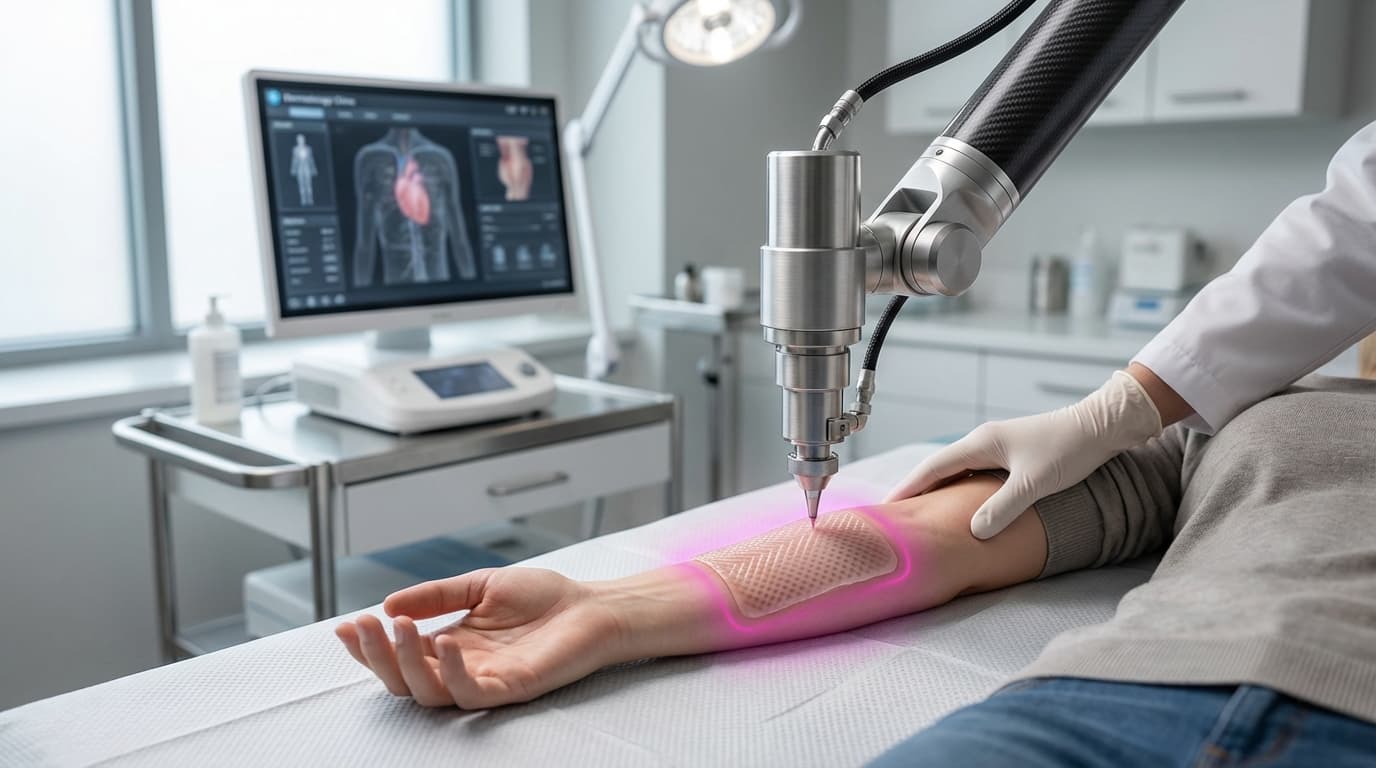
Bio-Printed Skin Grafts
3D bioprinting platforms use layer-by-layer deposition of living cells, bioinks, and scaffold materials to create structured skin constructs with functional epidermis, dermis, and integrated vasculature. These systems precisely control cell placement and matrix composition, enabling the fabrication of skin grafts that match patient-specific thickness, pigmentation, and structural properties. Advanced printers can incorporate multiple cell types—keratinocytes, fibroblasts, melanocytes, and endothelial cells—along with growth factors and extracellular matrix components to create grafts that integrate naturally with surrounding tissue.
This innovation addresses critical limitations in traditional skin grafting, where donor site availability, scarring, and aesthetic mismatches constrain reconstructive and aesthetic procedures. By printing custom skin constructs, these platforms enable scarless healing, precise aesthetic matching, and potentially unlimited graft material. Companies like Organovo, 3D Bioprinting Solutions, and research institutions are advancing these technologies, with some systems already producing functional skin grafts for burn treatment and reconstructive surgery.
The technology is particularly significant for aesthetic applications, where printed skin could enable scar revision, wrinkle reduction, and even elective enhancement procedures. As the technology matures and regulatory pathways clear, bioprinted skin could transform both reconstructive and aesthetic dermatology. However, ensuring long-term viability, managing immune responses, and achieving regulatory approval remain challenges. The technology represents a convergence of tissue engineering and aesthetic medicine, but requires continued development to achieve the reliability and aesthetic outcomes needed for widespread clinical adoption.
Related Organizations

Poietis
France · Company
Uses laser-assisted bioprinting (LAB) to print living cells with single-cell resolution.

A premier research institute led by Dr. Anthony Atala, famous for printing bladders and developing the ITOP printer.
Sweden · Company
The market leader in bio-convergence, producing a wide range of 3D bioprinters and bio-inks for research.
United States · Company
A pioneer in bioprinting functional human tissues for drug discovery and development, specifically liver and kidney models.

Develops the Dr. INVIVO 4D bioprinter series for organ regeneration and skin printing.

Develops rhCollagen bioinks and partners with 3D Systems to print breast implants and other tissue scaffolds.
France · Company
Specializes in 3D bioprinting and predictive ex vivo models for dermocosmetics and personalized medicine.
South Korea · Company
A Korean biomedical engineering company specializing in 3D bioprinting scaffolds and tissues.

Uses microfluidic 3D bioprinting technology to create bioprinted therapeutics, partnering with Novo Nordisk.
Supporting Evidence
Research this in Signals
Signals turns a topic into a sourced research record you can inspect and rerun. Your first scan is free, and this one starts with Bio-Printed Skin Grafts already loaded, so edit it or scan as is.