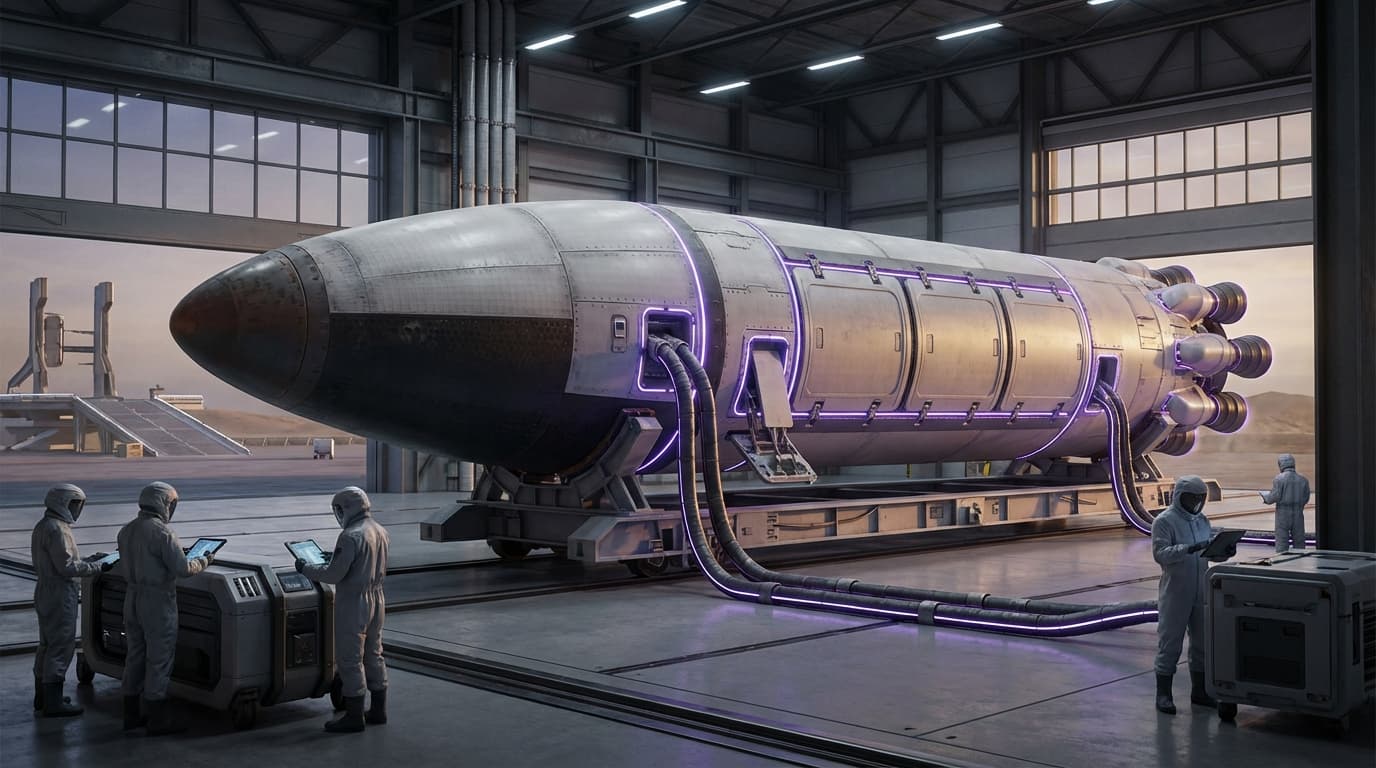
Point-to-Point Orbital Logistics
Point-to-point orbital logistics uses suborbital or orbital trajectories to deliver cargo anywhere on Earth in under an hour, using ballistic flight paths that travel through or above the atmosphere. These systems would enable rapid global cargo transport, potentially revolutionizing military logistics, emergency response, and time-sensitive supply chains. The technology leverages reusable rocket capabilities to create a new form of rapid global transportation.
This innovation addresses the need for extremely rapid global logistics, where conventional transportation takes many hours or days even for urgent cargo. By using space trajectories, these systems could deliver critical supplies, medical equipment, or other time-sensitive cargo to any location on Earth in a fraction of the time required by conventional means. Military organizations and logistics companies are studying these concepts for applications including humanitarian relief and critical supply chains.
The technology is still largely conceptual, with significant challenges including cost, payload capacity, safety, and regulatory approval. While technically feasible, it's unclear whether such systems would be economically viable or practical for widespread use. However, as reusable rocket technology matures and costs decrease, the economics could become more favorable. The technology represents an interesting application of space technology to Earth logistics, but practical implementation would require significant advances in cost, safety, and regulatory frameworks. The concept highlights how space technology could potentially transform Earth-based transportation, but many questions remain about feasibility and viability.
Related Organizations

Deploys optical inter-satellite links (lasers) on Starlink satellites to reduce latency and ground station dependence.

Scientific research organization of the US Air Force.
United States Transportation Command (USTRANSCOM)
United States · Government Agency
One of eleven unified combatant commands of the US Department of Defense.


Blue Origin
United States · Company
Aerospace manufacturer developing the 'Blue Alchemist' technology to produce solar cells and transmission wire from lunar regolith simulants.

Developing the Mk-II Aurora spaceplane for horizontal launch from standard runways in New Zealand.

Destinus
Switzerland · Startup
A European company developing hydrogen-powered hypersonic aircraft.

A company developing a single-stage-to-orbit (SSTO) spaceplane.

Developing the Dream Chaser spaceplane and LIFE habitats to support commercial space activities including manufacturing.
Supporting Evidence
Research this in Signals
Signals turns a topic into a sourced research record you can inspect and rerun. Your first scan is free, and this one starts with Point-to-Point Orbital Logistics already loaded, so edit it or scan as is.