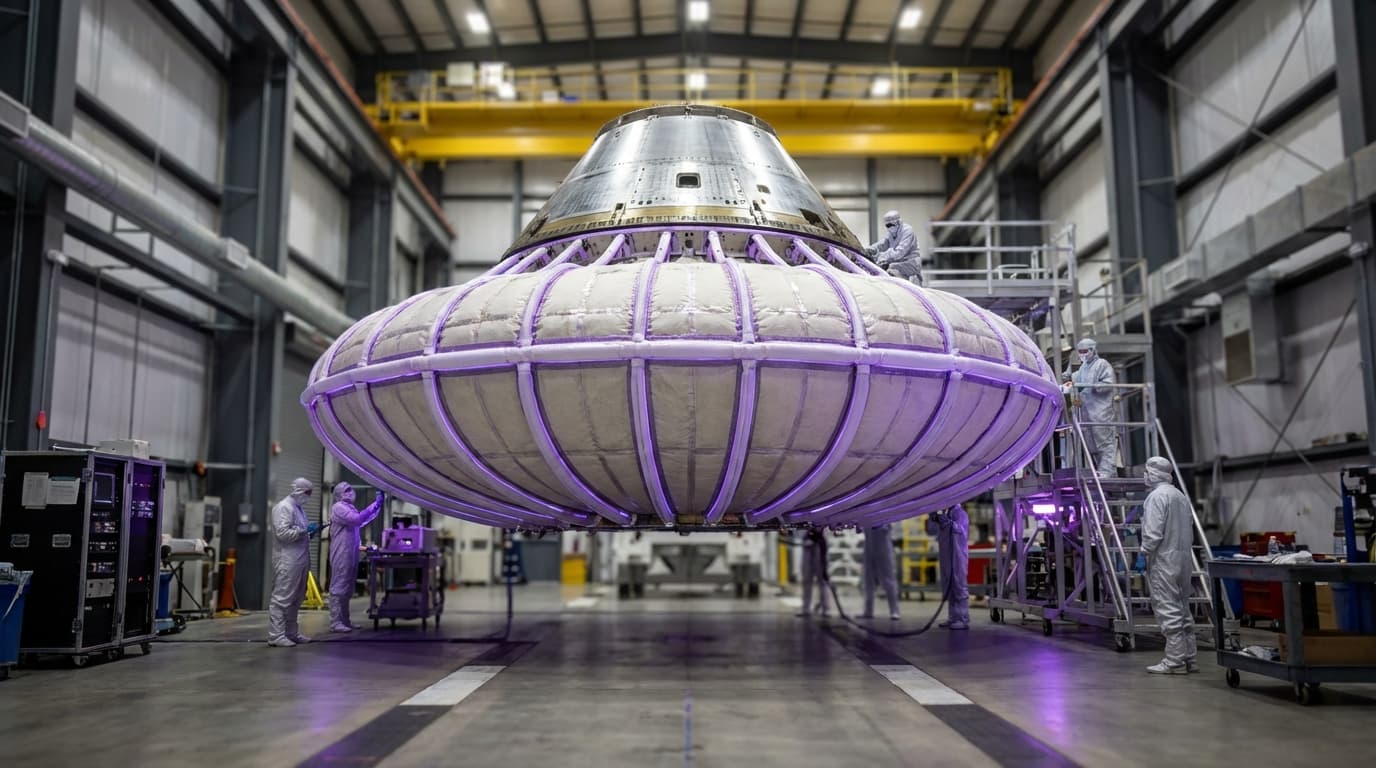
Inflatable Heat Shields
Inflatable heat shields are deployable aeroshells that expand to large diameters before atmospheric entry, dramatically increasing drag area and enabling safe entry for heavier payloads or gentler deceleration with lower G-forces. Systems like NASA's LOFTID (Low-Earth Orbit Flight Test of an Inflatable Decelerator) demonstrate the technology, using flexible thermal protection materials that can be stowed compactly during launch and deployed to much larger sizes for entry.
This innovation addresses the fundamental challenge of planetary entry, where traditional rigid heat shields are limited in size by launch vehicle fairings, constraining payload mass and entry conditions. By deploying large inflatable shields, these systems can decelerate much heavier payloads or provide gentler entry profiles that are safer for crewed missions or delicate cargo. The technology is essential for future Mars missions, sample return missions, and cargo delivery to planetary surfaces.
The technology is particularly significant for enabling human Mars missions, where landing heavy payloads safely is a critical challenge, and for sample return missions where delicate samples must survive entry. As these systems mature and are demonstrated, they could enable new classes of missions that require heavy payload delivery or gentle entry conditions. The technology represents an important capability for expanding what's possible in planetary exploration and enabling sustainable human presence on other worlds.
Related Organizations

Conducts advanced demonstrations like LCRD (Laser Communications Relay Demonstration) and DSOC (Deep Space Optical Comm).

Developing the RED (Re-entry Device) product line using flexible thermal protection systems.

Specializes in deployable fabric structures and inflatable habitats/shields for space applications.

Partnered with NASA to flight test LOFTID on an Atlas V rocket and studies engine recovery via inflatables.

Develops parachutes and inflatable deceleration systems for Mars missions and re-entry vehicles.

Developing the IRENE (Italian Re-Entry NacellE) deployable reentry technology.
Leads the EAGLE-1 mission and the SAGA program to build a European quantum communication infrastructure in space.
Vorticity
United Kingdom · Company
Provides systems engineering for entry, descent, and landing, including analysis of inflatable decelerators.

A premier supplier of environmental control and life support systems (ECLSS).
Supporting Evidence
Research this in Signals
Signals turns a topic into a sourced research record you can inspect and rerun. Your first scan is free, and this one starts with Inflatable Heat Shields already loaded, so edit it or scan as is.