Nano-Satellite Voice-Enabled Communications
Geography: Asia Pacific · Oceania · Australia New Zealand
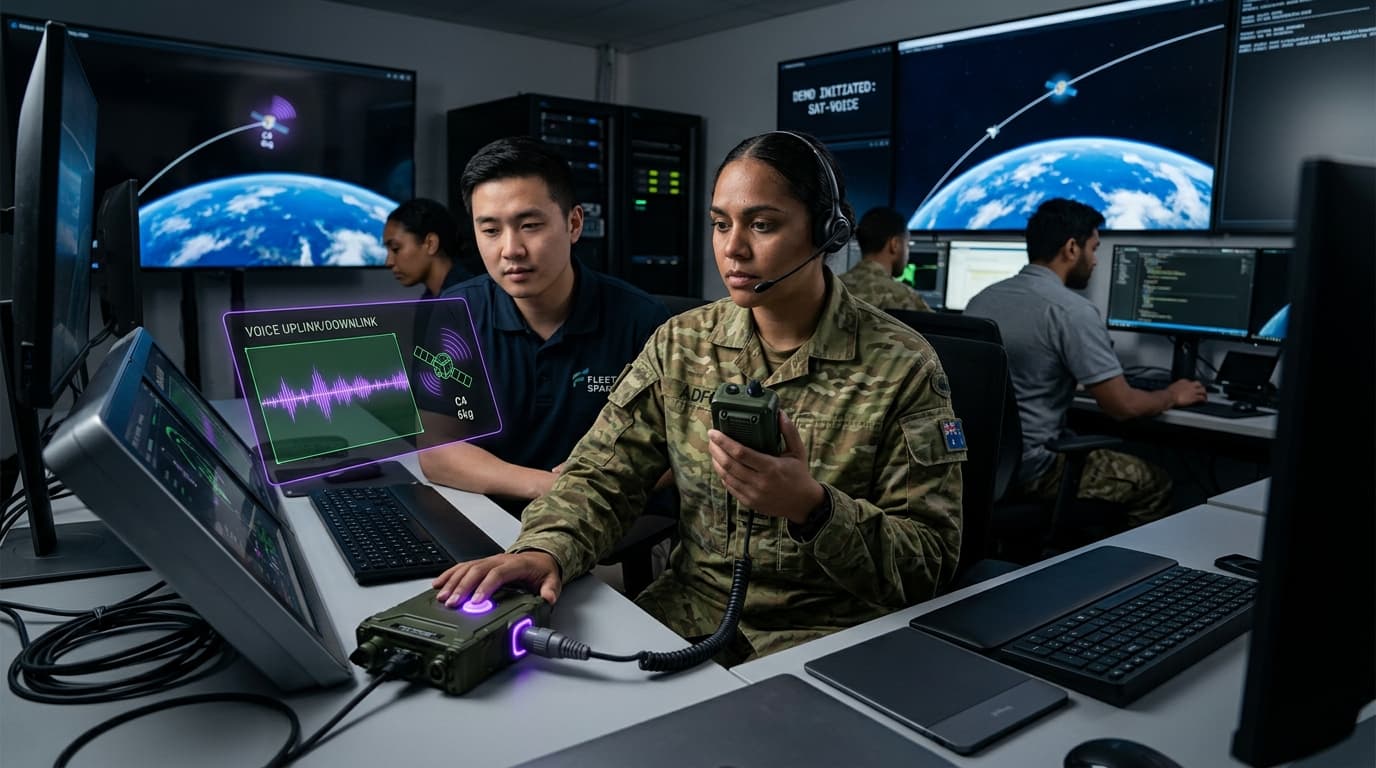
Fleet Space Technologies demonstrated satellite-enabled Push-to-Talk (PTT) voice communications for the Australian Defence Force's ASCEND2LEO program using its Centauri-4 satellite — at 6kg, the world's smallest known satellite capable of voice relay. The demonstration proved that nano-satellites could provide tactical communications capability in areas without terrestrial network coverage, relevant for both military operations and remote civilian applications across Australia's vast interior.
Australia's geography — a continent the size of the contiguous United States with a population concentrated on the coasts — creates enormous communications dead zones in the interior. Military operations, mining activities, pastoral stations, and emergency services in these areas currently depend on expensive HF radio or satellite phones. Nano-satellite voice relay at the cost point enabled by Fleet Space's constellation could democratize satellite communications access.
For defense applications, the ability to provide secure voice communications through an Australian-built and operated satellite constellation offers sovereignty advantages over reliance on foreign-owned systems (Iridium, Inmarsat). The ASCEND2LEO program explicitly aims to develop Australian sovereign space communications capability, with nano-satellites offering rapid constellation deployment and replacement at costs orders of magnitude lower than traditional military communications satellites.
Research this in Signals
Signals turns a topic into a sourced research record you can inspect and rerun. Your first scan is free, and this one starts with Nano-Satellite Voice-Enabled Communications already loaded, so edit it or scan as is.