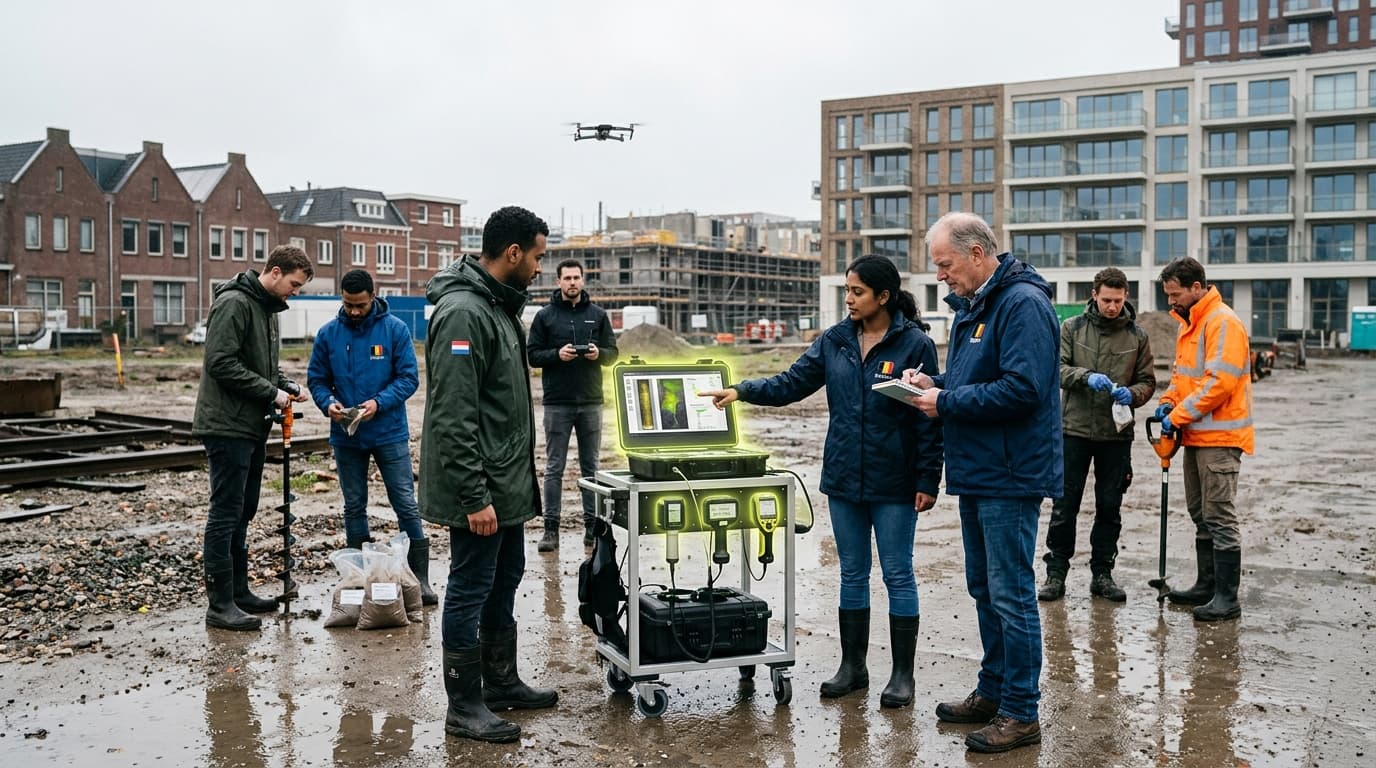
PFAS Soil Contamination
The PFAS contamination crisis represents a fundamental challenge to the redevelopment of brownfield sites across the Benelux region, where decades of industrial activity have left a legacy of persistent chemical pollution that resists natural degradation. Per- and polyfluoroalkyl substances, collectively known as PFAS or "forever chemicals," were widely used in industrial processes, firefighting foams, and consumer products throughout the 20th century. Their extreme stability—the very property that made them valuable for industrial applications—means they accumulate in soil and groundwater rather than breaking down, creating contamination that can persist for thousands of years. This permanence transforms what were once routine brownfield redevelopment projects into complex environmental remediation challenges, as stricter testing protocols reveal contamination levels that exceed newly established safety thresholds. The scale of this emerging barrier became starkly visible following the 3M Zwijndrecht scandal in Flanders, where previously undetected PFAS pollution triggered emergency health measures and forced authorities to reconsider soil standards across the region.
The mechanics of this barrier operate through both regulatory tightening and economic viability constraints. As scientific understanding of PFAS health risks has advanced, governments in the Netherlands, Belgium, and Luxembourg have progressively lowered acceptable contamination thresholds, requiring more extensive testing before development permits can be issued. Sites that passed environmental assessments even five years ago now fail under updated standards, forcing developers to undertake remediation processes that can cost millions of euros per hectare. Available remediation technologies—including soil excavation and disposal, thermal treatment, or advanced filtration systems—remain expensive and energy-intensive, with effectiveness varying significantly depending on contamination type and soil conditions. Industry observers note that remediation costs frequently exceed the residual land value of contaminated sites, particularly in secondary cities where housing market pressures are less acute. This economic calculus is stalling brownfield redevelopment pipelines precisely when housing shortages demand accelerated construction on available urban land.
The implications extend beyond individual project delays to reshape regional housing strategies and land-use priorities. Municipalities face difficult trade-offs between precautionary health standards and development urgency, while developers increasingly redirect investment toward greenfield sites that avoid contamination risks entirely—a shift that undermines compact city objectives and agricultural land preservation goals. Monitoring should focus on several critical thresholds: the rate at which contaminated sites are being identified versus remediated, changes in brownfield land values relative to greenfield alternatives, and policy responses that might socialise remediation costs or establish liability frameworks for historical polluters. The emergence of PFAS as a development barrier comparable to nitrogen deposition constraints suggests a pattern where environmental legacy issues increasingly constrain spatial planning options, requiring either substantial public investment in remediation infrastructure or fundamental recalibration of where and how housing growth can occur across the Benelux region.
Related Organizations
Multinational manufacturing conglomerate; its Zwijndrecht facility is a primary source of PFAS contamination in Flanders.
Major marine engineering and environmental contractor whose subsidiary, DEC, specializes in soil remediation and groundwater treatment, specifically targeting PFAS in the Benelux region.

Global construction and engineering firm with a dedicated environmental division (Envisan) focused on complex soil remediation and sediment treatment.

The Public Waste Agency of Flanders, which plays a key role in the TOTEM tool (Tool to Optimise the Total Environmental impact of Materials).

Dutch government research institute that sets the standards and action frameworks for PFAS limits in soil and water.

Global design and consultancy firm for natural and built assets.

Global dredging and offshore contractor and maritime services provider.
Chemours Netherlands
Netherlands · Company
Chemical company spun off from DuPont, operating a major plant in Dordrecht associated with PFAS emissions.

A leading European independent research and technology organisation in the areas of cleantech and sustainable development.

An independent international engineering and project management consultancy.

World's leading inspection, verification, testing, and certification company with extensive labs in Benelux.

European environmental consulting firm with strong expertise in soil investigation and remediation management.

Witteveen+Bos
Netherlands · Company
Engineering and consultancy firm advising on infrastructure, water, and environment.