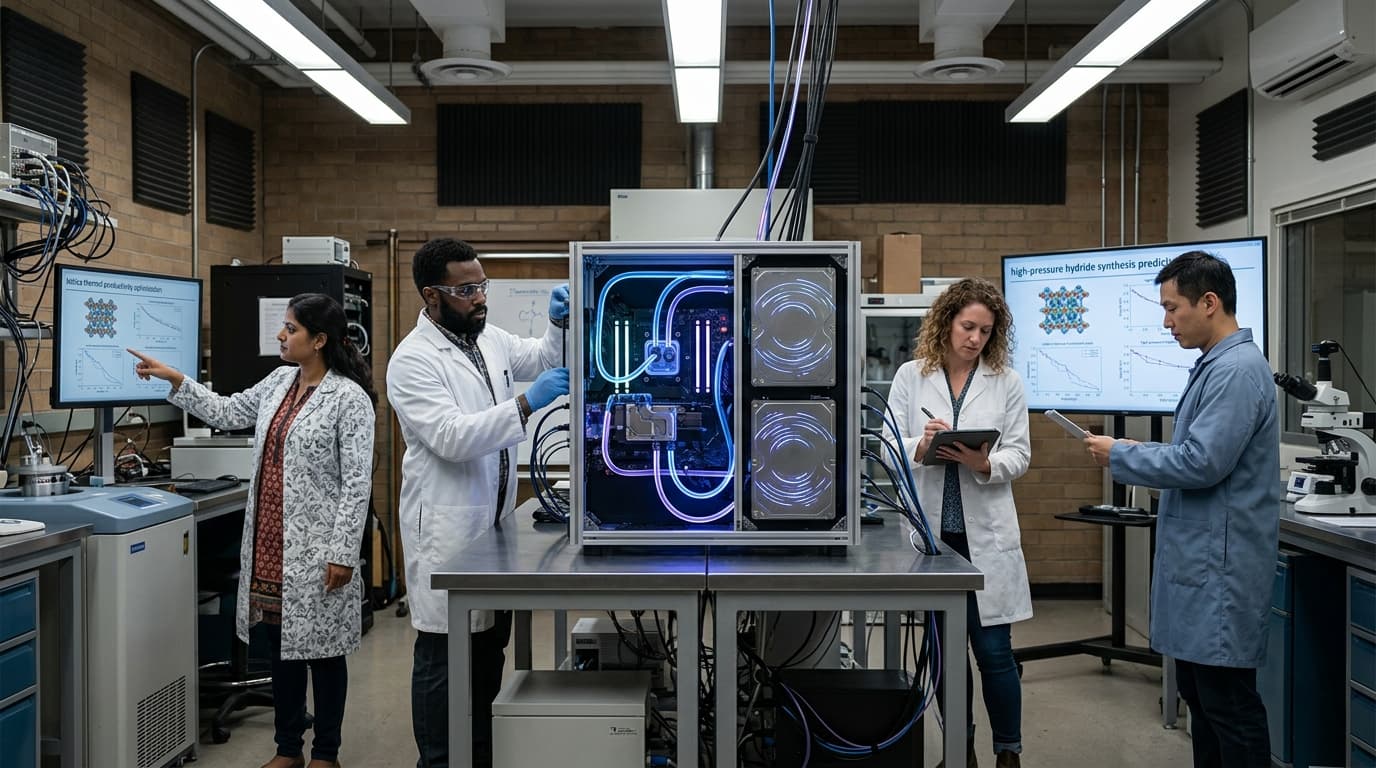
AI for Scientific Discovery
Geography: Americas · North America · United States
AI-driven scientific discovery has moved from protein structure prediction (AlphaFold) to active hypothesis generation and experimental design. Google DeepMind's GNoME discovered 2.2 million new crystal structures. DARPA's Exponentiating Mathematics (expMath) program applies AI techniques to enable breakthrough advances in national security-related mathematical fields. AI systems are now designing novel molecules, optimizing chemical reactions, and discovering physical laws from data.
This represents a potential acceleration of the scientific method itself. Traditional discovery cycles of hypothesis-experiment-analysis that take years can be compressed to days when AI can simulate experiments, predict outcomes, and suggest the most informative next steps. The implications span materials science, drug discovery, climate modeling, and fundamental physics.
The US leads in AI-for-science due to its concentration of top research universities, national laboratories, and frontier AI companies. However, China is rapidly building comparable capabilities, particularly in materials science and drug discovery. The country that best integrates AI into its scientific ecosystem will have a compounding advantage across all technology domains.
Research this in Signals
Signals turns a topic into a sourced research record you can inspect and rerun. Your first scan is free, and this one starts with AI for Scientific Discovery already loaded, so edit it or scan as is.