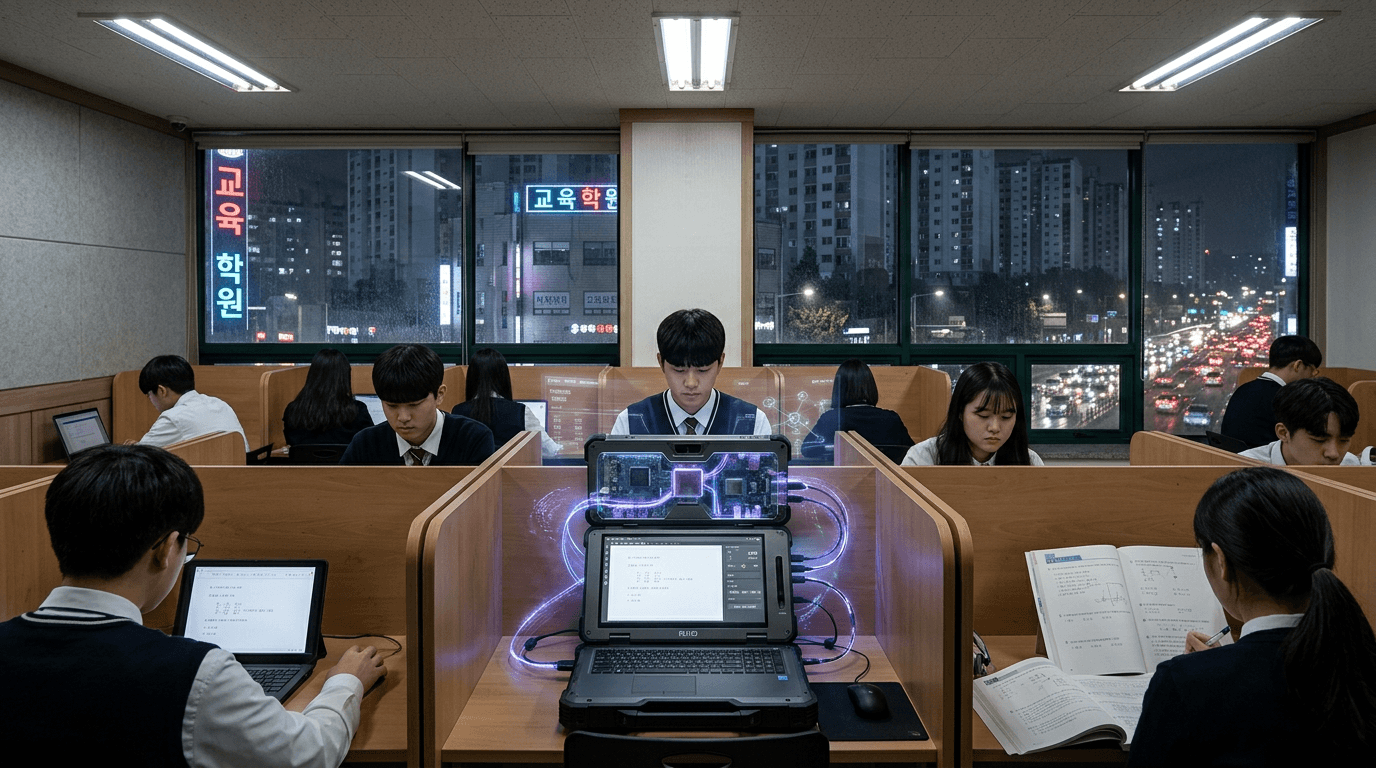
AI-Powered Education Technology
Geography: Asia Pacific · East Asia · South Korea
South Korea spends more per capita on private education than almost any other country — the hagwon (cram school) industry generates over $20B annually, driven by the ultra-competitive university entrance exam (Suneung). This intense demand for educational optimization created a natural market for AI-powered learning. Riiid, which raised $175M+ in funding, uses deep learning to predict which questions a student will get wrong and personalizes study plans accordingly. Mathpresso's Qanda app uses AI to solve math problems from photos, serving 10M+ users across Asia. Elice provides AI-driven coding education and corporate training.
Korea's education technology is uniquely advanced because the input data is extraordinarily rich. Korean students take more standardized tests, more frequently, across more subjects than students in any other OECD country. This creates massive, high-quality datasets for training adaptive learning algorithms. Riiid's AI has been trained on hundreds of millions of student-question interactions, enabling prediction of student performance with accuracy that no Western edtech company can match due to sparser data.
The Korean government announced in 2023 that AI digital textbooks would be introduced in all schools by 2025, making Korea one of the first countries to mandate AI-assisted learning at the national level. This top-down adoption, combined with bottom-up demand from test-obsessed families, creates a dual engine for edtech innovation. Korean edtech companies are expanding to India, Southeast Asia, and the Middle East, exporting adaptive learning systems calibrated on the world's most competitive educational environment.
Research this in Signals
Signals turns a topic into a sourced research record you can inspect and rerun. Your first scan is free, and this one starts with AI-Powered Education Technology already loaded, so edit it or scan as is.