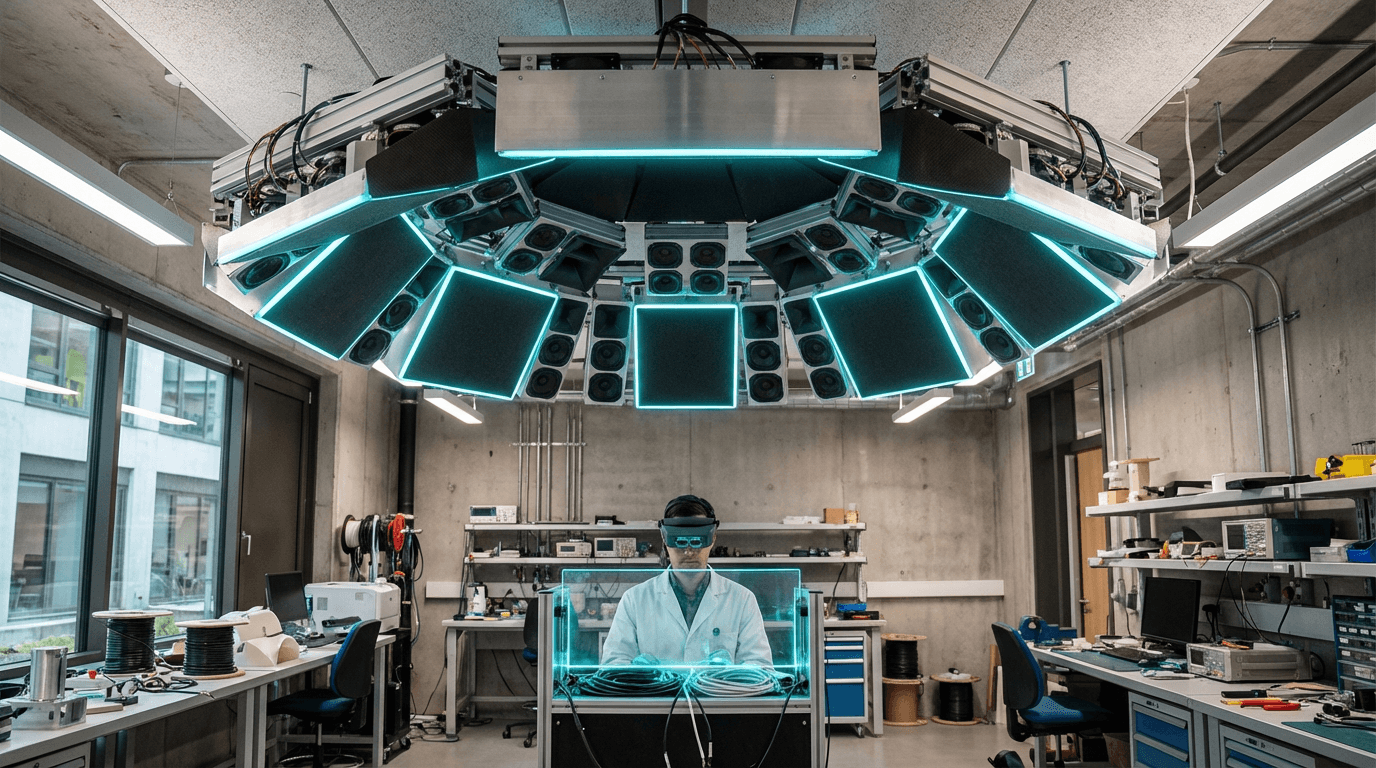
Personalized Spatial Audio Arrays
Personalized spatial audio arrays represent a sophisticated evolution in sound reproduction technology, utilizing beamforming techniques and advanced signal processing to create distinct three-dimensional audio zones within a shared physical space. Unlike traditional speaker systems that broadcast sound uniformly across a room, these arrays employ multiple precisely-positioned transducers working in concert to direct sound waves toward specific listeners. The core mechanism relies on controlling the phase and amplitude of audio signals across the array, creating constructive and destructive interference patterns that concentrate sound energy in targeted areas while minimizing spillover to adjacent zones. When combined with head-tracking systems—using cameras, depth sensors, or wearable devices—these arrays can dynamically adjust their acoustic beams as listeners move, maintaining the integrity of each person's individualized soundscape. This approach builds upon principles from acoustic holography and wave field synthesis, enabling the projection of convincing directional cues and spatial positioning without requiring headphones.
The entertainment and streaming industries face a fundamental challenge in delivering immersive audio experiences to multiple viewers simultaneously without compromising individual preferences or forcing everyone to wear headphones. Traditional home theater systems optimize sound for a single "sweet spot," leaving other seating positions with degraded spatial imaging. Personalized spatial audio arrays address this limitation by enabling each person in a room to experience their own customized audio mix—different language tracks, personalized volume levels, or even entirely different content streams—while sharing the same visual display. For interactive content such as choose-your-own-adventure narratives or multiplayer gaming experiences, this technology allows each participant to receive distinct audio cues, dialogue, or musical scores that reflect their unique choices and perspectives. This capability transforms living rooms into multi-user entertainment venues where individual agency doesn't require isolation, opening new possibilities for social viewing experiences and collaborative content consumption.
Early implementations of this technology have appeared in research laboratories and high-end commercial installations, with demonstrations showing promise for home entertainment applications as manufacturing costs decline. Concert venues and immersive theater productions represent near-term deployment scenarios, where creating distinct audio experiences for different seating sections enhances the sense of presence and narrative engagement. The technology aligns with broader industry trends toward personalization and adaptive content delivery, potentially enabling new subscription models where household members maintain individual audio profiles that automatically activate when they enter the viewing space. As streaming platforms increasingly invest in spatial audio content and interactive storytelling formats, personalized audio arrays could become a differentiating feature for premium home entertainment systems, bridging the gap between the isolation of headphone-based immersion and the social nature of shared viewing experiences.
Related Organizations

Manufacturer of 3D audio beamforming systems, famously deployed at The Sphere in Las Vegas to target sound to specific seats.

Develops 3D audio beamforming technology that tracks the listener's head to deliver binaural sound without headphones.

Develops light-field production tools and Realception software for processing volumetric video.

Creators of 'invisible headphones' technology that beams ultrasound pockets of sound directly to a user's ears.

German audio company offering 'Soundscape', a system for object-based audio reproduction and acoustic emulation.

Creator of L-ISA, an immersive hyperreal sound technology that uses object-based mixing and spatial audio processing.

Professional audio manufacturer known for the Constellation acoustic system which electronically alters room acoustics.

Audio giant developing the AMBEO program, which includes spatial audio soundbars and mobility solutions.
Supporting Evidence
Research this in Signals
Signals turns a topic into a sourced research record you can inspect and rerun. Your first scan is free, and this one starts with Personalized Spatial Audio Arrays already loaded, so edit it or scan as is.