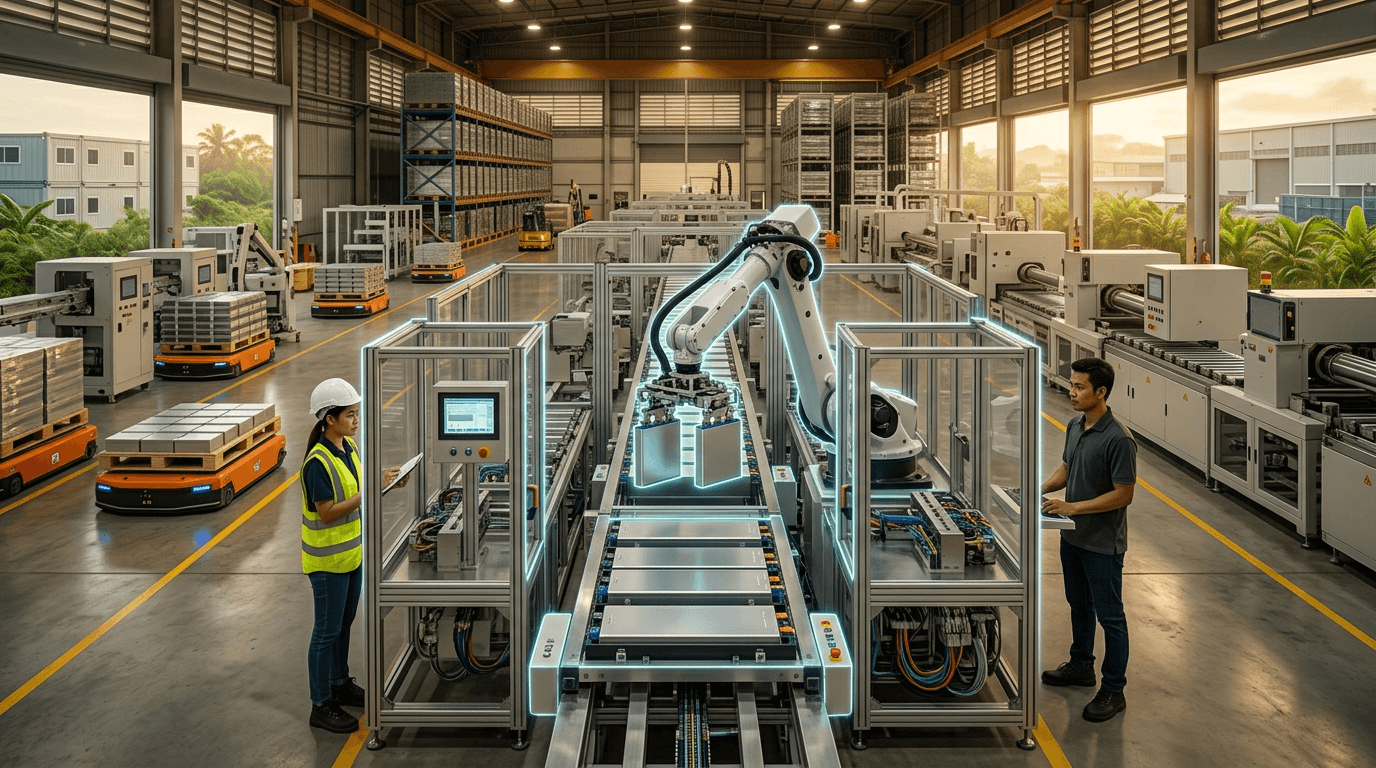
EV Battery Cell Production
Geography: Asia Pacific · Southeast Asia · Southeast Asia
Thailand — As Thailand positions itself as ASEAN's EV manufacturing hub, battery cell production is the critical missing link. Chinese manufacturers including BYD (which produces batteries for its own EVs at the Rayong plant) and potentially CATL are investing in local cell production. The Board of Investment offers enhanced incentives for battery manufacturing, recognizing it as the highest-value component of EVs.
Current Thai EV production largely imports battery cells from China, capturing only the assembly margin. The government's '30@30' target (30% EV production by 2030) requires localized battery supply chains to be economically sustainable and to qualify for preferential trade treatment under various FTAs.
The competition for ASEAN battery production is fierce: Indonesia has nickel (raw material advantage), Vietnam has lower labor costs, and Malaysia has the semiconductor packaging ecosystem. Thailand's pitch is its existing automotive manufacturing ecosystem — 30+ years of automotive supply chain maturity that can be retooled for EV components. If Thailand captures battery cell production, its EV ecosystem becomes self-sustaining; if it doesn't, it risks becoming a Chinese brand assembly platform.
Research this in Signals
Signals turns a topic into a sourced research record you can inspect and rerun. Your first scan is free, and this one starts with EV Battery Cell Production already loaded, so edit it or scan as is.