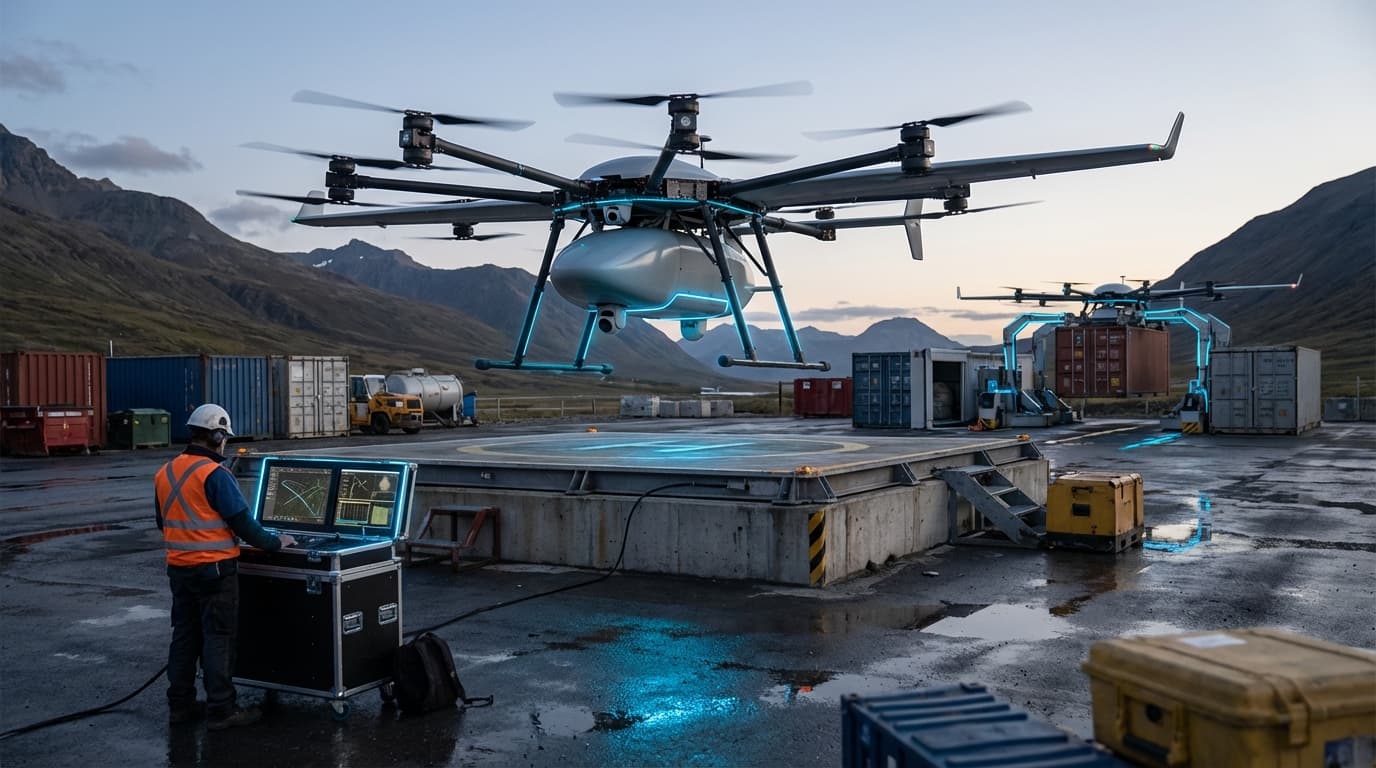
Heavy-Lift Cargo Drones
Heavy-lift cargo drones represent a significant evolution in autonomous aerial vehicle technology, designed to transport substantial payloads—typically ranging from 100 kilograms to several hundred kilograms—over medium distances without human pilots onboard. Unlike smaller delivery drones limited to lightweight parcels, these systems employ robust airframes, advanced propulsion systems, and sophisticated flight control algorithms to manage the aerodynamic and operational challenges of carrying heavy cargo. The technology integrates GPS navigation, obstacle detection sensors, and automated landing systems to enable autonomous operation across varied terrain and weather conditions. Most heavy-lift platforms utilize either multirotor configurations for vertical takeoff and landing capabilities or hybrid designs that combine fixed-wing efficiency for longer range with rotorcraft versatility for accessing confined spaces.
The logistics and transportation industries face persistent challenges in what's known as the "middle mile"—the movement of goods between distribution hubs and local delivery points—particularly in areas where ground infrastructure is congested, underdeveloped, or nonexistent. Heavy-lift cargo drones address these bottlenecks by creating direct aerial routes that bypass traffic congestion, poor road conditions, and geographic barriers such as mountains, waterways, or dense forests. This capability proves especially valuable for time-sensitive deliveries including medical supplies, emergency equipment, and perishable goods where delays can have serious consequences. The technology also enables new logistics models for industries operating in remote locations, such as mining, offshore energy, and disaster response, where traditional ground or manned aircraft transport proves prohibitively expensive or operationally challenging.
Early commercial deployments indicate growing adoption across multiple sectors, with pilot programs transporting medical supplies to rural healthcare facilities, delivering parts to offshore platforms, and supporting humanitarian operations in disaster-affected regions. Research suggests that these systems can reduce delivery times by 60-80% compared to ground transport in challenging terrain while potentially lowering operational costs for specific use cases. The technology aligns with broader industry trends toward autonomous logistics networks and sustainable transportation, as electric-powered variants promise reduced carbon emissions compared to traditional delivery vehicles. However, widespread adoption faces regulatory hurdles around airspace integration, noise concerns in populated areas, and the need for reliable beyond-visual-line-of-sight operations. As aviation authorities develop frameworks for unmanned cargo operations and battery technology continues improving payload capacity and range, heavy-lift drones are positioned to become integral components of multimodal logistics networks, particularly for connecting underserved regions to global supply chains.
Related Organizations

European developer of the 'Black Swan' cargo drone, designed to carry 350 kg over 2,500 km.

Developing the Chaparral, an autonomous VTOL cargo aircraft capable of carrying 300-500 lbs over 300 miles.

Developing the ALIA-250 aircraft and an extensive charging network for electric aviation.

Developing the LCA60T, a rigid airship solution for transporting up to 60 tons of heavy cargo.

Developing the Cento, an autonomous hybrid-electric VTOL cargo drone with a 100 lb+ payload capacity.

Designing a fleet of autonomous blended wing body (BWB) cargo aircraft.

Builds autonomous electric airplanes for crop protection and cargo transport.

Developing the K-RACER, a heavy-lift unmanned helicopter for logistics.

A Textron company developing the Nuuva V300, a long-range large-capacity heavy-lift cargo drone.

German aircraft manufacturer specializing in multicopter designs like the VoloCity for inner-city flights.
Supporting Evidence
Research this in Signals
Signals turns a topic into a sourced research record you can inspect and rerun. Your first scan is free, and this one starts with Heavy-Lift Cargo Drones already loaded, so edit it or scan as is.