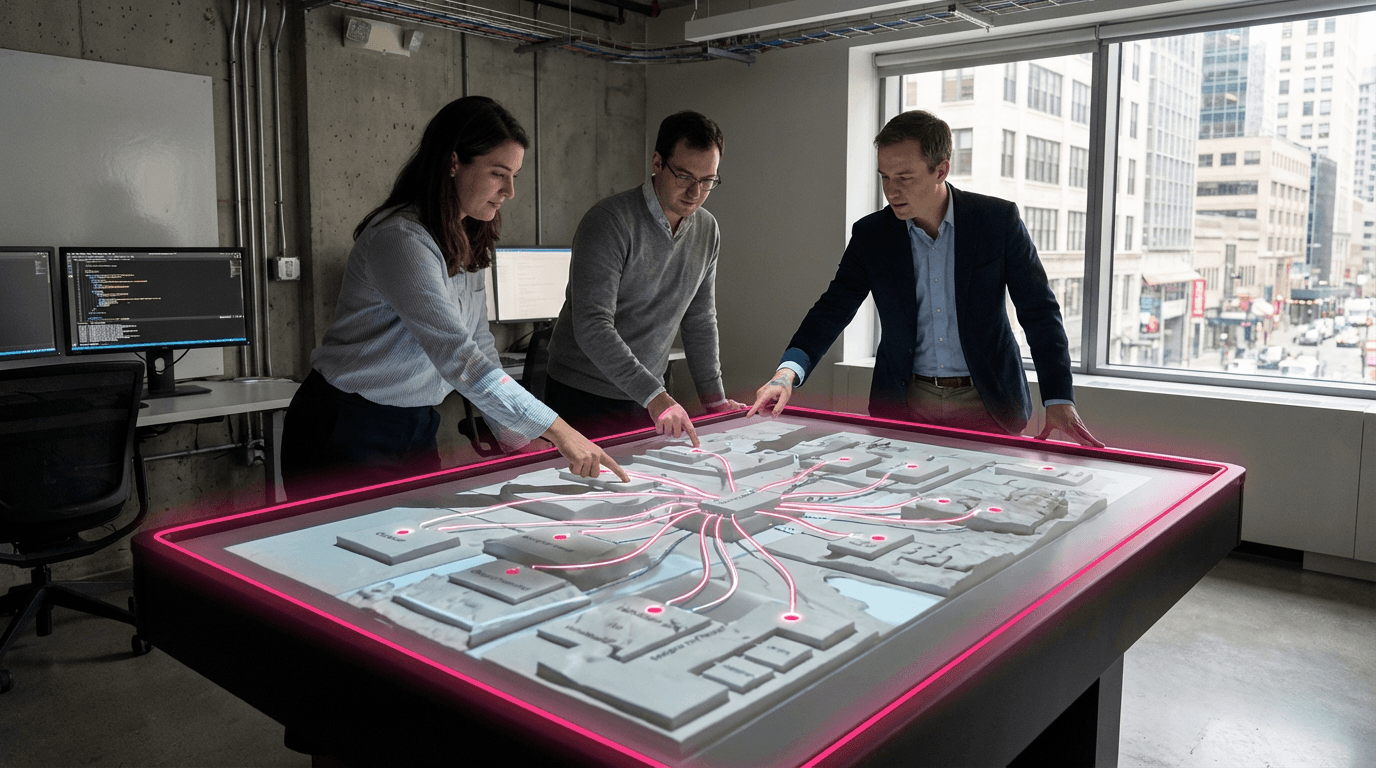
Digital Twin of Organization (DTO)
Digital Twin of Organization (DTO) represents a sophisticated virtual modeling approach that creates dynamic, data-driven replicas of an enterprise's entire operational ecosystem. Unlike traditional organizational charts or static process maps, DTOs integrate real-time data streams from multiple sources—including workflow management systems, communication platforms, resource allocation tools, and employee performance metrics—to construct a living simulation of how an organization actually functions. The technology employs advanced algorithms to model complex interdependencies between teams, processes, and resources, capturing not just formal reporting structures but also informal communication patterns, decision-making bottlenecks, and resource constraints that emerge in daily operations. By continuously ingesting operational data, these digital replicas can reflect current organizational states with remarkable fidelity, enabling leaders to observe how information flows, where delays accumulate, and how changes in one department ripple through the entire system.
The fundamental challenge that DTOs address is the inherent risk and uncertainty associated with organizational transformation. Traditional approaches to restructuring, process reengineering, or scaling operations often rely on intuition, past experience, or simplified models that fail to account for the intricate web of dependencies within modern enterprises. When leaders implement major changes—whether merging departments, adopting new workflows, or redistributing responsibilities—they typically discover unforeseen consequences only after implementation, when reversal becomes costly or impossible. DTOs transform this high-stakes guesswork into evidence-based planning by allowing decision-makers to simulate proposed changes and observe their cascading effects across the organization. This capability proves particularly valuable for testing scenarios such as workforce reductions, new team structures, technology implementations, or shifts in operational priorities, revealing potential productivity losses, communication breakdowns, or capacity constraints before they materialize in the real organization.
Early adopters of DTO technology include large enterprises in sectors where operational complexity and coordination costs are particularly high, such as manufacturing, healthcare systems, and professional services firms. Research suggests that organizations using digital twin simulations for restructuring decisions report higher confidence in change initiatives and reduced implementation timelines, as potential issues are identified and resolved in the virtual environment. The technology connects to broader trends in organizational analytics and evidence-based management, where leaders increasingly demand quantitative validation for strategic decisions. As remote and hybrid work models add new layers of complexity to organizational dynamics, DTOs offer a framework for understanding how distributed teams collaborate and where virtual communication patterns may differ from traditional office-based interactions. Looking forward, the integration of artificial intelligence and machine learning into DTO platforms promises even more sophisticated predictive capabilities, potentially enabling organizations to not only test proposed changes but also to discover optimal configurations that human planners might never consider.
Related Organizations
The market leader in process mining, providing an 'MRI' of organizational processes to drive execution management.
Provides simulation digital twin software for enterprise decision making.

Enterprise software company, developer of the Cumulocity IoT platform.
Provides software for business process management and digital twin creation, integrated heavily with Microsoft ecosystems.

Cloud-based business transformation suite offering simulation and digital twin capabilities.

Finnish software firm specializing in process mining and enterprise architecture modeling.

Provides simulation and scheduling software used to create digital twins of hospital emergency departments and surgical suites.

Predictive simulation software company acquired by Royal HaskoningDHV.
Gartner
United States · Company
Global research and advisory firm.
Supporting Evidence
Research this in Signals
Signals turns a topic into a sourced research record you can inspect and rerun. Your first scan is free, and this one starts with Digital Twin of Organization (DTO) already loaded, so edit it or scan as is.