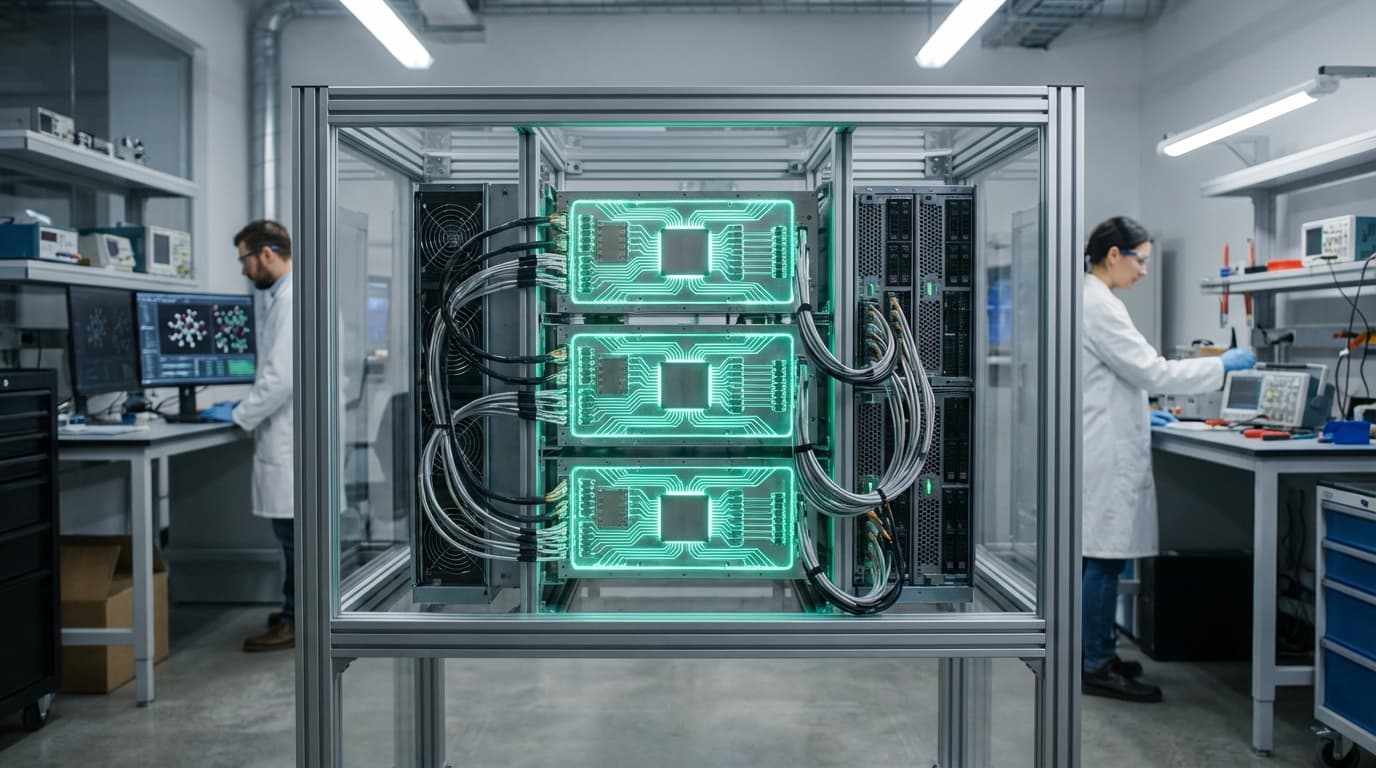
Quantum Chemistry Simulation Platforms
Quantum chemistry simulation platforms are cloud-based services that run quantum algorithms including VQE (variational quantum eigensolver, an algorithm for finding molecular ground states) and phase estimation (an algorithm for precise energy calculations) for molecular discovery, combining quantum circuits (quantum algorithms) with classical post-processing (classical computation to refine results) to compute reaction pathways (how molecules react), binding energies (how strongly molecules bind together), and material properties (characteristics of materials). Pharmaceutical and materials science teams use these services to prioritize candidate molecules before committing to wet-lab experiments (expensive laboratory tests), accelerating drug discovery (finding new medicines) and catalysis design (designing catalysts for chemical reactions), potentially saving significant time and money by using quantum simulation to screen candidates before experimental testing.
This innovation addresses the computational challenge of simulating molecules, where classical computers struggle with large molecules. By using quantum computers, these platforms can simulate molecules more accurately. Companies like IBM, Google, and specialized quantum chemistry platforms are developing these services.
The technology is particularly significant for accelerating drug discovery and materials science, where accurate molecular simulation could save significant time and money. As quantum computers improve, these platforms will become more powerful. However, ensuring accuracy, managing noise, and achieving useful results remain challenges. The technology represents an important application of quantum computing, but requires continued development to achieve practical advantages. Success could accelerate drug discovery, but the technology must prove its advantages over classical methods. Quantum chemistry simulation is one of the most promising near-term applications of quantum computing.
Research this in Signals
Signals turns a topic into a sourced research record you can inspect and rerun. Your first scan is free, and this one starts with Quantum Chemistry Simulation Platforms already loaded, so edit it or scan as is.