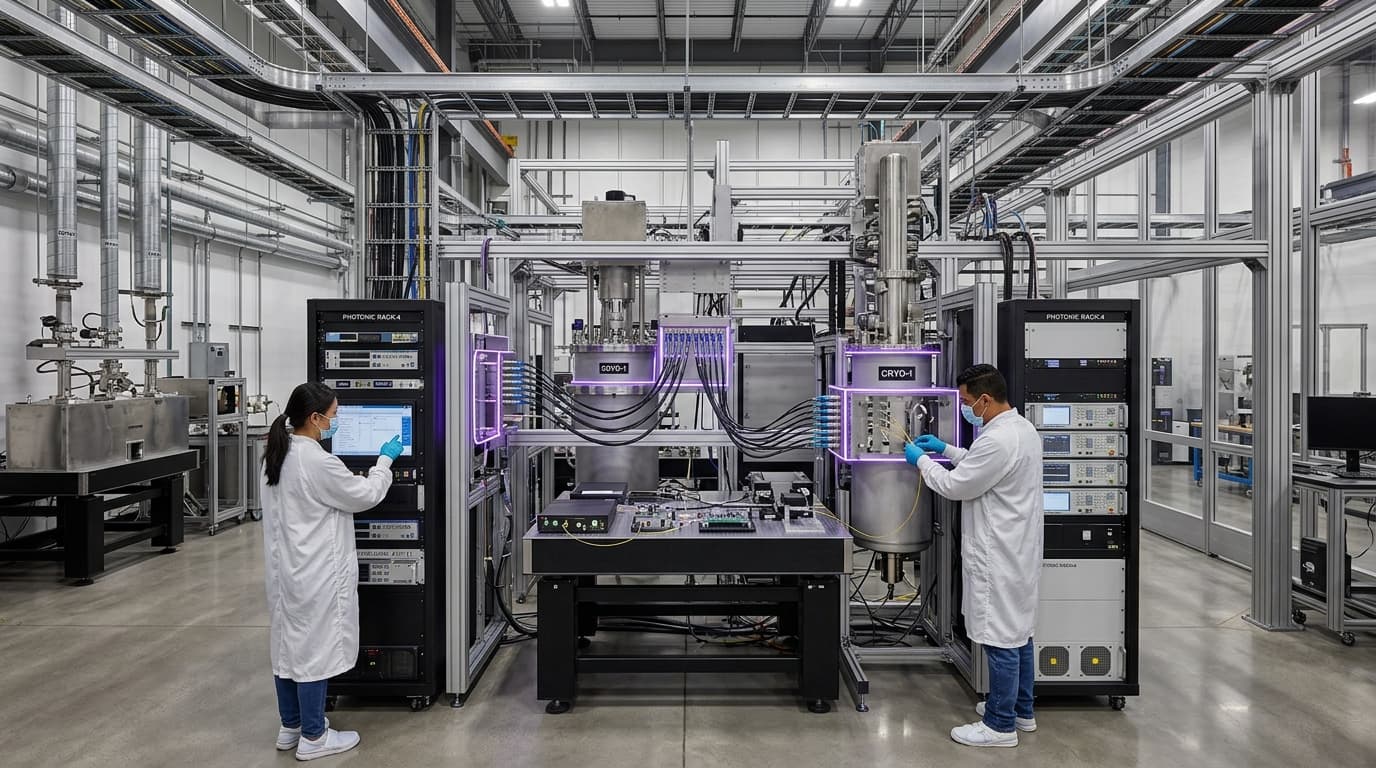
Photonic Quantum Computing
Geography: Americas · North America · United States
PsiQuantum is pursuing a fundamentally different approach to quantum computing: using photons (particles of light) on silicon chips rather than superconducting circuits or trapped ions. Their key insight is that photonic qubits can be manufactured using existing semiconductor fabrication processes, potentially enabling rapid scaling to the millions of qubits needed for fault-tolerant quantum computation. The company solved a critical manufacturing challenge in 2025.
Photonic quantum computing has several theoretical advantages: qubits operate at room temperature (unlike superconducting systems that require millikelvin cooling), photons don't interact with their environment as easily (reducing decoherence), and the technology is inherently compatible with quantum networking over fiber optic cables. The downside is higher photon loss rates that require more physical qubits per logical qubit.
With a $7 billion valuation and $1 billion in funding, PsiQuantum represents the largest private bet on a single quantum computing architecture. If their approach works, it could leapfrog competitors who are scaling superconducting or trapped-ion systems incrementally. The US government has invested in PsiQuantum through DARPA's quantum programs, viewing photonic quantum computing as a potential shortcut to cryptographically relevant machines.
Research this in Signals
Signals turns a topic into a sourced research record you can inspect and rerun. Your first scan is free, and this one starts with Photonic Quantum Computing already loaded, so edit it or scan as is.