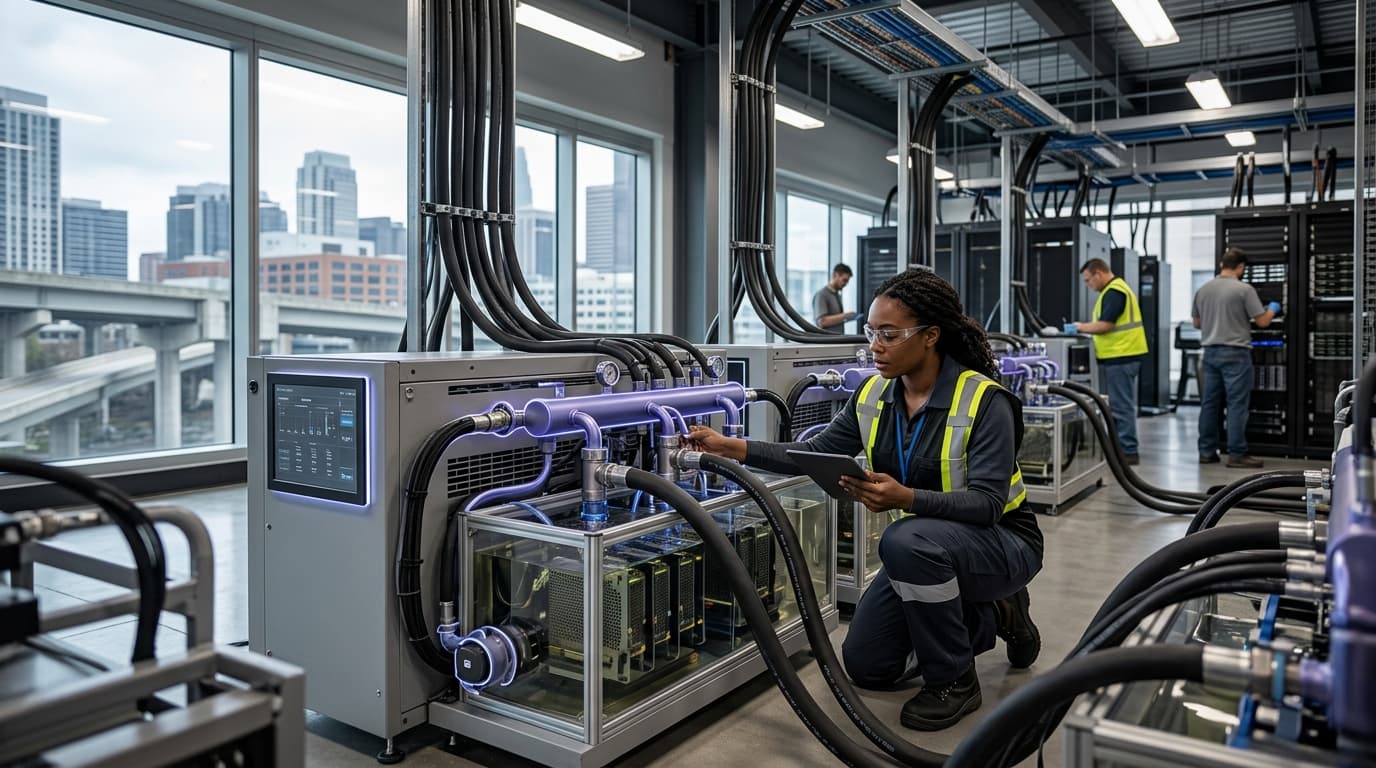
Advanced Liquid Cooling for Data Centers
Geography: Americas · North America · United States
Advanced liquid cooling systems use water or specialized fluids to remove heat directly from AI chips, replacing or supplementing traditional air conditioning. Direct-to-chip cooling pipes cold plates directly onto GPU/CPU surfaces. Full immersion cooling submerges entire server boards in non-conductive fluid. Rear-door heat exchangers add liquid cooling to existing air-cooled racks.
Modern AI accelerators (NVIDIA H100/B200, AMD MI300) generate 700W-1000W+ per chip. At data center densities of 40-100+ kW per rack, air cooling becomes physically insufficient — the air simply cannot absorb enough heat. Liquid cooling is 1,000x more efficient at heat transfer than air, making it the only viable option for next-generation AI infrastructure.
The shift to liquid cooling restructures data center economics and design. It enables higher compute density (more chips per rack), reduces cooling energy consumption by 30-40%, and allows heat reuse for district heating. The US data center industry is leading adoption due to the concentration of AI infrastructure investment, creating a new ecosystem of cooling technology companies.
Research this in Signals
Signals turns a topic into a sourced research record you can inspect and rerun. Your first scan is free, and this one starts with Advanced Liquid Cooling for Data Centers already loaded, so edit it or scan as is.