Hyperscaler AI capital expenditure
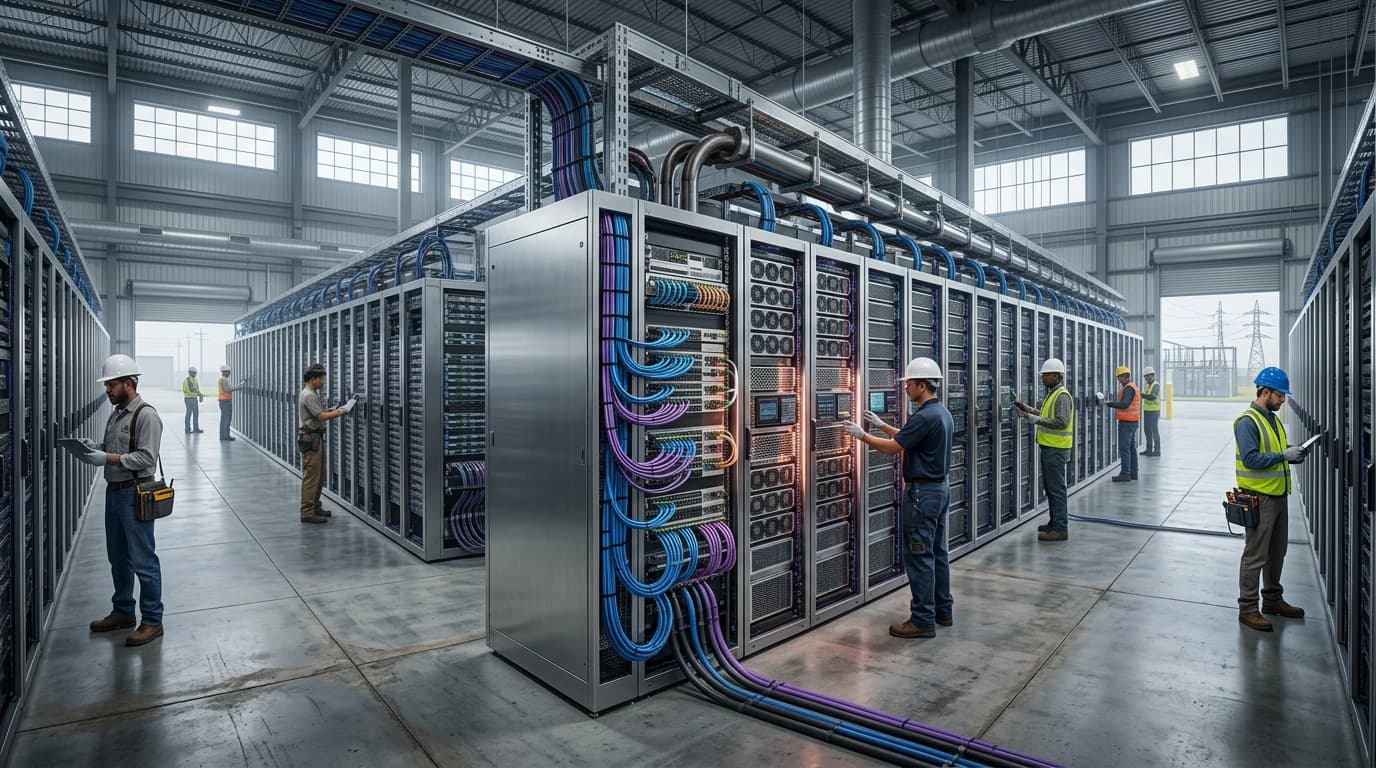
Hyperscale AI Data Center Infrastructure
US hyperscalers are investing over $300 billion in AI data centers in 2025-2026, with Microsoft, Google, Amazon, and Meta each planning multi-gigawatt campuses that consume as much power as small cities.
Geography: Americas · North America · United States
The AI infrastructure buildout is the largest capital expenditure program in technology history. Microsoft, Google, Amazon, and Meta are each investing $50-80 billion annually in data center construction, primarily for AI training and inference. Individual campuses are reaching gigawatt-scale power consumption — equivalent to small cities. Novel cooling technologies (liquid cooling, immersion cooling) are required to handle the heat density of AI accelerators.
This infrastructure investment creates a physical moat for US AI leadership. Training frontier models requires clusters of tens of thousands of GPUs operating in concert, interconnected by ultra-low-latency networks. The engineering complexity of building and operating these facilities at scale is itself a competitive barrier. The pivot to inference infrastructure in 2026 is driving demand for distributed, modular 'micro-data centers' closer to end users.
The energy demands of AI data centers are reshaping US energy policy. Hyperscalers are signing power purchase agreements with nuclear, geothermal, and CCS-equipped gas plants. Some data center projects face grid connection delays of 5-7 years due to insufficient transmission infrastructure. This energy constraint may become the binding limit on AI scaling before computing constraints.
TRL
8/9Deployed
Impact
5/5
Investment
5/5
Category
Software
What was expected
Published forecasts about this technology, graded against what happened in Hindsight.
AI data center electricity use
This page is broader than it.
AI data center capacity demand
This page is a narrower case of it.
AI share of data center demand
This page is a narrower case of it.
Data Center Cities
This page is a narrower case of it.
Hyperscale AI data centers
This page is a narrower case of it.
National AI compute infrastructure (AI hypercenters)
This page is a narrower case of it.
Research this in Signals
Scan Hyperscale AI Data Center Infrastructure for yourself.
Signals turns a topic into a sourced research record you can inspect and rerun. Your first scan is free, and this one starts with Hyperscale AI Data Center Infrastructure already loaded, so edit it or scan as is.