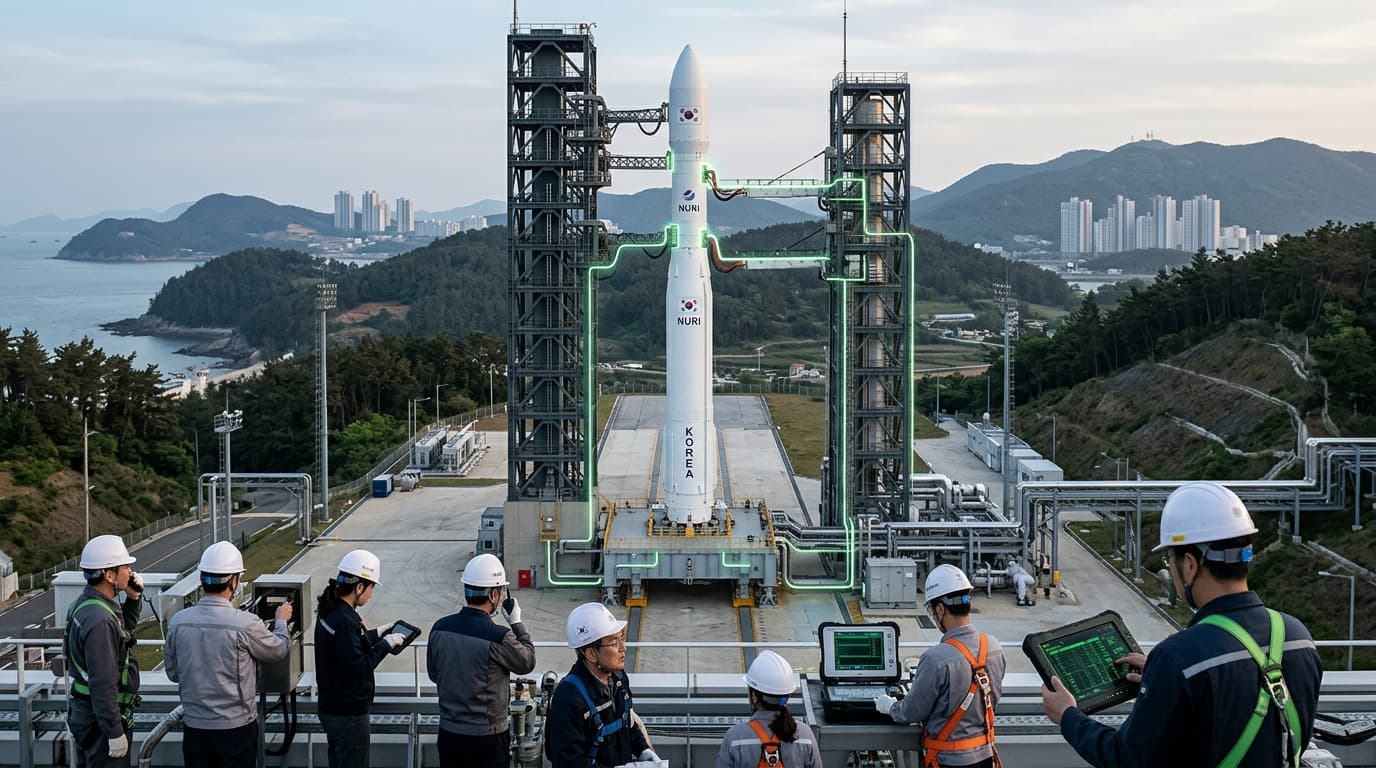
Nuri Space Launch Vehicle
Geography: Asia Pacific · East Asia · South Korea
The Nuri (KSLV-II) rocket, developed by KARI (Korea Aerospace Research Institute) and Hanwha Aerospace, is a three-stage liquid-fuel launch vehicle capable of placing 1.5 tons into 600-800km sun-synchronous orbit. After a partial failure in 2021 and a successful first orbital launch in June 2022, Nuri has completed multiple successful missions deploying Korean Earth observation satellites.
Nuri's significance is strategic autonomy — before its development, Korea relied entirely on foreign launch services (SpaceX, Arianespace, Russia's Roscosmos) to access space. The 75-ton thrust liquid oxygen/kerosene engines were developed entirely domestically, giving Korea indigenous propulsion technology. Hanwha Aerospace is now commercializing Nuri technology for the small satellite launch market.
Korea's space ambitions extend beyond Nuri: the Korea Pathfinder Lunar Orbiter (Danuri) is operating around the Moon since 2022, and plans include a lunar lander mission and participation in the Artemis program. The space program, while smaller than those of the US, China, or ESA, demonstrates Korea's ability to develop complex systems in yet another high-technology domain.
Research this in Signals
Signals turns a topic into a sourced research record you can inspect and rerun. Your first scan is free, and this one starts with Nuri Space Launch Vehicle already loaded, so edit it or scan as is.