Micro-LED Display Technology
Geography: Asia Pacific · East Asia · South Korea
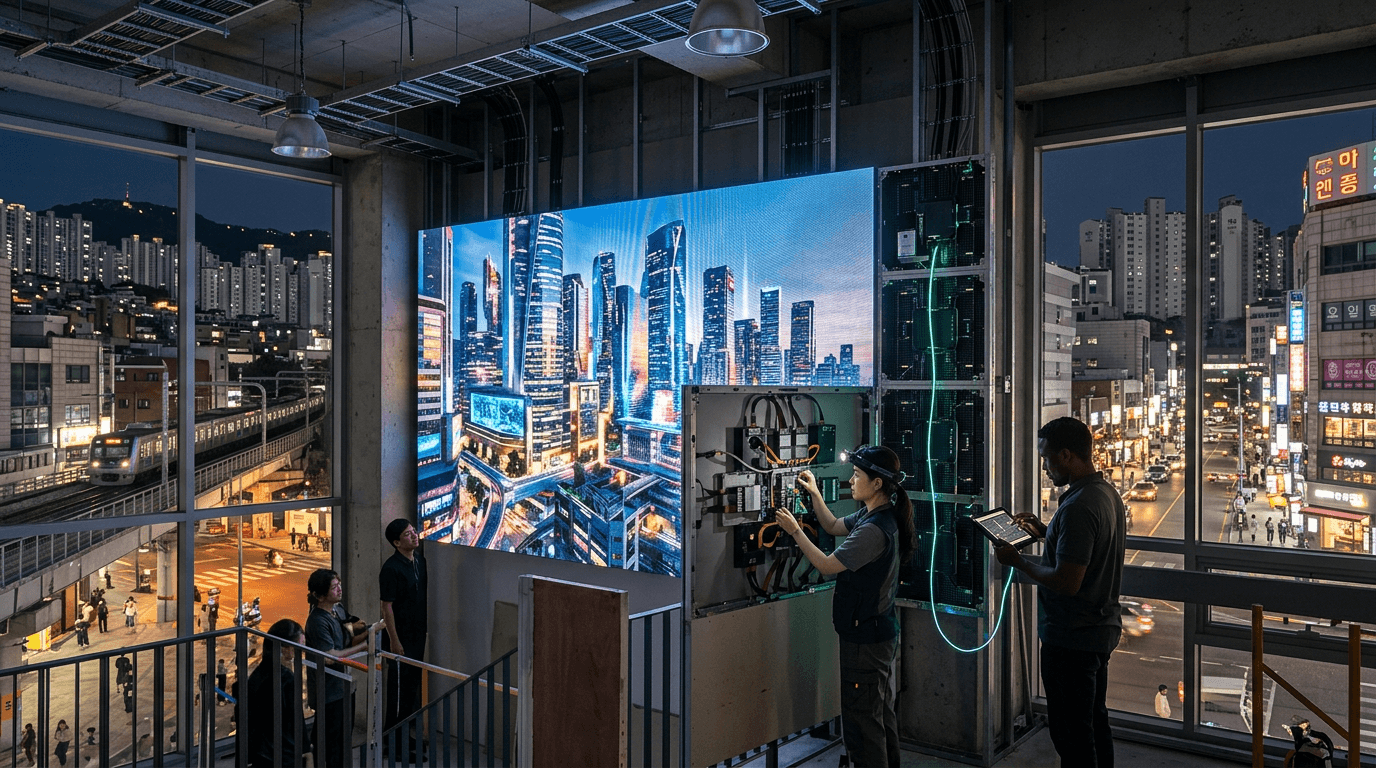
Samsung's 'The Wall' is a modular Micro-LED display available in sizes from 76" to 292", using millions of individual inorganic LED chips less than 50μm each to produce self-emissive images with no burn-in risk, theoretically infinite lifespan, and 2,000+ nit brightness. Current pricing remains in the six-figure range, limiting deployment to commercial, luxury, and professional applications.
The core challenge in Micro-LED is mass transfer — picking up and placing millions of microscopic LED chips onto a backplane quickly and accurately enough for cost-effective production. Samsung has invested in multiple mass-transfer approaches including laser-based, elastomer stamp, and fluidic self-assembly. LG and Seoul Semiconductor are also pursuing Micro-LED for automotive and AR/VR applications.
Micro-LED is considered the eventual successor to OLED for premium displays, offering all of OLED's advantages (self-emissive, perfect blacks, wide viewing angles) without its weaknesses (organic material degradation, burn-in). Whoever solves mass transfer at scale first will own the next generation of display technology — and Korean companies are among the best-positioned to do so.
Research this in Signals
Signals turns a topic into a sourced research record you can inspect and rerun. Your first scan is free, and this one starts with Micro-LED Display Technology already loaded, so edit it or scan as is.