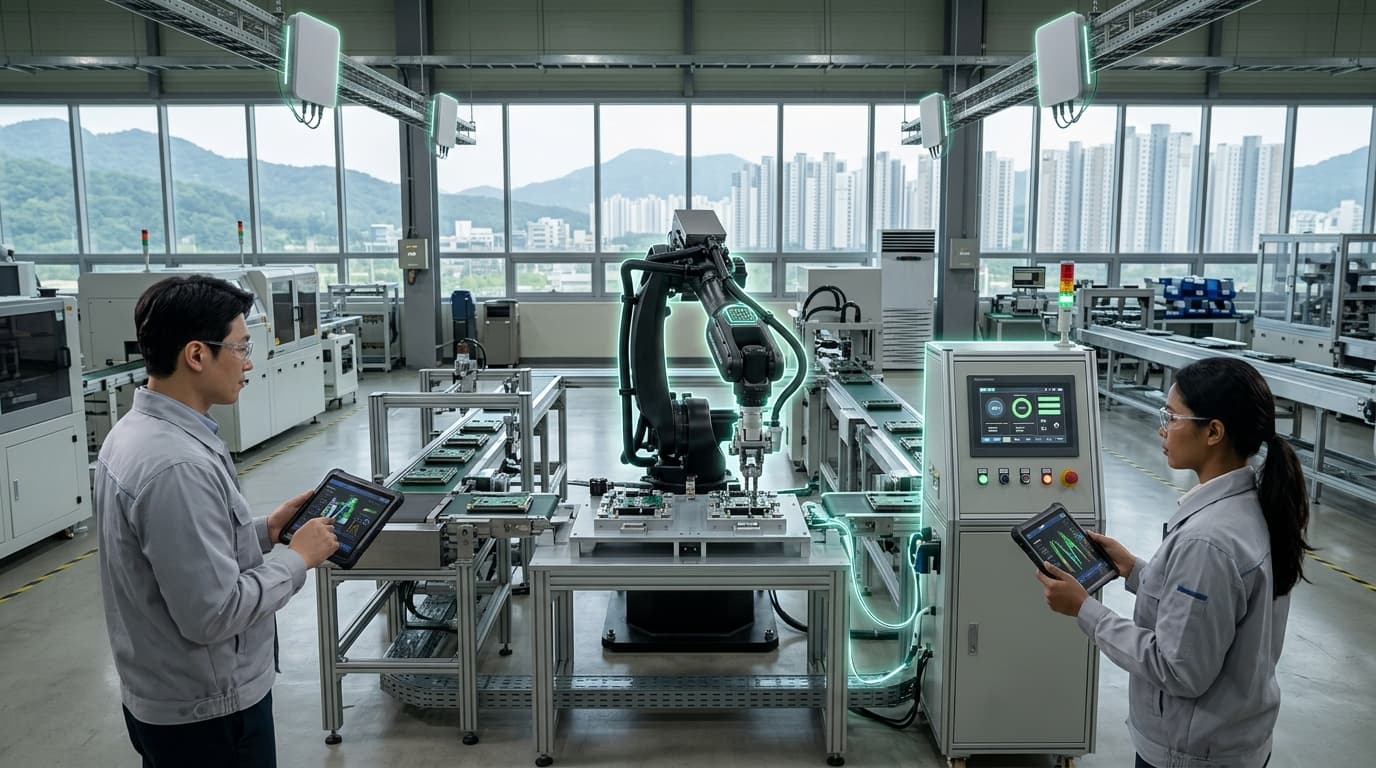
5G-Connected Smart Factory Network
Geography: Asia Pacific · East Asia · South Korea
The Korean government's Manufacturing Innovation 3.0 strategy set a target of 30,000 smart factories by 2025 — factories equipped with IoT sensors, AI-driven quality control, robotic automation, and real-time data analytics. Within this broader initiative, 1,000 cutting-edge facilities use private 5G networks for ultra-low-latency machine communication, and 100 'K-Smart Lighthouse Factories' serve as showcase sites demonstrating world-class Industry 4.0 integration. Samsung, Hyundai, LG, and SK factories anchor the program, with SME participation subsidized by MOTIE.
Korea's 5G smart factory advantage comes from a unique convergence: the world's most advanced 5G infrastructure (60% subscriber penetration), the highest industrial robot density, and chaebol manufacturers willing to invest billions in digitization. Samsung's Pyeongtaek semiconductor fab, for example, uses 5G-connected autonomous guided vehicles, real-time defect detection via AI vision systems, and digital twins that simulate production flows before implementation. This is not a pilot — it's production-scale deployment.
The program also targets SMEs (small and medium enterprises), which make up 99% of Korean businesses but lag in digitization. Government subsidies cover 50-70% of smart factory conversion costs for SMEs, creating a nationwide manufacturing upgrade that improves the competitiveness of Korea's entire industrial base, not just the chaebols. The model is now being exported to Vietnam, Indonesia, and Uzbekistan through Korea's ODA (Official Development Assistance) programs.
Research this in Signals
Signals turns a topic into a sourced research record you can inspect and rerun. Your first scan is free, and this one starts with 5G-Connected Smart Factory Network already loaded, so edit it or scan as is.