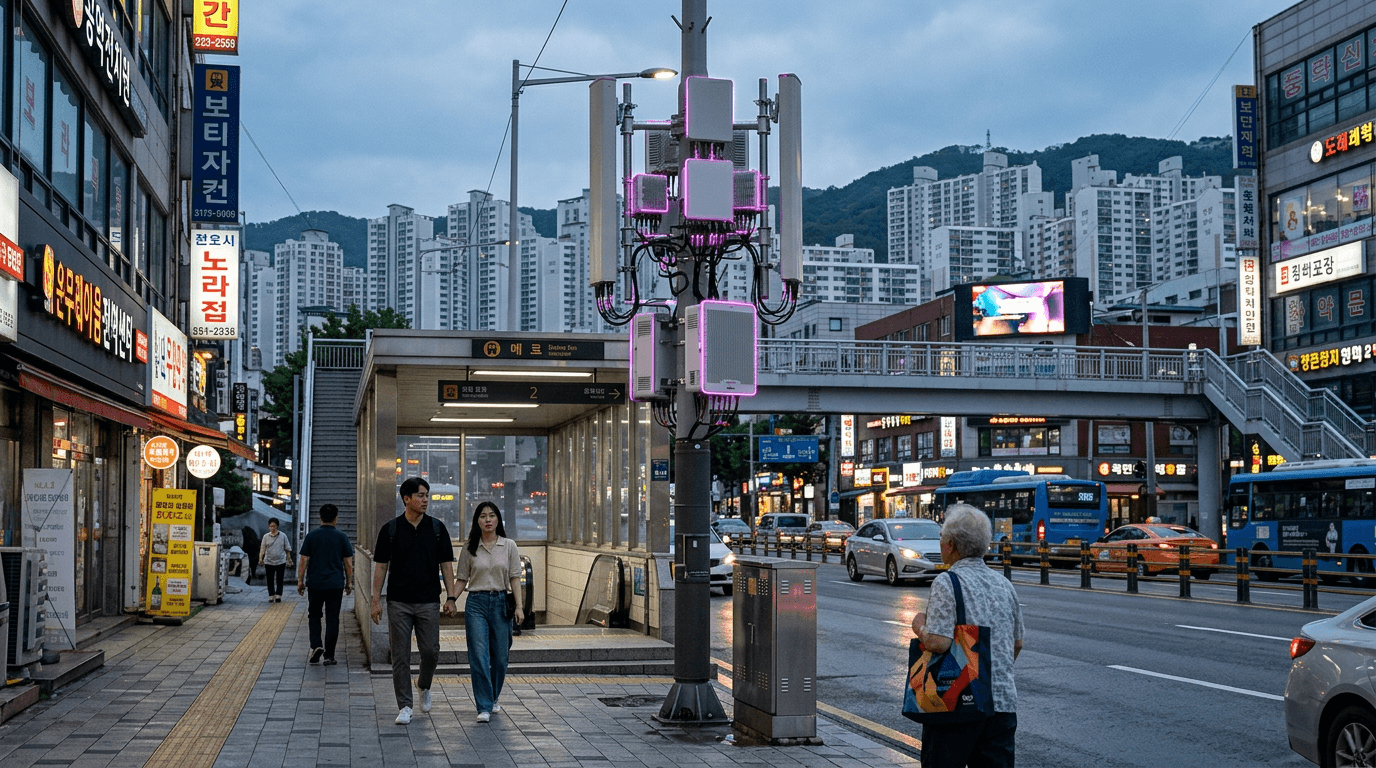
5G/6G Network Infrastructure
Geography: Asia Pacific · East Asia · South Korea
South Korea became the first country to launch commercial 5G services in April 2019, and by 2025 has over 30 million 5G subscribers — roughly 60% of its mobile user base. SK Telecom, KT, and LG Uplus operate dense 5G networks with coverage across all major cities. Samsung Networks is a global 5G equipment supplier, competing with Ericsson, Nokia, and Huawei.
Korea's 5G deployment serves as a national testbed for applications that other countries are still theorizing about: cloud gaming, AR navigation, smart factory connectivity, autonomous vehicle communication, and real-time holographic calls. The high subscriber density provides Korean companies with real-world data and usage patterns that inform next-generation network design.
The 6G research program, coordinated by the Ministry of Science and ICT, targets 2030 commercialization with peak data rates of 1 Tbps (50x faster than 5G), sub-millisecond latency, and support for holographic communication. Samsung Research has demonstrated sub-terahertz wireless links, and KAIST is developing 6G-native AI architectures. Korea aims to set international 6G standards, as it did for 5G, leveraging first-mover deployment to influence global specifications.
Research this in Signals
Signals turns a topic into a sourced research record you can inspect and rerun. Your first scan is free, and this one starts with 5G/6G Network Infrastructure already loaded, so edit it or scan as is.