







Cislunar Activity
This page is a narrower case of it.
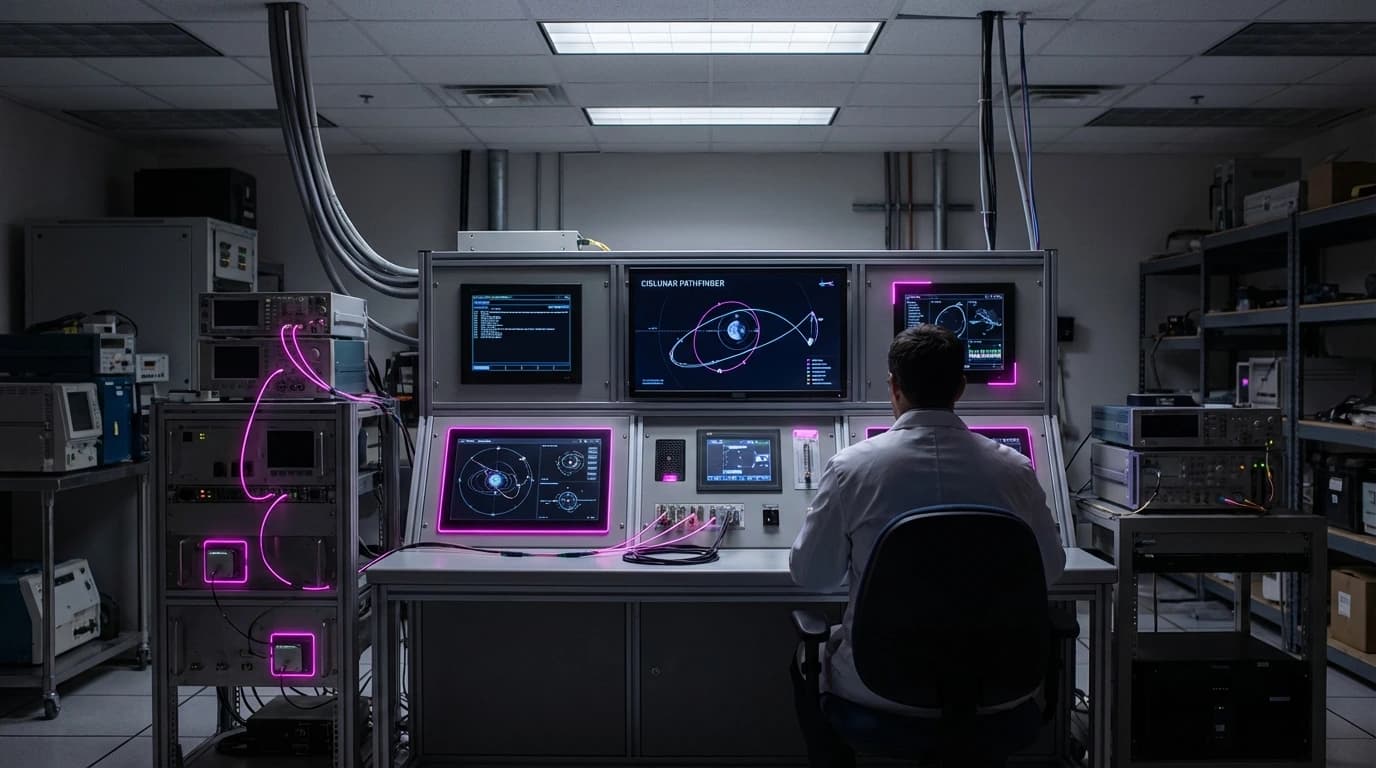
The cislunar region—the vast expanse between Earth and the Moon—has historically been navigated using ground-based tracking stations and onboard inertial systems, methods that become increasingly imprecise and communication-limited as spacecraft venture farther from Earth. Traditional deep-space navigation relies on intermittent contact with terrestrial facilities like NASA's Deep Space Network, creating gaps in coverage and requiring spacecraft to operate autonomously for extended periods. As lunar exploration intensifies and commercial activities expand beyond low Earth orbit, the absence of a dedicated positioning, navigation, and timing (PNT) infrastructure in cislunar space has emerged as a critical bottleneck. The Cislunar Navigation & Communications Backbone addresses this challenge by establishing a distributed network of relay satellites in lunar orbit and surface beacons that work in concert to provide continuous, GPS-like services throughout the Earth-Moon system. This infrastructure employs a constellation of satellites positioned in various lunar orbits—including elliptical frozen orbits and near-rectilinear halo orbits—that maintain line-of-sight with both Earth and the lunar surface while broadcasting precise timing signals. Surface beacons augment this orbital layer, creating a hybrid architecture that enables spacecraft, landers, and rovers to determine their position with unprecedented accuracy without constant reliance on Earth-based tracking.
The development of this backbone solves several interconnected problems that have constrained lunar operations. Without autonomous navigation capabilities, every spacecraft requires dedicated ground support for trajectory corrections and landing sequences, creating scheduling conflicts and limiting the number of simultaneous missions. Communication blackouts during critical phases—such as landing on the lunar far side—have historically posed significant risks and operational constraints. By providing continuous positioning data and communication relay services, this infrastructure enables multiple actors to operate independently and simultaneously in cislunar space. Mining operations can coordinate autonomous excavators across different sites, construction projects can synchronise robotic assembly sequences, and scientific missions can precisely navigate to targets of interest without waiting for Earth-based guidance. The backbone also facilitates collision avoidance as traffic in lunar orbit increases, providing the situational awareness necessary for a sustainable cislunar economy. Furthermore, standardised navigation services reduce mission costs by allowing spacecraft designers to rely on external infrastructure rather than carrying redundant tracking and communication systems.
Early implementations of cislunar navigation infrastructure are already underway, with space agencies and commercial entities developing compatible systems. NASA's Lunar Communications Relay and Navigation System concept and similar international initiatives reflect growing recognition that shared infrastructure will prove more economical than mission-specific solutions. Pilot deployments may begin with limited constellations supporting specific landing sites, gradually expanding coverage as lunar activity intensifies. Potential applications extend beyond traditional exploration: autonomous cargo delivery between Earth and lunar facilities, precision landing for commercial payloads, real-time telemetry for crewed missions, and coordinated swarms of scientific instruments exploring the lunar surface. As this backbone matures, it will likely incorporate advanced capabilities such as inter-satellite ranging, optical communication links, and integration with Earth-based navigation systems, creating a seamless PNT service spanning from low Earth orbit to the lunar surface. This infrastructure represents a fundamental shift from exploration as isolated expeditions to sustained presence, establishing the digital nervous system upon which an entire cislunar economy can develop and flourish.
Leads the EAGLE-1 mission and the SAGA program to build a European quantum communication infrastructure in space.
NASA's lead center for the In-Space Manufacturing (ISM) project, focusing on on-demand fabrication and repair.
A Lockheed Martin subsidiary developing 'Parsec', a cislunar communications and navigation network.
Specializes in astrodynamics and trajectory design, notably for the CAPSTONE mission to the Moon.
Provides lunar access, data transmission services, and surface infrastructure.
Led the RemoveDEBRIS mission, which successfully tested net and harpoon capture technologies in orbit.
A non-profit engineering innovation company that develops acoustic microfluidic separation systems for CAR-T manufacturing.
Developing the Ranger vehicle for cislunar logistics and data services.

Telespazio
Italy · Company
A joint venture between Leonardo and Thales, providing satellite services.
Published forecasts about this technology, graded against what happened in Hindsight.
Cislunar Activity
This page is a narrower case of it.
Signals turns a topic into a sourced research record you can inspect and rerun. Your first scan is free, and this one starts with Cislunar Navigation & Communications Backbone already loaded, so edit it or scan as is.