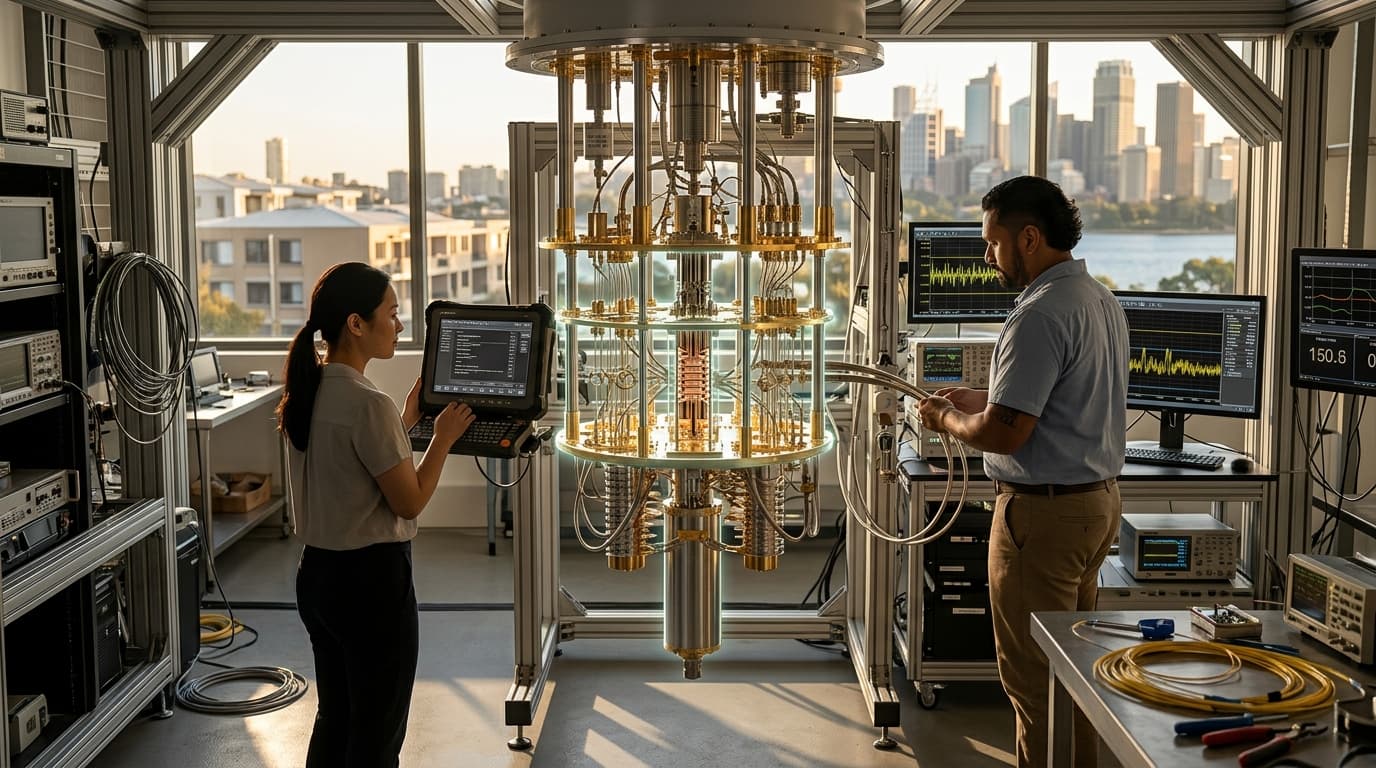
Silicon-Phosphorus Quantum Computing
Geography: Asia Pacific · Oceania · Australia New Zealand
Silicon Quantum Computing (SQC), founded by Nobel-adjacent physicist Michelle Simmons, manufactures quantum processors by placing individual phosphorus atoms into isotopically pure silicon-28 with atomic precision. Their element 14|15 platform demonstrated an 11-qubit processor published in Nature in December 2025, achieving two-qubit gate fidelities above 99%. The approach is unique globally — no other organization manufactures at the atomic scale — and leverages existing semiconductor fabrication knowledge.
This matters because silicon-based quantum computing could ultimately leverage the trillion-dollar classical semiconductor manufacturing ecosystem, unlike superconducting or trapped-ion approaches that require entirely novel fabrication infrastructure. SQC's qubits exhibit nuclear spin coherence times exceeding one second, orders of magnitude longer than competing platforms, which directly translates to lower error correction overhead. The April 2025 announcement of record qubit read-out fidelities at elevated temperatures further reduces the cryogenic engineering burden.
Strategically, SQC positions Australia as one of fewer than five nations with a credible indigenous path to fault-tolerant quantum computing. The company is backed by the Australian government, UNSW, and Telstra, making it a sovereign capability asset. If silicon-phosphorus qubits scale as theorized, Australia would hold foundational IP for the dominant quantum computing architecture, with implications for cryptography, materials science, and defense applications across the Five Eyes alliance.
Research this in Signals
Signals turns a topic into a sourced research record you can inspect and rerun. Your first scan is free, and this one starts with Silicon-Phosphorus Quantum Computing already loaded, so edit it or scan as is.