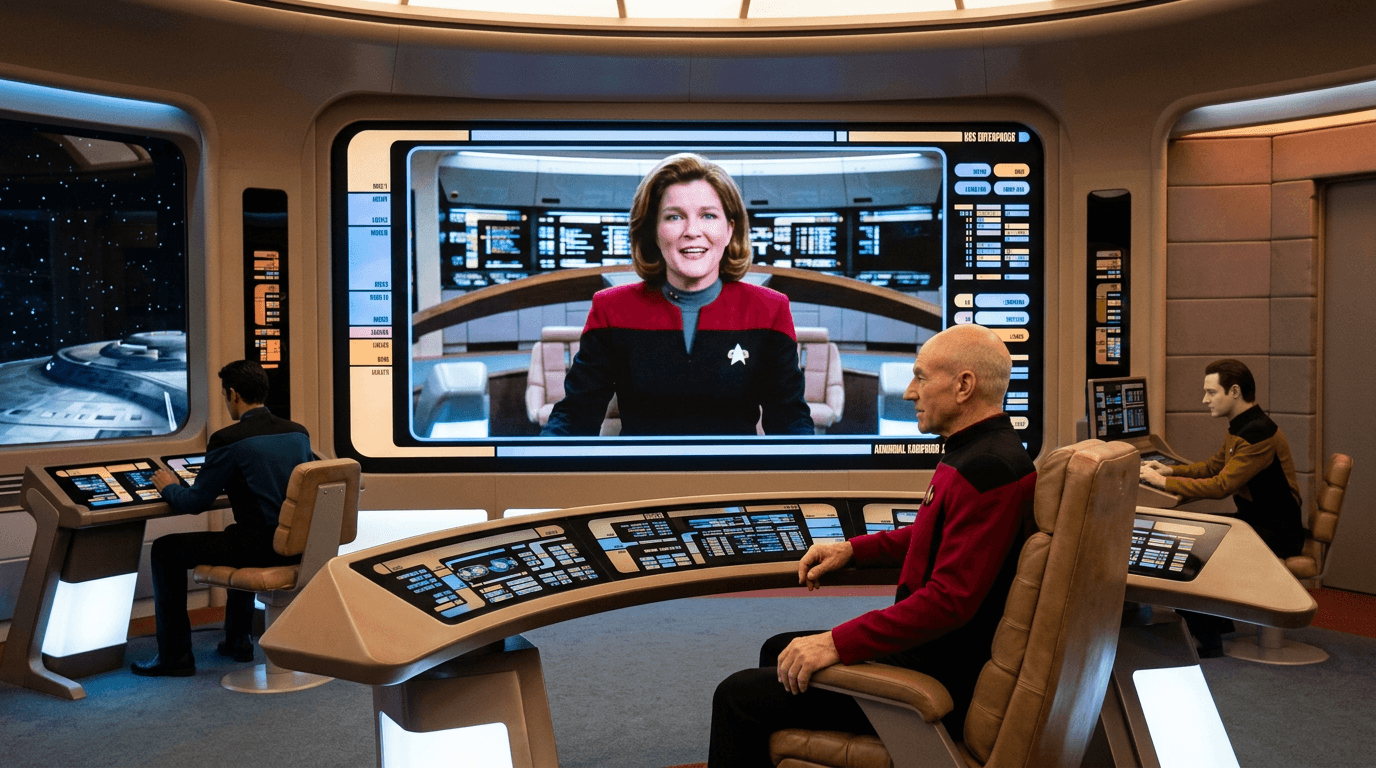
Visual Communication System
In speculative interstellar settings, visual communication systems represent an extension of contemporary video conferencing into the realm of faster-than-light data transmission. The concept builds on the premise that subspace or hyperspace channels—hypothetical structures that bypass normal spacetime limitations—could carry not just audio signals but full-motion video across distances that would otherwise require years or centuries for light-speed transmission. The imagined mechanics involve compressing visual data streams into formats compatible with these exotic transmission media, then reconstructing them at the receiving end with sufficient fidelity to preserve facial expressions, gestures, and environmental context. Unlike simple audio channels, these systems must handle vastly larger data volumes while maintaining the temporal coherence necessary for natural conversation, requiring theoretical advances in both data compression algorithms and the underlying physics of superluminal information transfer.
The narrative appeal of face-to-face interstellar communication lies in its dramatic potential and its reflection of contemporary communication preferences. In diplomatic scenarios, first contact situations, or crisis negotiations depicted in science fiction, the ability to observe an alien ambassador's body language or a distant commander's facial reactions adds layers of meaning that pure audio transmission cannot convey. This technology serves as a storytelling device that preserves the intimacy and nuance of in-person dialogue while operating across cosmic distances, allowing writers to explore interpersonal dynamics without the delays that realistic physics would impose. The inclusion of features like automatic translation overlays and priority channels reflects real-world concerns about secure communications and language barriers, transplanted into an interstellar context where cultural differences might be far more profound than anything encountered on Earth.
From a plausibility standpoint, visual communication systems face the same fundamental constraint as all faster-than-light communication: no known physics supports information transmission exceeding light speed without violating causality. Current quantum entanglement research, sometimes cited in speculative discussions, cannot transmit classical information faster than light, and proposals for wormholes or exotic spacetime geometries remain purely theoretical and would require forms of matter not known to exist. The technology's feasibility depends entirely on breakthrough discoveries in fundamental physics that currently have no experimental support. However, assuming such a breakthrough occurred, the engineering challenges of high-bandwidth video transmission would likely prove more tractable than the underlying FTL mechanism itself, as contemporary streaming technology already handles sophisticated compression, error correction, and synchronization across terrestrial networks. The concept remains valuable as a thought experiment about how communication infrastructure might evolve if the light-speed barrier could somehow be circumvented, and as a reminder that the social and diplomatic dimensions of contact across vast distances extend beyond mere message exchange.
Research this in Signals
Signals turns a topic into a sourced research record you can inspect and rerun. Your first scan is free, and this one starts with Visual Communication System already loaded, so edit it or scan as is.