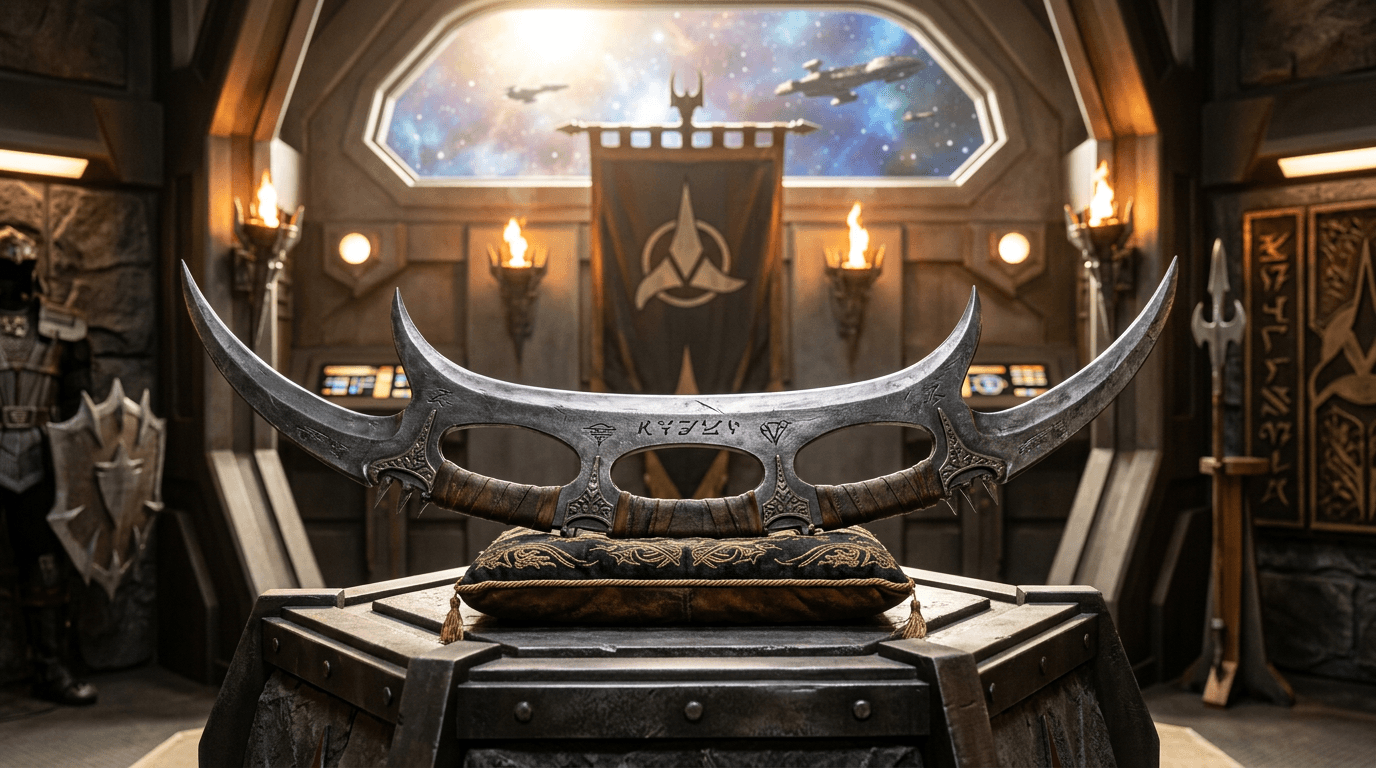
Bat'leth (Sword of Honor)
The bat'leth represents a distinctive approach to melee weapon design that challenges conventional sword-making principles through its crescent-shaped configuration and dual-grip system. Unlike linear blades optimized for thrusting or single-edge cutting, this weapon features a curved metal body approximately four feet in length, with handholds positioned along the inner curve and cutting edges along the outer arc and pointed tips. The design philosophy prioritizes sweeping, rotational strikes and defensive blocking maneuvers, requiring practitioners to master techniques fundamentally different from traditional sword combat. In narrative contexts, the weapon's creation is attributed to legendary warrior-philosopher Kahless, who allegedly forged the first blade from a lock of his hair dipped in molten metal—a mythological origin story that establishes the weapon's symbolic significance beyond its tactical function. The bat'leth appears prominently in speculative military fiction as both a practical combat tool and a ceremonial object, representing a culture that maintains ritualized combat traditions alongside advanced technology.
Within warrior societies depicted in science fiction narratives, the bat'leth serves multiple strategic and cultural functions that extend beyond battlefield utility. The weapon features prominently in formalized dueling protocols and honor-based conflict resolution systems, where combat proficiency demonstrates not merely physical capability but adherence to cultural values. Tournament competitions and ritual challenges using the bat'leth establish social hierarchies, settle disputes, and mark significant life transitions within these fictional societies. The weapon's presence in ceremonial contexts—coronations, coming-of-age rituals, and memorial services—reinforces its role as a cultural artifact that connects contemporary practitioners to ancestral traditions. This dual nature as both functional weapon and symbolic object reflects broader anthropological patterns observed in historical warrior cultures, where specific weapons become inseparable from group identity and value systems. The practice of passing individual blades through family lineages creates material connections across generations, with each weapon accumulating historical significance through the deeds of its wielders.
From a practical standpoint, the bat'leth's unusual geometry presents both advantages and constraints that make it an interesting case study in alternative weapon design. The dual-grip configuration potentially offers superior leverage for blocking and binding opponent weapons compared to single-handed swords, while the curved profile creates multiple striking angles from a single rotational movement. However, the weapon's size and weight would demand significant upper body strength and specialized training to wield effectively, limiting its accessibility compared to more conventional blade designs. The learning curve for mastering rotational striking patterns and the weapon's defensive applications would likely be steeper than for linear sword techniques, explaining why fictional depictions emphasize extensive training traditions and master-apprentice relationships. While no direct real-world equivalent exists, the bat'leth's design principles invite comparison to various historical polearms and specialized dueling weapons that similarly prioritized specific tactical advantages within particular combat contexts. The weapon's enduring presence in speculative fiction demonstrates how alternative design philosophies can create distinctive combat aesthetics that reinforce broader cultural worldbuilding.
Research this in Signals
Signals turns a topic into a sourced research record you can inspect and rerun. Your first scan is free, and this one starts with Bat'leth (Sword of Honor) already loaded, so edit it or scan as is.