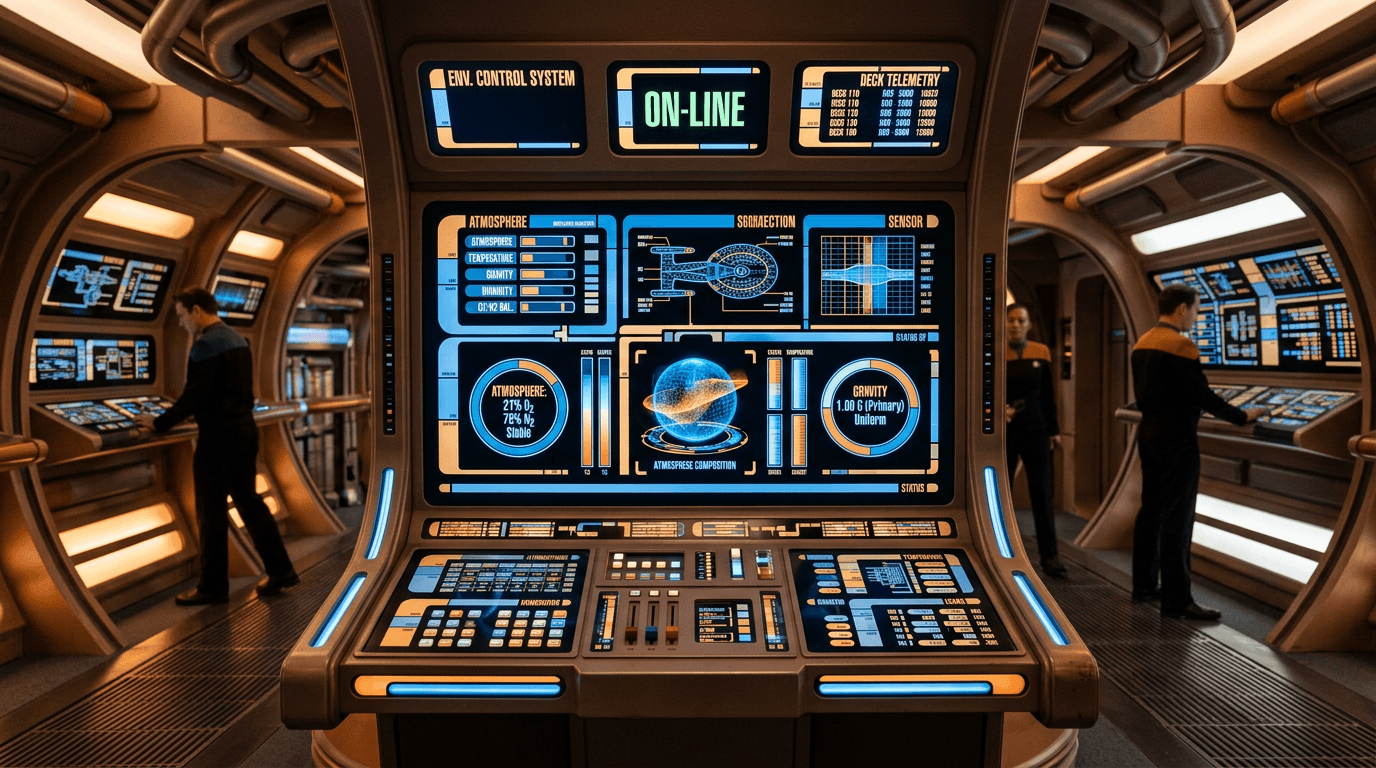
Environmental Control System
An environmental control system (ECS) in the Star Trek context refers to an integrated life-support and habitat-stability stack that continuously manages atmosphere, pressure, temperature, humidity, airborne contaminants, and microbial load across enclosed starship and station volumes. Conceptually, it combines distributed sensing, adaptive airflow architecture, chemical and biological filtration, and closed-loop recycling so inhabited compartments remain safe despite changing crew density, power constraints, and mission conditions. In speculative engineering terms, ECS sits at the intersection of aerospace environmental control, industrial process control, and autonomous safety management.
Its narrative and strategic importance comes from treating habitability as infrastructure rather than background utility. In long-duration missions, resilient environmental control determines crew performance, medical risk, equipment reliability, and operational tempo; in crisis scenarios it becomes a first-line defense against contamination events, fire byproducts, or subsystem failures. Real-world analogues already exist in submarines, spacecraft, biosafety laboratories, and smart-building HVAC platforms, where predictive control and anomaly detection are increasingly used to reduce risk and energy burden. The Star Trek version extends these ideas toward multi-zone autonomy, rapid reconfiguration, and fail-operational behavior under combat or systems damage conditions.
From a plausibility standpoint, many ECS primitives are real and advancing, while full-fiction capabilities depend on breakthroughs in ultra-reliable closed-loop life support, compact high-efficiency scrubbing chemistry, and autonomous diagnostics with very low false-negative rates. The most credible near-term trajectory is gradual convergence: tighter coupling of sensor networks, AI-assisted controls, and modular life-support subsystems for extreme environments. In futures planning, ECS concepts remain useful because they frame a practical question for terrestrial housing, offshore habitats, and space infrastructure alike: how to design built environments that can preserve human safety and comfort under persistent uncertainty and constrained resources.
Research this in Signals
Signals turns a topic into a sourced research record you can inspect and rerun. Your first scan is free, and this one starts with Environmental Control System already loaded, so edit it or scan as is.