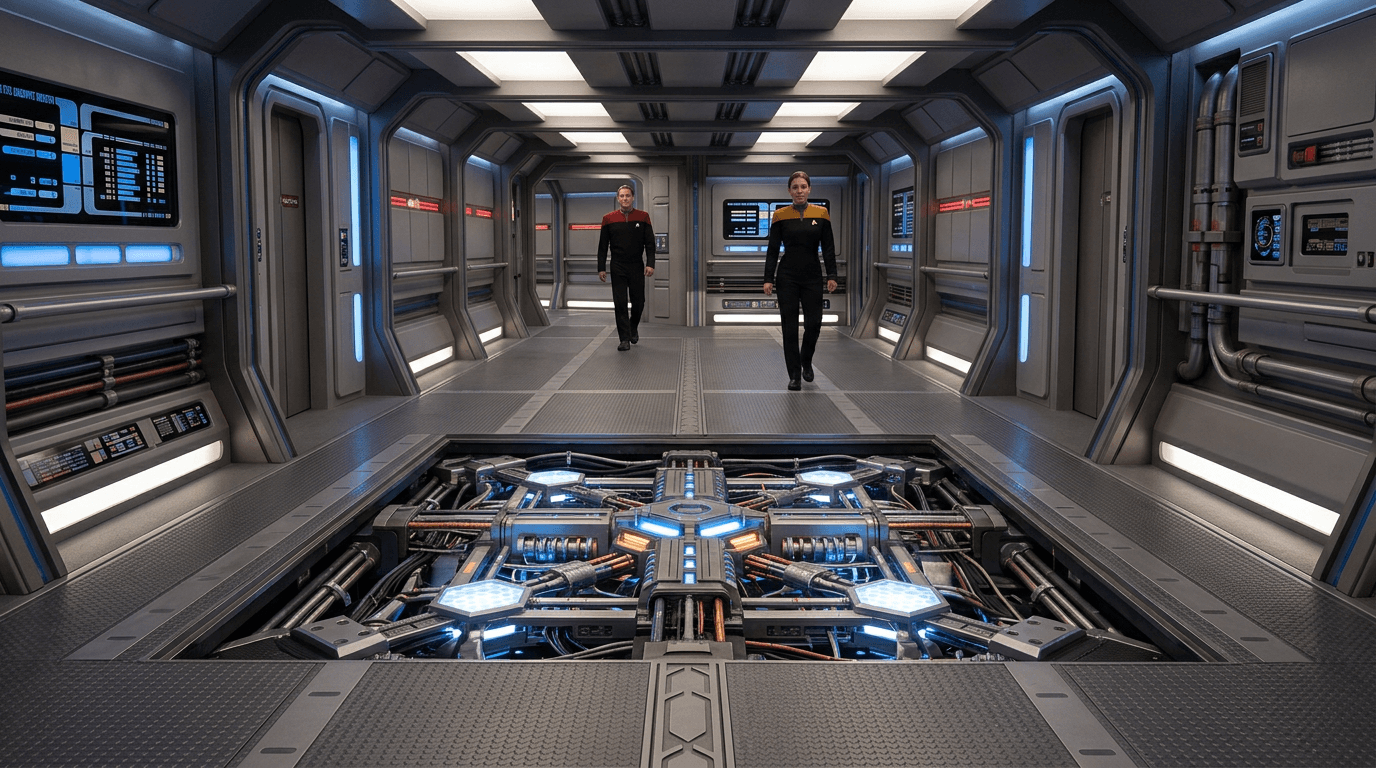
Artificial Gravity Plating
Artificial gravity plating represents one of the most ubiquitous yet theoretically challenging technologies in science fiction spacecraft design. The concept envisions gravitational fields generated directly from thin panels or plates embedded within deck surfaces, creating a consistent downward pull that mimics planetary gravity without requiring massive rotating structures. Unlike centrifugal gravity systems that rely on rotation to create apparent weight through acceleration, gravity plating is imagined to manipulate gravitational forces themselves—or create an equivalent effect through unknown physical mechanisms. In most fictional depictions, these systems operate silently and invisibly, requiring no moving parts and consuming relatively modest amounts of power given the fundamental forces they supposedly manipulate. The technology typically allows for zone-specific control, enabling different gravity levels in medical bays, training facilities, or quarters designed for alien species with varying physiological requirements. This granular control extends to the ability to disable gravity in cargo holds for easier handling of massive objects or in engineering spaces where three-dimensional access proves advantageous.
The narrative appeal of artificial gravity plating is straightforward: it eliminates the dramatic and budgetary complications of depicting zero-gravity environments while maintaining the visual and storytelling conventions of naval or architectural spaces. From a production standpoint, gravity plating allows science fiction to focus on character interactions and plot development rather than the constant physical challenges of microgravity. Strategically, the technology appears in scenarios exploring long-duration space travel, permanent orbital habitation, and interstellar commerce, where the health consequences of prolonged weightlessness—bone density loss, muscle atrophy, fluid redistribution—would otherwise prove prohibitive. The reliability of these systems in most fictional universes reflects an assumption that any civilization capable of routine interstellar travel has necessarily solved one of the fundamental engineering challenges that would otherwise limit such expansion. When gravity systems do fail in narrative contexts, the event typically serves as a crisis point, highlighting both the crew's dependence on the technology and their resourcefulness in managing its absence.
From a physics perspective, generating gravitational fields of meaningful strength without planetary-scale masses remains firmly in the realm of speculation, with no current scientific pathway to such technology. General relativity describes gravity as the curvature of spacetime by mass-energy, and creating Earth-standard gravitational acceleration (9.8 m/s²) through field generation would require either impossible mass concentrations or manipulation of spacetime geometry through mechanisms unknown to current physics. Theoretical concepts like gravitomagnetism or frame-dragging effects exist within general relativity but produce vanishingly small forces under any achievable conditions. Alternative approaches might involve extremely rapid acceleration in alternating directions to simulate sustained weight, though this would require engineering far beyond present capabilities and would likely produce detectable vibration and noise. The power requirements for any genuine gravity manipulation technology would presumably be enormous, contradicting the efficient, maintenance-free operation depicted in most fiction. Any movement toward plausible artificial gravity would likely require either revolutionary discoveries in fundamental physics—perhaps emerging from quantum gravity theories—or acceptance of massive rotating habitats as the practical solution for long-duration space presence.
Research this in Signals
Signals turns a topic into a sourced research record you can inspect and rerun. Your first scan is free, and this one starts with Artificial Gravity Plating already loaded, so edit it or scan as is.