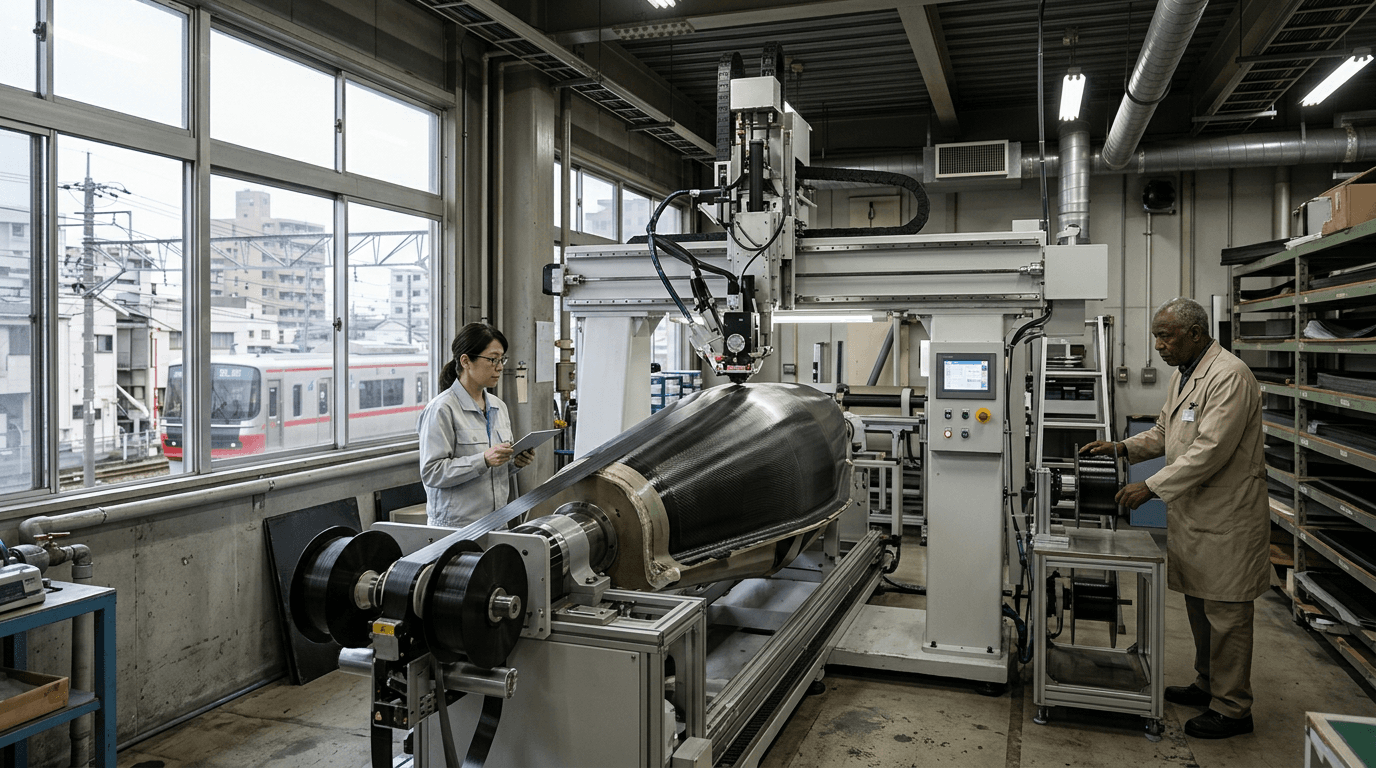
Carbon Fiber Composites
Geography: Asia Pacific · East Asia · Japan
Toray Industries is the world's largest carbon fiber manufacturer, controlling over 50% of global aerospace-grade carbon fiber production. Together with Teijin and Mitsubishi Chemical, Japanese companies dominate the global market with approximately 70% share. Toray's T800 and T1100 fibers are the primary structural materials in Boeing's 787 Dreamliner (50% composite by weight) and supply Airbus's A350 program.
In November 2025, Toray announced a breakthrough recycling technology that decomposes thermoset-based carbon fiber reinforced plastic (CFRP) while preserving over 95% of fiber strength and reducing CO2 emissions by half. This addresses the industry's biggest sustainability challenge — end-of-life carbon fiber has historically been unrecyclable. Toray is also pursuing bio-based carbon fiber precursors and has obtained ISCC certification for European production facilities.
Carbon fiber is a strategic chokepoint material. No alternative exists for aerospace structural applications at comparable strength-to-weight ratios. As carbon fiber demand expands into hydrogen pressure vessels, wind turbine blades, and automotive lightweighting, Japan's control of production technology becomes increasingly valuable. China is investing heavily in domestic carbon fiber but remains 5-10 years behind Japanese quality levels for aerospace applications.
Research this in Signals
Signals turns a topic into a sourced research record you can inspect and rerun. Your first scan is free, and this one starts with Carbon Fiber Composites already loaded, so edit it or scan as is.