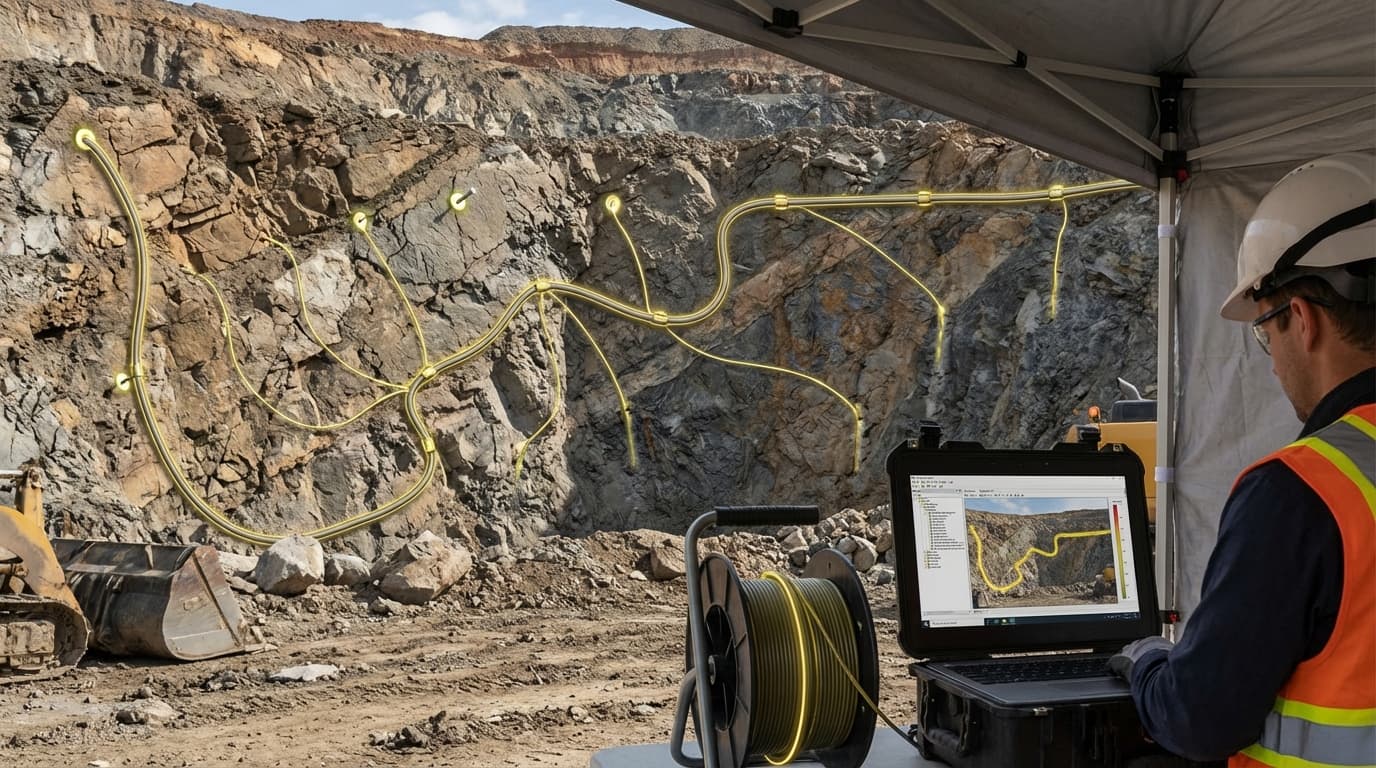
Fiber-Optic Ground and Slope Monitoring
Fiber-optic ground and slope monitoring represents a fundamental shift in how mining operations detect and respond to geotechnical hazards. Traditional monitoring approaches rely on discrete point sensors—inclinometers, extensometers, and survey prisms—that measure conditions only at specific locations, creating blind spots between measurement points where critical ground movements may go undetected. Distributed fiber-optic sensing overcomes this limitation by transforming the entire length of a fiber-optic cable into a continuous sensor array. The technology exploits the natural phenomenon of light scattering within optical fibers: when laser pulses travel through the cable, microscopic imperfections cause backscatter that changes measurably in response to strain, temperature, and vibration. By analysing these backscatter patterns using techniques such as Brillouin or Rayleigh scattering, monitoring systems can detect minute changes in ground conditions at spatial resolutions as fine as one meter along cables that may extend for kilometres. This creates a comprehensive picture of subsurface behaviour across entire pit walls, tailings dams, underground excavations, and waste rock dumps.
The mining industry faces mounting pressure to prevent catastrophic slope failures and ground collapses that threaten worker safety, disrupt operations, and carry severe environmental and financial consequences. Conventional monitoring systems often provide insufficient warning time because they sample conditions too sparsely or require manual data collection that introduces dangerous delays. Fiber-optic monitoring addresses these challenges by delivering real-time, continuous data streams that feed directly into geotechnical analysis platforms. When integrated with numerical models and machine learning algorithms, these systems can identify precursor signatures of instability—subtle strain accumulations, accelerating deformation rates, or anomalous vibration patterns—days or weeks before visible failure occurs. This extended warning window enables mine operators to implement graduated response protocols, from enhanced surveillance and access restrictions to controlled destressing operations or full-scale evacuations. The technology also supports more aggressive mine planning by providing the detailed ground behaviour data needed to safely steepen pit slopes, extend underground workings closer to geological boundaries, or optimise extraction sequences in challenging ground conditions.
Fiber-optic monitoring systems have transitioned from experimental deployments to standard practice at major mining operations worldwide, particularly in open-pit mines with challenging geotechnical conditions and underground operations in seismically active regions. Cables are typically installed during construction—embedded in backfill, grouted into boreholes, or attached to rock faces—creating permanent monitoring infrastructure that operates continuously throughout a mine's operational life and into closure. The technology has proven especially valuable in monitoring tailings storage facilities, where early detection of embankment deformation or seepage can prevent dam failures with potentially devastating downstream consequences. Recent advances have extended capabilities beyond strain and temperature to include distributed acoustic sensing, which detects microseismic events and rockfall activity, providing additional layers of hazard awareness. As mining operations push into more geologically complex environments and regulatory scrutiny of safety systems intensifies, fiber-optic ground monitoring is becoming integral to risk management frameworks, offering a level of spatial and temporal resolution that fundamentally changes how the industry understands and responds to ground instability.
Related Organizations

A pioneer in Distributed Acoustic Sensing (DAS) and Distributed Temperature Sensing (DTS), providing high-resolution monitoring for mining tailings and environmental applications.

An Australian technology company specializing in vibration and acoustic sensing via fiber optics, with a strong focus on mining infrastructure and conveyor monitoring.

A spin-off from HP/Agilent, providing distributed optical sensing technology for fire detection and infrastructure monitoring in mines.

A QinetiQ company specializing in DAS technology, used for perimeter security and pipeline monitoring, with applications in seismic monitoring for mining.

An Australian manufacturer of industrial measurement technology, offering fiber optic sensing solutions for conveyor belt monitoring and leak detection.

Develops advanced distributed fiber optic sensing systems (DAS, DTS, DSS) for infrastructure health monitoring, including geohazard detection.

Provides high-definition fiber optic sensing solutions for structural testing and monitoring, capable of measuring strain with extremely high spatial resolution.

Orica
Australia · Company
The world's largest provider of commercial explosives and blasting systems, which has heavily invested in ground monitoring technologies (including acquiring GroundProbe).

Global technology company driving energy innovation.
Supporting Evidence
Research this in Signals
Signals turns a topic into a sourced research record you can inspect and rerun. Your first scan is free, and this one starts with Fiber-Optic Ground and Slope Monitoring already loaded, so edit it or scan as is.