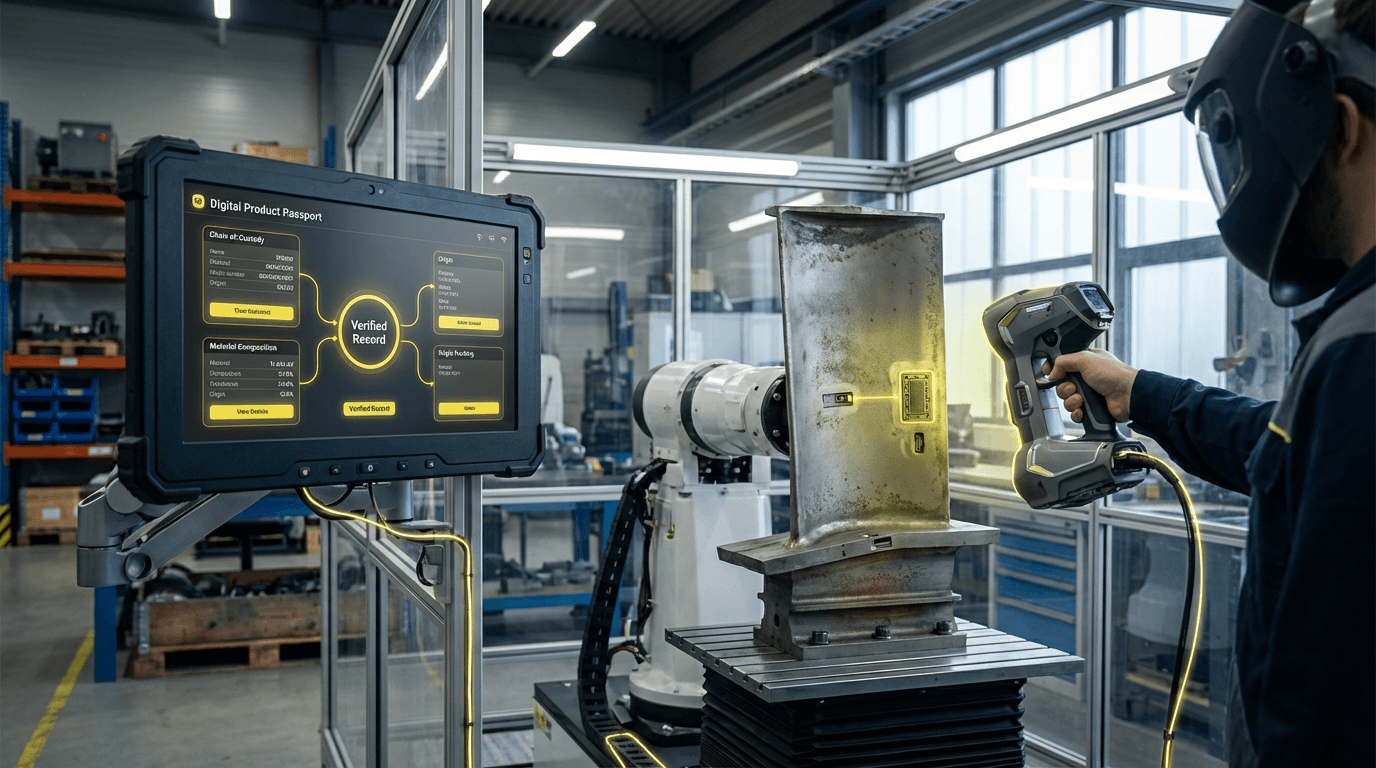
Digital Product Passports (DPP)
Digital Product Passports represent a fundamental shift in how industrial materials and products are tracked throughout their lifecycle, creating comprehensive digital records that document everything from raw material extraction to end-of-life recycling. At their core, these systems function as standardized digital identities for physical products, typically accessed through QR codes, RFID tags, or blockchain-based identifiers embedded in or attached to materials, components, and finished goods. The passport aggregates verified data from multiple points in the supply chain, including mining operations, processing facilities, manufacturing plants, and distribution networks. This information encompasses chemical composition, material provenance, carbon emissions associated with production and transport, percentage of recycled versus virgin content, and documentation of labor practices and human rights compliance throughout the value chain. The technical architecture often relies on distributed ledger technologies or centralized databases with strict authentication protocols to ensure data integrity and prevent tampering, while interoperability standards allow different systems to communicate across industries and borders.
The extractives and heavy industry sectors face mounting pressure to demonstrate environmental responsibility and supply chain transparency, challenges that Digital Product Passports directly address. Mining companies and materials processors struggle to prove the sustainability credentials of their products in an era where buyers increasingly demand verifiable evidence of ethical sourcing and reduced environmental impact. Regulatory frameworks, particularly the EU Battery Regulation and forthcoming Ecodesign for Sustainable Products Regulation, are making such documentation mandatory for market access in major economies. Beyond compliance, these passports solve critical information asymmetries that have long plagued circular economy initiatives—recyclers and remanufacturers often lack precise knowledge of material composition, making efficient recovery and reuse difficult or impossible. By providing detailed material specifications and disassembly instructions, Digital Product Passports enable more effective sorting, higher-quality recycling, and the recovery of valuable materials that would otherwise be lost. This capability is particularly crucial for complex products like batteries, electronics, and composite materials where trace elements and precise alloy compositions determine recyclability and value.
Early implementations are already emerging across the battery value chain, with manufacturers piloting passport systems that track lithium-ion cells from cobalt mines through production to eventual recycling. The construction industry is exploring similar approaches for steel, concrete, and other building materials, while the chemicals sector is developing passports to document hazardous substances and enable safer handling throughout product lifecycles. Industry analysts note that as these systems mature and achieve broader adoption, they will fundamentally reshape procurement practices, with purchasing decisions increasingly influenced by the completeness and quality of digital documentation. The technology also enables new business models, such as materials-as-a-service arrangements where manufacturers retain ownership of valuable materials and recover them at end-of-life, transforming waste streams into resource reservoirs. As global supply chains face growing scrutiny and circular economy principles gain traction, Digital Product Passports are positioned to become essential infrastructure for heavy industry, creating the data foundation necessary for truly sustainable materials management and enabling the transition from linear extraction-to-disposal models toward closed-loop industrial systems.
Related Organizations

The executive branch of the EU, responsible for the AI Act.

Public-private partnership establishing the Battery Passport.

Consortium funded by the German government to develop battery passport content/standards.

Provides supply chain traceability and battery passports to ensure ethical sourcing and recycling verification.

An open data ecosystem for the automotive industry to create a uniform standard for information and data sharing.

Uses blockchain to create digital records of provenance for high-value assets like diamonds, art, and minerals.

A blockchain protocol for tracking responsible mineral sourcing in the supply chain.


Decentralized digital identity software provider focusing on Digital Product Passports and machine identity.

Automotive and energy company developing custom AI silicon for autonomous driving.
Supporting Evidence
Research this in Signals
Signals turns a topic into a sourced research record you can inspect and rerun. Your first scan is free, and this one starts with Digital Product Passports (DPP) already loaded, so edit it or scan as is.