Remote Operations Centre Technology
Geography: Asia Pacific · Oceania · Australia New Zealand
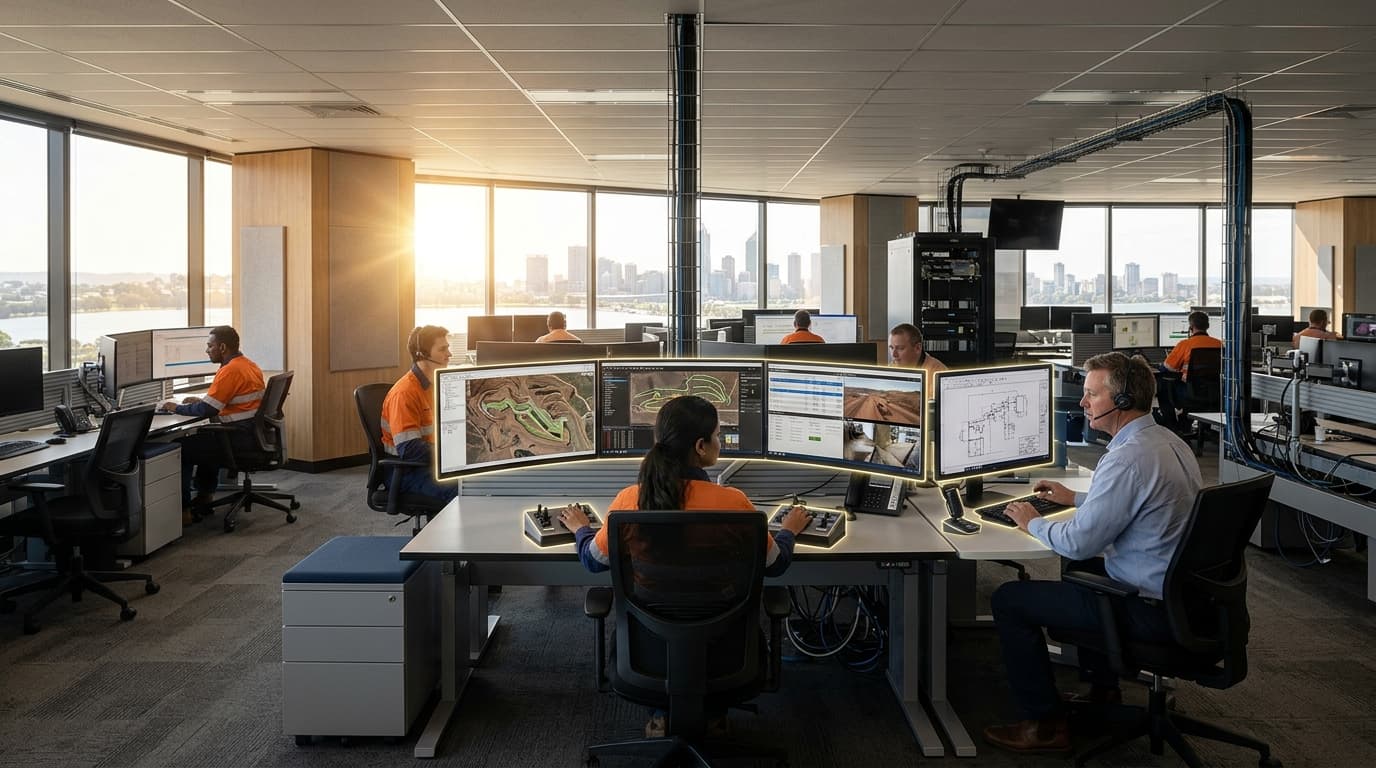
Australia's major mining companies have pioneered the concept of Remote Operations Centres (ROCs), where entire mine sites in the remote Pilbara region are controlled from offices in Perth, over 1,500km away. Rio Tinto's Operations Centre in Perth coordinates autonomous trucks, trains (the world's first fully autonomous heavy-haul railway), processing plants, and port operations across multiple mine sites. BHP and Fortescue operate similar facilities. The ROC model requires high-bandwidth communications, real-time telemetry, advanced visualization systems, and AI-assisted decision support.
Remote operations fundamentally change the social and economic model of mining. Instead of fly-in-fly-out (FIFO) camps in extreme heat, skilled operators work regular shifts in air-conditioned Perth offices. This improves worker retention (a chronic mining industry problem), reduces the enormous costs of remote accommodation and transport, and enables 24/7 operations with shift rotations managed like any urban workplace.
The ROC concept is exportable to any industry with remote, hazardous, or monotonous operations — pipeline monitoring, offshore platforms, agricultural stations, and military forward bases. Australia's mining industry has effectively built the operational template for remote-controlled industrial operations, with implications extending far beyond mining into the future of distributed autonomous systems management.
Research this in Signals
Signals turns a topic into a sourced research record you can inspect and rerun. Your first scan is free, and this one starts with Remote Operations Centre Technology already loaded, so edit it or scan as is.