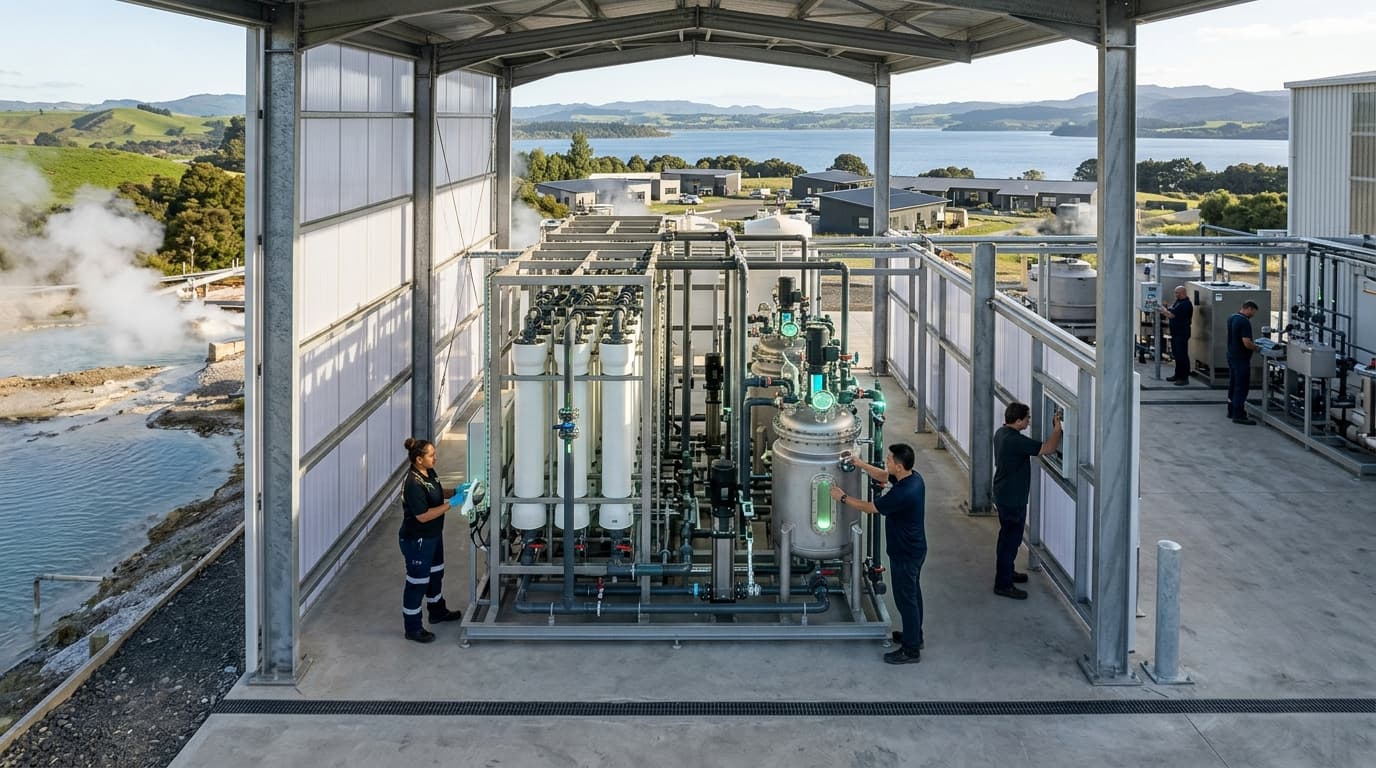
Direct Lithium Extraction from Brines
Geography: Asia Pacific · Oceania · Australia New Zealand
Direct Lithium Extraction (DLE) technologies, being developed by multiple Australian companies and research groups, use selective ion exchange, membrane separation, or solvent extraction to pull lithium directly from brines, geothermal waters, and mine wastewater. Unlike conventional lithium extraction from South American salt flats — which requires massive evaporation ponds operating for 12-18 months with 40-50% lithium recovery rates — DLE can achieve 90%+ recovery in hours with a fraction of the water footprint.
Australia is the world's largest lithium producer from hard-rock (spodumene) mining in Western Australia, but the country also has significant brine resources that are uneconomic with conventional evaporation technology. DLE would unlock these resources while also enabling lithium recovery from geothermal brine (a convergence with NZ's geothermal program) and industrial wastewater. The technology complements MTE's bio-membrane approach with more established chemical engineering methods.
The global battery supply chain is screaming for more lithium. EV battery demand is projected to require 2-3x current lithium production by 2030. DLE is one of the most active areas of mining technology R&D globally, with Australian companies competing against US (Lilac Solutions), German (Vulcan Energy), and Chinese competitors. Success would further cement Australia's position as the Western world's primary lithium supplier while dramatically reducing the environmental footprint of production.
Research this in Signals
Signals turns a topic into a sourced research record you can inspect and rerun. Your first scan is free, and this one starts with Direct Lithium Extraction from Brines already loaded, so edit it or scan as is.