Digital Twin Ventilation Simulation for Deep Mines
Geography: Emea · Africa · Africa
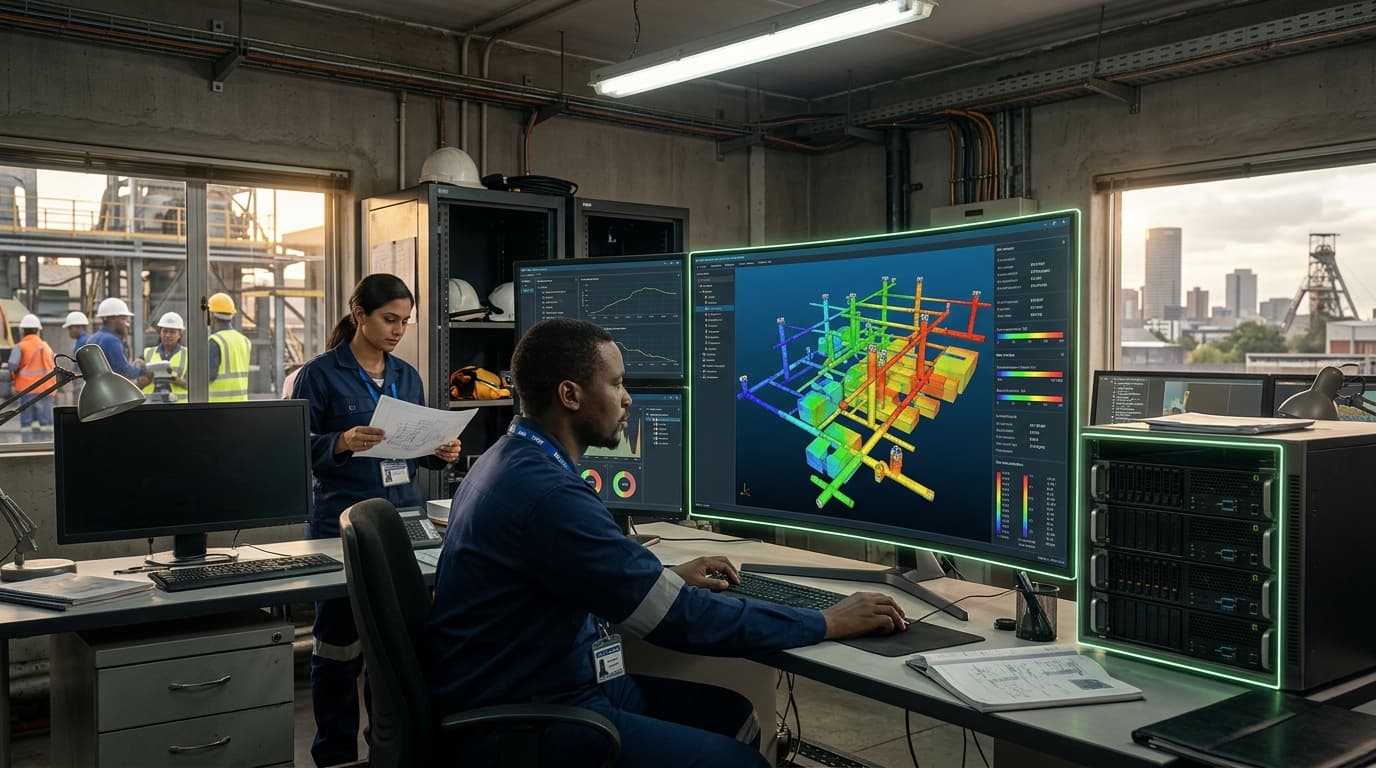
South African mining researchers have developed world-leading digital twin technology for underground mine ventilation and cooling networks. The Process Toolbox (PTB) and VUMA-3D software packages simulate transient, integrated cooling and ventilation networks of entire deep-level mines — modeling airflow, temperature, humidity, gas concentrations, and refrigeration performance across hundreds of kilometers of interconnected tunnels. These calibrated digital twins predict hazardous conditions (heat stress zones, gas accumulation, ventilation short-circuits) before they occur, enabling proactive intervention.
The technology was born from necessity: South African deep mines have the world's most complex ventilation challenges. A single mine may have 200+ km of airways, multiple refrigeration plants, hundreds of fans, and thousands of workers whose metabolic heat adds to the thermal load. PTB can simulate the entire system in real time, allowing engineers to model scenarios: what happens if a fan fails? If a new tunnel opens? If production shifts to a hotter area? The University of Pretoria and North-West University have been primary developers of these simulation capabilities.
The strategic value is that this technology represents accumulated intellectual property from solving problems no one else in the world has faced at this scale and depth. As other mining nations encounter similar challenges — and as underground construction for infrastructure, data centers, and energy storage increases globally — South African ventilation simulation technology becomes a valuable export. The digital twin approach is also being extended to energy optimization, predicting which combination of fan speeds and refrigeration settings minimizes electricity consumption while maintaining safe conditions.
Research this in Signals
Signals turns a topic into a sourced research record you can inspect and rerun. Your first scan is free, and this one starts with Digital Twin Ventilation Simulation for Deep Mines already loaded, so edit it or scan as is.