Deep-Mine Ice Slurry Cooling Technology
Geography: Emea · Africa · Africa
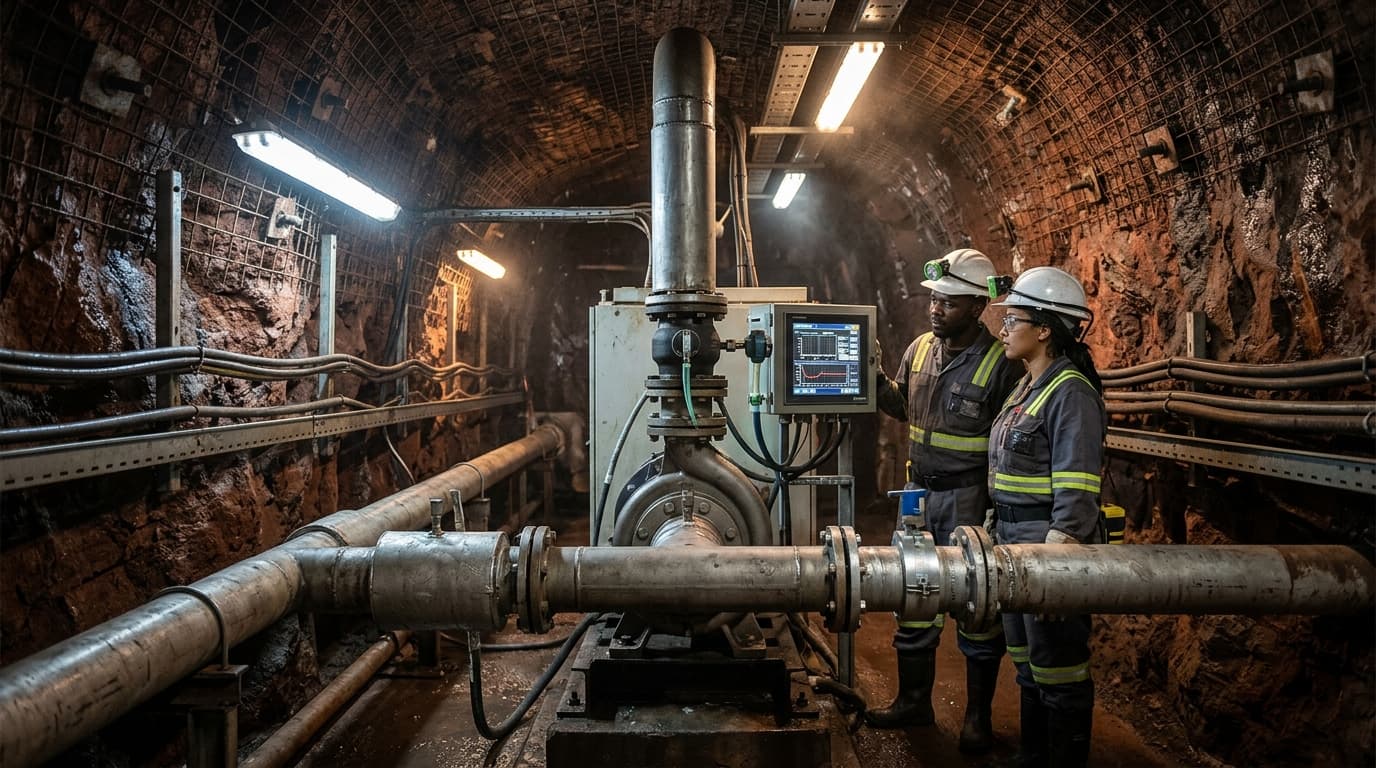
South Africa's ultra-deep gold and platinum mines — Mponeng reaches nearly 4 km below surface where virgin rock temperatures exceed 66°C — require cooling technologies found nowhere else on Earth. The solution developed over decades is surface-based hard ice plants that produce ice slurry, pipe it down the shaft, and use its phase-change energy absorption to cool underground workings. Mponeng's ice plant expansion by Howden uses duplex stainless steel plate ice makers producing thousands of tonnes of ice daily, delivered as a slurry to underground cooling dams.
The engineering challenge is uniquely South African. At these depths, conventional chilled water systems become impractical because the water itself heats up during the descent, and the pumping energy to return warm water to surface is enormous. Ice provides 3.5 times more cooling per kilogram than chilled water due to latent heat of fusion, dramatically reducing water flow rates and return pumping costs. South African mining engineers developed the integrated systems — surface refrigeration plants, ice-making equipment, slurry transport, underground distribution, and ventilation networks — through decades of iterative development at progressively deeper mines.
This technology is strategically significant because the world's remaining high-grade ore deposits are increasingly deep. As mining moves deeper globally — in Canada, Australia, and South America — South African deep-mine cooling expertise becomes an exportable capability. Companies like Howden (with deep South African engineering roots) and BBE Consulting already export this knowledge. The technology also has potential applications in deep geothermal energy extraction and underground infrastructure cooling.
Research this in Signals
Signals turns a topic into a sourced research record you can inspect and rerun. Your first scan is free, and this one starts with Deep-Mine Ice Slurry Cooling Technology already loaded, so edit it or scan as is.