GigaFarm Insect-Based Circular Agriculture
Geography: Emea · Middle East · Gulf States
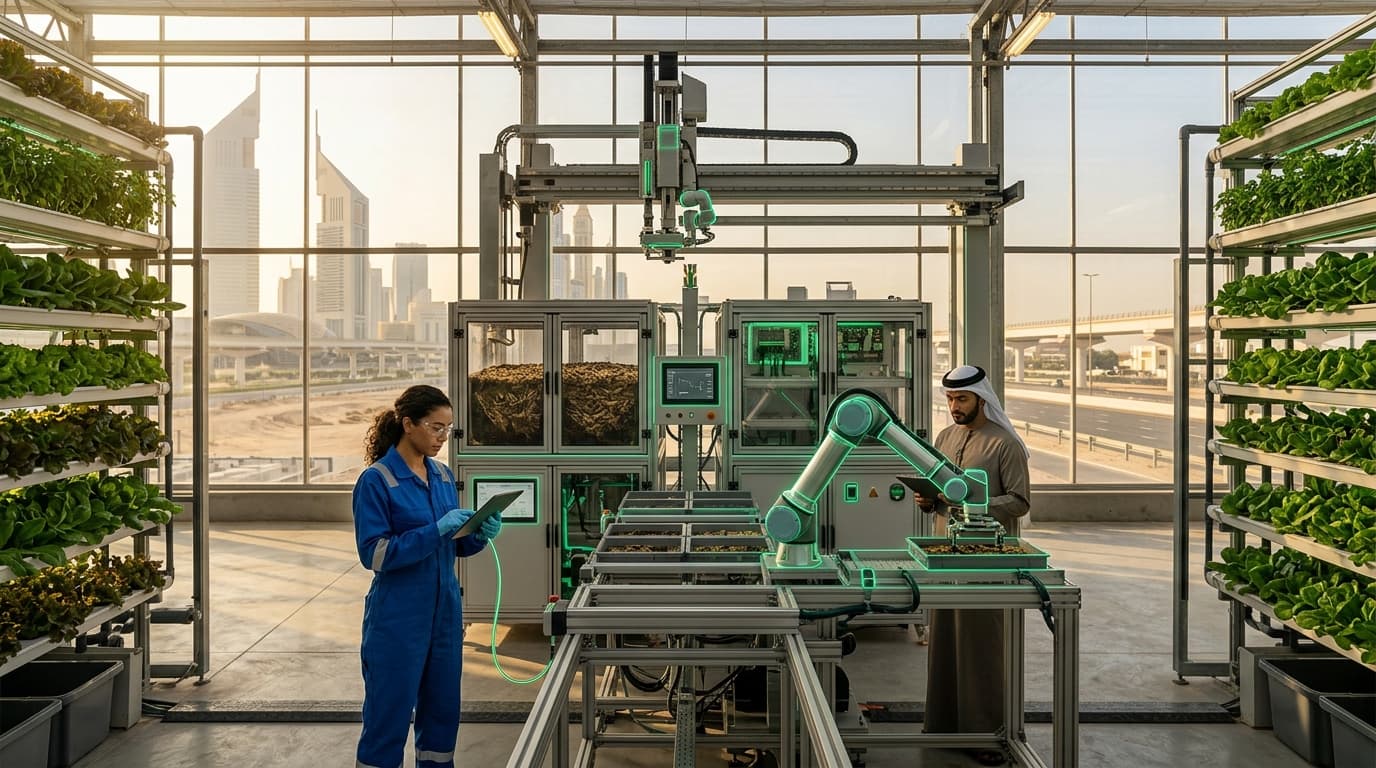
The GigaFarm project in Dubai's Food Tech Valley, developed by Intelligent Growth Solutions (IGS) in partnership with the UAE Ministry of Climate Change and Environment, represents a genuinely novel approach to desert food production. Unlike conventional vertical farms that simply stack hydroponic trays, GigaFarm operates as a closed-loop system: black soldier fly larvae consume the facility's organic waste, producing water and protein meal that feed back into the growing system, while solid waste incineration generates the facility's energy. The 80,000 sqm site began production in 2025 and aims to replace 1% of UAE food imports from a single facility.
What makes GigaFarm non-obvious is the systems integration. Most vertical farming initiatives treat energy, waste, water, and growing as separate problems. GigaFarm treats them as a single circular system, using insect bioconversion as the metabolic bridge between waste streams and agricultural inputs. The AI-driven growing environment optimizes light spectra, nutrient delivery, and climate control for each crop type, achieving 95% water savings compared to field agriculture.
The export potential is significant for arid and semi-arid regions worldwide. As climate change pushes more agricultural zones toward water scarcity, integrated circular agriculture systems that minimize external inputs become increasingly valuable. The GigaFarm model — waste-to-energy, insect-to-water, AI-to-yield — could be replicated in North Africa, Central Asia, and sub-Saharan Africa where both food security and waste management are pressing challenges.
Research this in Signals
Signals turns a topic into a sourced research record you can inspect and rerun. Your first scan is free, and this one starts with GigaFarm Insect-Based Circular Agriculture already loaded, so edit it or scan as is.