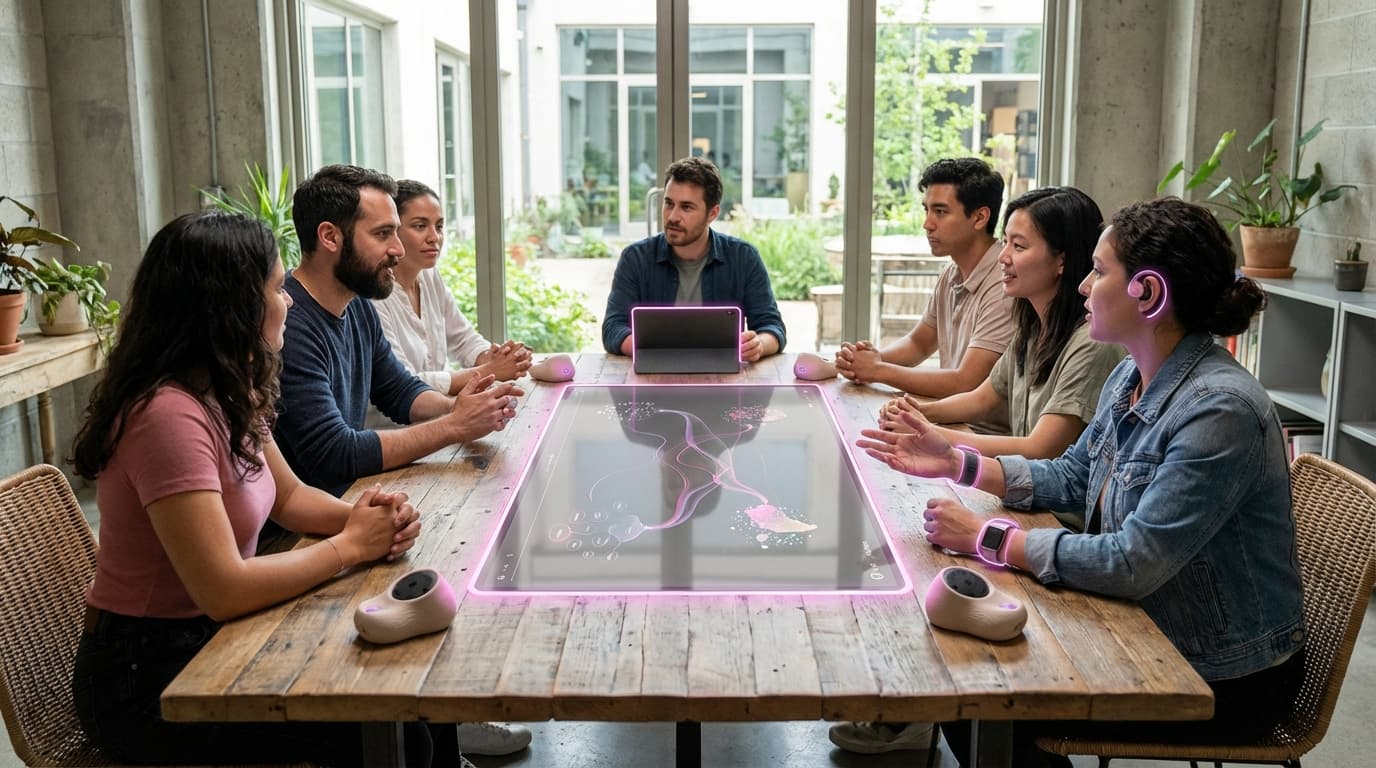
AI-Mediated Group Facilitation
AI-mediated group facilitation represents a significant evolution in how humans collaborate, leveraging artificial intelligence to enhance the quality and productivity of collective dialogue. These systems employ natural language processing, sentiment analysis, and real-time discourse modeling to understand not just what participants are saying, but how they are saying it—detecting emotional undertones, power dynamics, and patterns of engagement or withdrawal. By continuously analyzing conversational flow, these agents can identify when discussions are becoming unbalanced, when certain voices are being marginalized, or when the group is circling around unproductive patterns. The technology integrates multimodal sensing capabilities that may include voice tone analysis, facial expression recognition, and even physiological signals to build a comprehensive picture of group affective states. This allows the system to function as an intelligent mediator that understands both the content and the emotional landscape of human interaction.
The fundamental challenge these systems address is the persistent difficulty groups face in maintaining productive, inclusive dialogue—particularly in contexts involving diverse perspectives, power imbalances, or emotionally charged topics. Traditional facilitation relies heavily on the skill and availability of trained human facilitators, creating bottlenecks in organizations and communities that need regular collaborative sessions. AI-mediated facilitation democratizes access to sophisticated group process support, enabling more frequent and higher-quality collaborative work across organizational boundaries. These systems can detect when conversations are dominated by a few voices and gently prompt quieter participants, identify moments of emerging consensus that might otherwise be missed, and suggest reframing techniques when discussions become stuck in adversarial patterns. In conflict resolution contexts, the technology can help parties identify shared values and common ground that human emotions might obscure, while in creative co-creation sessions, it can track and synthesize diverse contributions into coherent themes.
Early deployments of AI-mediated facilitation are appearing in corporate innovation workshops, community deliberation processes, and online collaborative platforms, where they assist rather than replace human facilitators. Research in human-computer interaction and organizational behavior suggests that hybrid models—where AI augments human facilitation rather than operating autonomously—show particular promise in maintaining the trust and psychological safety essential for meaningful dialogue. These systems are being explored in contexts ranging from citizen assemblies addressing local policy questions to distributed teams navigating complex project decisions. As organizations increasingly recognize that collaboration quality directly impacts innovation capacity and social cohesion, AI-mediated facilitation aligns with broader movements toward participatory governance, collective intelligence, and inclusive decision-making. The technology's trajectory points toward increasingly sophisticated understanding of cultural context and group dynamics, potentially transforming how communities navigate difference and co-create shared futures.
Related Organizations

An AI 'co-pilot' for healthcare consultations that listens in to provide documentation and decision support.

Provides real-time analytics on speaking time to promote inclusion and prevent domination of conversations in meetings.

An AI platform that allows a single moderator to converse with a large group in real-time, using algorithms to find representative consensus.

Uses Swarm AI technology to amplify the intelligence of human groups.

Measures meeting engagement and sentiment in real-time, providing nudges to improve interaction and reduce meeting fatigue.

An AI communication coach that gives real-time feedback on clarity, confidence, and energy during meetings.

An AI meeting assistant that records, transcribes, and analyzes voice conversations, offering sentiment analysis and topic tracking.

An AI meeting assistant that records audio, writes notes, and generates summaries.

Offers Webex Hologram, an augmented reality meeting solution that projects photorealistic 3D holograms of participants into the room.

Visual collaboration platform that powers the software experience on many interactive displays.
Supporting Evidence
Research this in Signals
Signals turns a topic into a sourced research record you can inspect and rerun. Your first scan is free, and this one starts with AI-Mediated Group Facilitation already loaded, so edit it or scan as is.