Metal Additive Manufacturing Systems
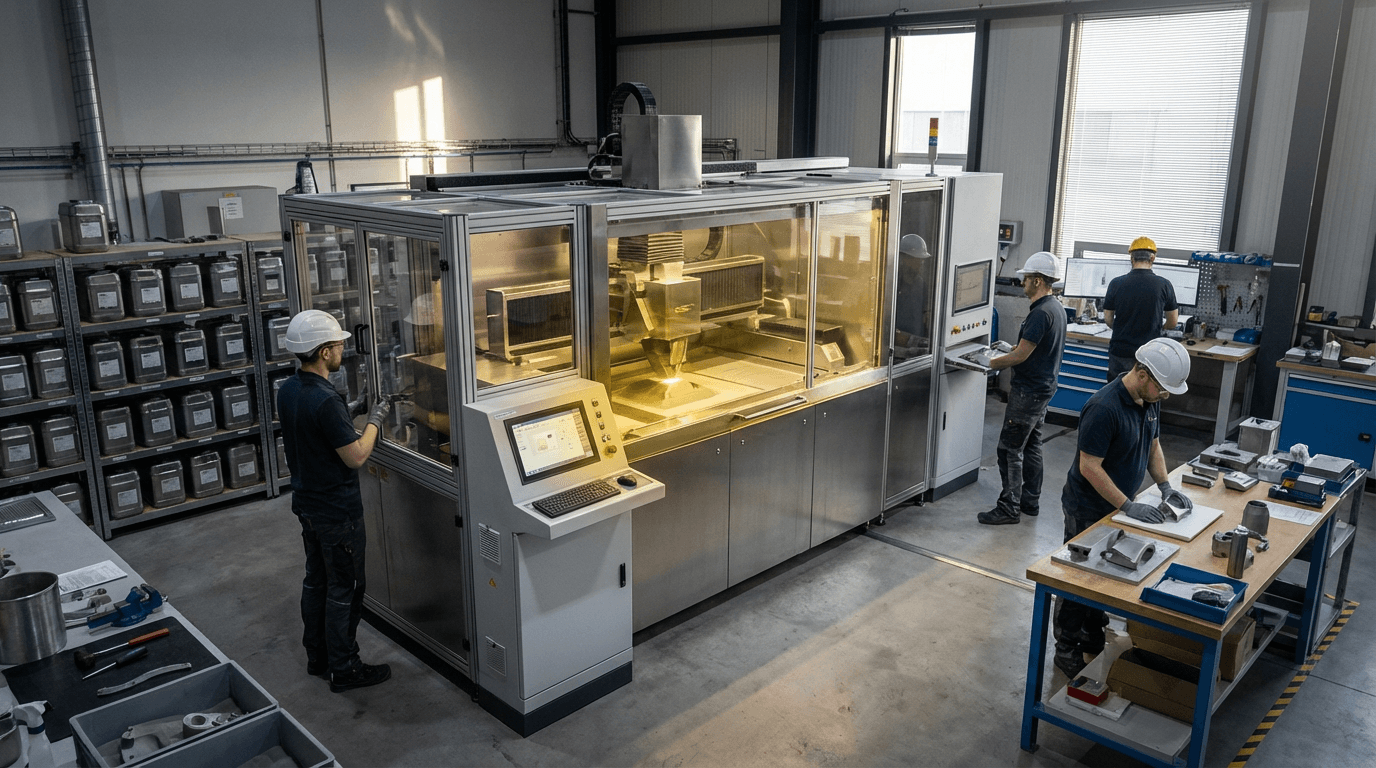
Metal additive manufacturing systems represent a paradigm shift in industrial production, enabling the creation of complex metal components that would be impossible or prohibitively expensive to produce through conventional subtractive methods. These systems employ several core technologies, most notably powder bed fusion (PBF) and directed energy deposition (DED), which build parts layer by layer from metal powders or wire feedstock. In PBF processes, a laser or electron beam selectively melts thin layers of metal powder spread across a build platform, fusing each layer to the one below it. DED systems, by contrast, use focused energy sources to melt material as it is deposited, allowing for the addition of material onto existing parts or the creation of large-scale components. Increasingly, manufacturers are deploying hybrid systems that combine additive capabilities with traditional CNC machining in a single platform, enabling the production of parts that leverage the geometric freedom of additive manufacturing while maintaining the precision and surface finish achievable through subtractive processes. These systems work with a range of metals including titanium alloys, nickel superalloys, stainless steels, and aluminium, each selected for specific performance requirements.
The industrial appeal of metal additive manufacturing lies in its ability to address longstanding manufacturing constraints that have limited design innovation and supply chain efficiency. Traditional manufacturing methods often require extensive tooling, impose geometric limitations, and generate significant material waste through machining away excess stock. Metal additive systems overcome these barriers by enabling topology optimization—the creation of structures that use material only where mechanically necessary, resulting in parts that can be 40-60% lighter while maintaining or exceeding strength requirements. This capability is particularly valuable in aerospace and automotive applications where weight reduction directly translates to fuel efficiency and performance gains. Furthermore, these systems allow engineers to integrate features such as conformal cooling channels, internal lattice structures, and embedded sensors directly into components during the build process, eliminating assembly steps and enabling functionality previously unattainable. The technology also transforms supply chain dynamics by enabling on-demand production of spare parts and reducing inventory requirements, a capability that has attracted significant interest from defense and maritime sectors where parts obsolescence poses ongoing challenges.
Early adoption of metal additive manufacturing has been concentrated in aerospace, where companies have deployed the technology for producing turbine blades, fuel nozzles, and structural brackets that demonstrate both performance improvements and cost reductions in low-to-medium volume production runs. The medical device industry has similarly embraced these systems for creating patient-specific implants with porous structures that encourage bone integration. As the technology matures, industrial deployments are expanding into tooling applications, where manufacturers use additively produced molds and dies with conformal cooling to reduce cycle times in injection molding and die casting operations. Looking forward, the trajectory of metal additive manufacturing points toward increased automation, improved process monitoring through in-situ sensing, and the development of new alloy compositions specifically formulated for additive processes. The convergence of this technology with digital manufacturing ecosystems—including simulation software that predicts build outcomes and machine learning algorithms that optimize process parameters—suggests a future where metal additive manufacturing transitions from a specialized prototyping tool to a mainstream production method capable of competing with conventional manufacturing across a broader range of applications and production volumes.
Related Organizations


Division of GE Aerospace focusing on metal additive technologies (EBM and Laser Powder Bed).

Provider of metal-based additive manufacturing systems, known for multi-laser technology.

Manufacturer of 3D printing systems for mass production of metal parts.

Developing the Terran R, a 3D-printed reusable medium-to-heavy lift launch vehicle.

Industrial laser leader offering Laser Metal Deposition (LMD) machines and heads.

Manufacturer of metal 3D printers featuring the Assure quality control system for layer-by-layer tracking.

HP
United States · Company
Partnering with Google to commercialize Project Starline hardware for enterprise meeting rooms.

Markforged
United States · Company
Creator of the Metal X system, which uses atomic diffusion additive manufacturing (ADAM).

Develops a wire-laser metal deposition head that can be integrated into CNCs, robots, or standalone printers.

A global metrology company that integrates advanced sensing (InfiniAM) into their metal AM systems for melt pool monitoring.

Area Printing technology developer for high-volume metal manufacturing.
Supporting Evidence
Research this in Signals
Signals turns a topic into a sourced research record you can inspect and rerun. Your first scan is free, and this one starts with Metal Additive Manufacturing Systems already loaded, so edit it or scan as is.