Industrial Metaverse Twins
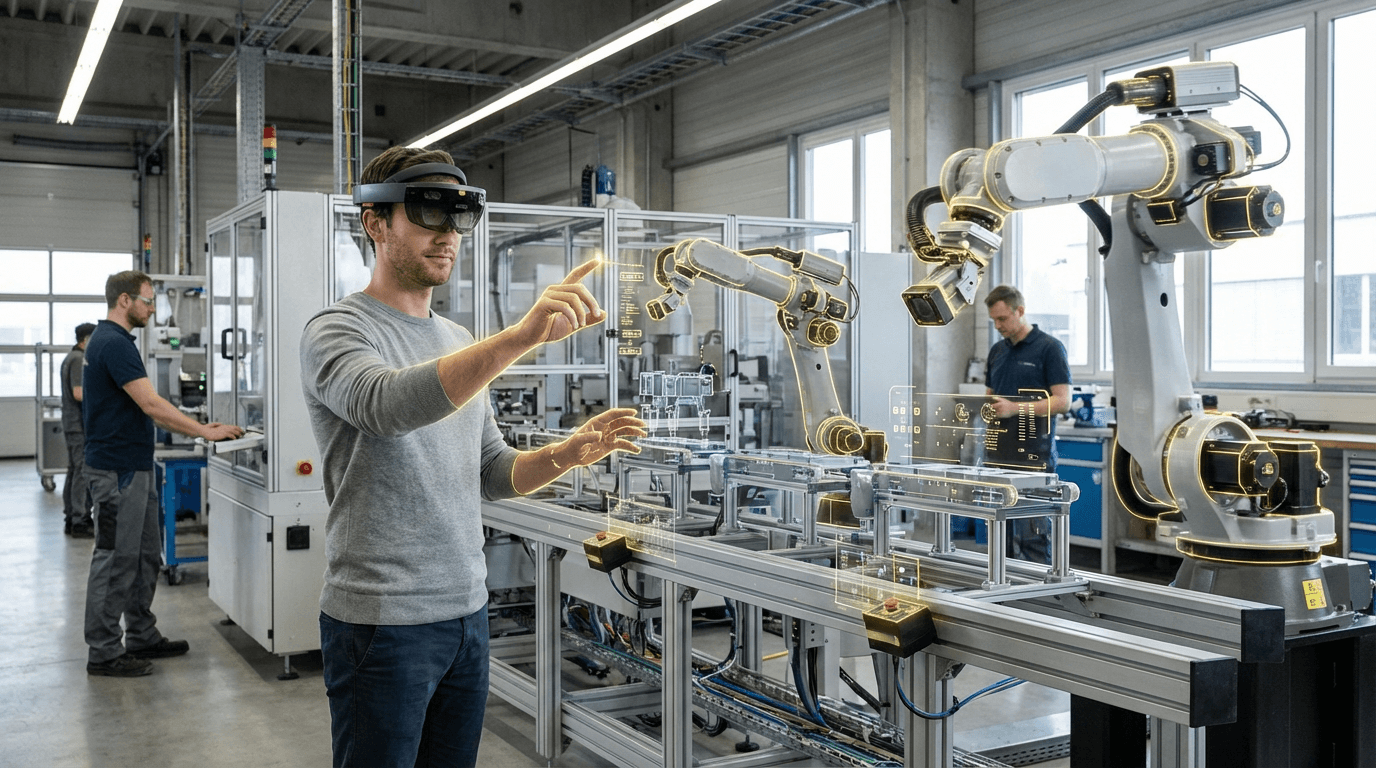
Industrial Metaverse Twins represent a convergence of digital twin technology with immersive virtual environments, creating high-fidelity, interactive replicas of physical industrial assets, processes, and entire facilities within persistent virtual worlds. Unlike traditional digital twins that primarily serve as monitoring dashboards or simulation tools, these metaverse-integrated systems leverage virtual reality, augmented reality, and spatial computing interfaces to enable stakeholders to step inside and interact with virtual representations of factories, supply chains, or complex machinery. The underlying architecture combines real-time sensor data streams from Internet of Things devices, physics-based simulation engines, and cloud computing infrastructure to maintain continuous synchronization between physical assets and their virtual counterparts. This creates what researchers describe as a "living mirror" of industrial operations, where every machine vibration, temperature fluctuation, and production metric is reflected instantaneously in an explorable three-dimensional environment that multiple users can inhabit simultaneously from anywhere in the world.
The industrial sector faces mounting pressure to reduce downtime, optimize energy consumption, and accelerate innovation cycles while managing increasingly distributed workforces and complex global supply chains. Industrial Metaverse Twins address these challenges by transforming how teams collaborate on design modifications, troubleshoot operational issues, and train personnel. Engineers can gather in a shared virtual space to examine a malfunctioning component at scale, manipulating it with gesture controls and running "what-if" scenarios that would be impossible or prohibitively expensive to test on physical equipment. This capability proves particularly valuable for generating synthetic training data for machine learning systems, as the physics-accurate simulations can produce thousands of operational scenarios—including rare failure modes—without risking actual assets or production schedules. The technology also enables remote operation and maintenance, allowing specialists to guide on-site technicians through complex procedures by overlaying instructions directly onto their view of equipment, effectively democratizing expertise across organizational boundaries.
Early deployments indicate strong interest from sectors managing high-value, safety-critical infrastructure such as energy production, aerospace manufacturing, and chemical processing. Pilot programs have demonstrated the technology's potential for reducing commissioning time for new facilities, as teams can virtually validate layouts and workflows before physical construction begins. Some manufacturers report using these immersive twins to optimize production line configurations, identifying bottlenecks and testing alternative arrangements in hours rather than the weeks required for physical reconfiguration. The approach aligns with broader Industry 4.0 trends toward cyber-physical integration and data-driven decision-making, while the collaborative virtual workspace aspect addresses the growing need for distributed teams to work together effectively on complex industrial challenges. As computing power continues to advance and extended reality hardware becomes more accessible, Industrial Metaverse Twins are positioned to become standard infrastructure for managing the increasingly sophisticated automated systems that characterize modern manufacturing and industrial operations.
Related Organizations

Developing foundation models for robotics (Project GR00T) and vision-language models like VILA.
Industrial giant offering the 'Senseye Predictive Maintenance' suite and MindSphere IoT platform.


Software corporation specializing in 3D design and digital mock-ups.

Hexagon AB
Sweden · Company
A global leader in sensor, software, and autonomous solutions, providing reality capture for digital twins.

Provider of mobile mapping systems and reality capture software for indoor spatial intelligence.

Creators of the Unity Engine and the ML-Agents toolkit, which allows researchers to train intelligent agents within game environments.


Spatial data company that integrated mobile LiDAR support into their capture app, democratizing real estate digital twins.

Manufacturing Automation Platform (MAP) that allows users to design, order, and deploy automated equipment.
Supporting Evidence
Research this in Signals
Signals turns a topic into a sourced research record you can inspect and rerun. Your first scan is free, and this one starts with Industrial Metaverse Twins already loaded, so edit it or scan as is.