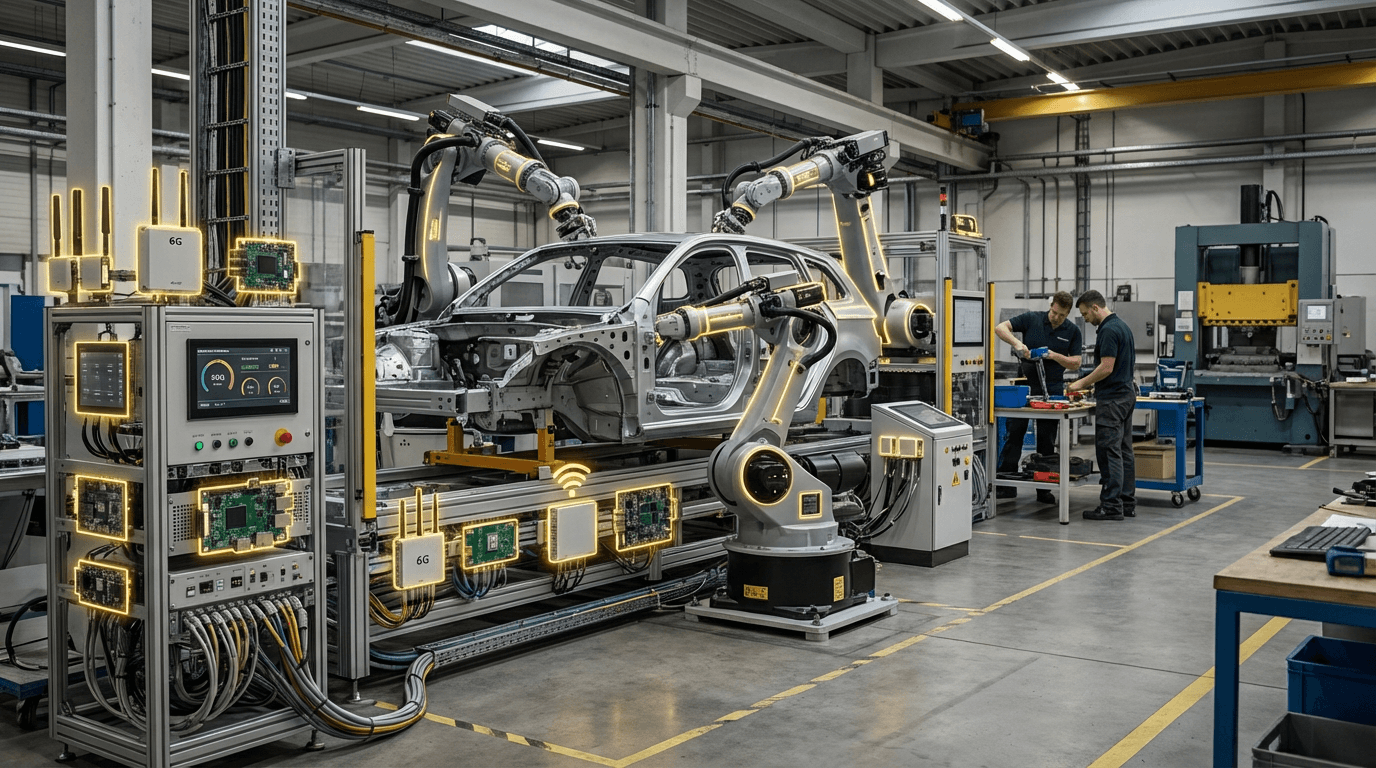
Industrial 6G & TSN Networks
Industrial 6G and Time-Sensitive Networking (TSN) represent the convergence of next-generation wireless communications with deterministic networking protocols, specifically engineered to meet the stringent requirements of cyber-physical systems in manufacturing and industrial environments. Unlike consumer-oriented mobile networks, these technologies prioritise predictability and reliability over raw speed, delivering guaranteed latency bounds typically in the sub-millisecond range and reliability rates exceeding 99.9999%. The technical foundation combines 6G's ultra-low latency wireless capabilities with TSN's IEEE 802.1 standards for time synchronisation and traffic scheduling, creating a unified network fabric that can seamlessly coordinate thousands of devices—from robotic arms and automated guided vehicles to precision sensors and programmable logic controllers—within a single production facility. Private campus networks operating on dedicated spectrum ensure that critical industrial communications remain isolated from public network congestion and interference.
The Fourth Industrial Revolution demands unprecedented levels of automation and real-time coordination between physical machinery and digital control systems, yet traditional industrial networking approaches struggle to deliver the flexibility and scalability required by modern smart factories. Wired Ethernet connections, while reliable, constrain the mobility of robotic systems and complicate factory reconfiguration, while conventional wireless networks cannot guarantee the deterministic performance needed for safety-critical applications like collaborative robotics or closed-loop process control. Industrial 6G and TSN address these limitations by enabling wireless connectivity with wired-level reliability, allowing manufacturers to deploy flexible, reconfigurable production lines where robots and automated systems can move freely while maintaining constant, predictable communication with central control systems. This capability unlocks new manufacturing paradigms such as mass customisation, where production lines can rapidly adapt to different product variants without physical rewiring, and enables the integration of mobile autonomous systems that can navigate factory floors while maintaining real-time coordination with other equipment.
Early industrial deployments of private 5G networks with TSN integration are already demonstrating the technology's potential, with automotive manufacturers and electronics producers piloting systems that coordinate hundreds of robots and automated systems across large production facilities. Research institutions and industry consortia are actively developing 6G specifications that will further enhance these capabilities, targeting even lower latencies and higher device densities to support the next generation of industrial automation. The technology aligns with broader trends toward digital twins, edge computing, and AI-driven manufacturing optimisation, where real-time data from thousands of sensors must be processed and acted upon within milliseconds. As manufacturing becomes increasingly software-defined and adaptive, industrial 6G and TSN networks will serve as the critical infrastructure enabling factories to operate as unified, self-optimising systems rather than collections of isolated machines, fundamentally transforming how physical goods are produced in the coming decades.
Related Organizations

Industrial research lab with a history of fundamental research in condensed matter physics relevant to topological phases.

Specializes in industrial automation and deterministic networking, specifically Time-Sensitive Networking (TSN).


German research institute developing advanced algorithms for 3D Human Body Reconstruction and volumetric video coding.

Host of the 6G Flagship, the world's first major 6G research program.

Manufacturer of networking hardware, including the Hirschmann brand which is a pioneer in Industrial Ethernet and TSN.

Offers the Quantum Engineering Toolkit (QET) and Labber software for instrument control and pulse generation.


Global semiconductor leader providing analog front ends (AFEs) and low-power microcontrollers (MAX78000) specifically for health sensing.
Supporting Evidence
Research this in Signals
Signals turns a topic into a sourced research record you can inspect and rerun. Your first scan is free, and this one starts with Industrial 6G & TSN Networks already loaded, so edit it or scan as is.