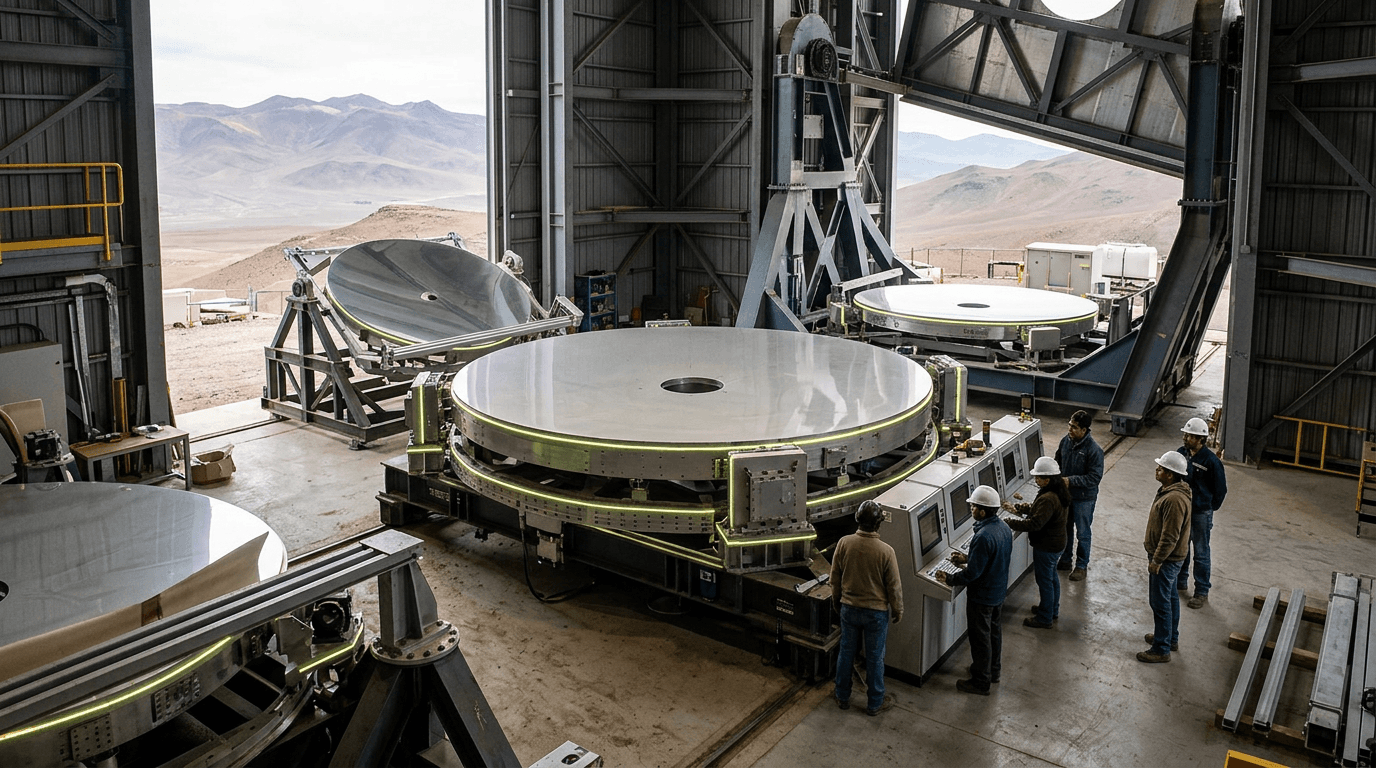
Giant Magellan Telescope Segmented Mirror Technology
Geography: Americas · South America · Latin America
The Giant Magellan Telescope (GMT), under construction at Las Campanas Observatory in Chile, takes a different approach to extremely large telescopes: rather than hundreds of small hexagonal segments (like the ELT), it combines seven 8.4-meter monolithic mirrors cast at the University of Arizona's Richard F. Cary Mirror Lab into a 25.4-meter composite primary mirror. This design provides a wider field of view than segmented-mirror telescopes, making GMT particularly powerful for survey observations.
The mirror fabrication technology is extraordinary: each 8.4-meter mirror is spin-cast in a rotating furnace at 1,165°C, creating a honeycomb structure that reduces weight while maintaining rigidity. The surface is then polished to an accuracy of 20 nanometers — a thousandth the width of a human hair. GMT's adaptive secondary mirror corrects atmospheric distortion 1,000 times per second, enabling ground-based images sharper than the Hubble Space Telescope.
GMT's primary science case is characterizing exoplanet atmospheres — detecting signatures of water, oxygen, and other biosignature gases in the atmospheres of Earth-like planets around nearby stars. This capability, combined with its wide field survey mode, makes GMT complementary to rather than competitive with the ELT. Together, these two telescopes in Chile will dominate ground-based astronomy for decades, reinforcing the Atacama's unique status as humanity's window to the universe.
Research this in Signals
Signals turns a topic into a sourced research record you can inspect and rerun. Your first scan is free, and this one starts with Giant Magellan Telescope Segmented Mirror Technology already loaded, so edit it or scan as is.