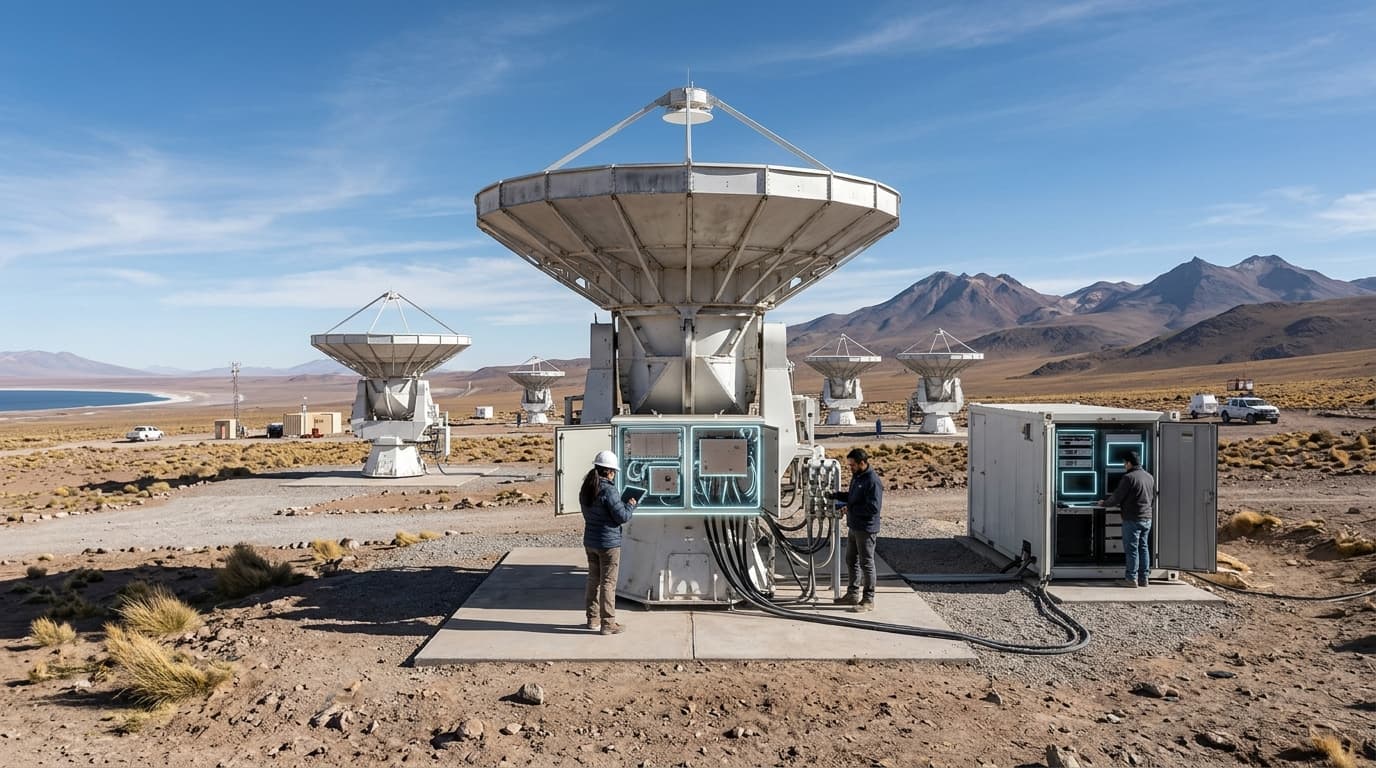
ALMA Submillimeter Radio Interferometry
Geography: Americas · South America · Latin America
The Atacama Large Millimeter/submillimeter Array (ALMA), located at 5,000 meters altitude on the Chajnantor plateau in Chile, is the world's most expensive ground-based telescope — a $1.4 billion international project operating 66 high-precision antennas that work together as a single telescope. ALMA observes the universe at millimeter and submillimeter wavelengths, revealing phenomena invisible to optical telescopes: the cold molecular gas from which stars form, protoplanetary disks around young stars, and the earliest galaxies in the universe.
ALMA's baseline configuration spans up to 16 kilometers, providing angular resolution comparable to the Hubble Space Telescope but at radio wavelengths. The technology includes supercooled receivers operating at 4 Kelvin (-269°C), a correlator that processes signals from all 66 antennas simultaneously, and precision pointing systems that maintain alignment despite wind loads at extreme altitude. The Chajnantor plateau was chosen because its extreme dryness minimizes atmospheric water vapor absorption that would otherwise block submillimeter observations.
For Chile, ALMA represents a guaranteed research asset: the hosting agreement provides 10% of observing time to Chilean institutions, building a generation of Chilean astronomers and astrophysicists working at the frontier of human knowledge. The facility also drives technology development in cryogenics, signal processing, and precision engineering that has applications in communications, remote sensing, and medical imaging.
Research this in Signals
Signals turns a topic into a sourced research record you can inspect and rerun. Your first scan is free, and this one starts with ALMA Submillimeter Radio Interferometry already loaded, so edit it or scan as is.