National Quantum Mission
Geography: Asia Pacific · South Asia · India
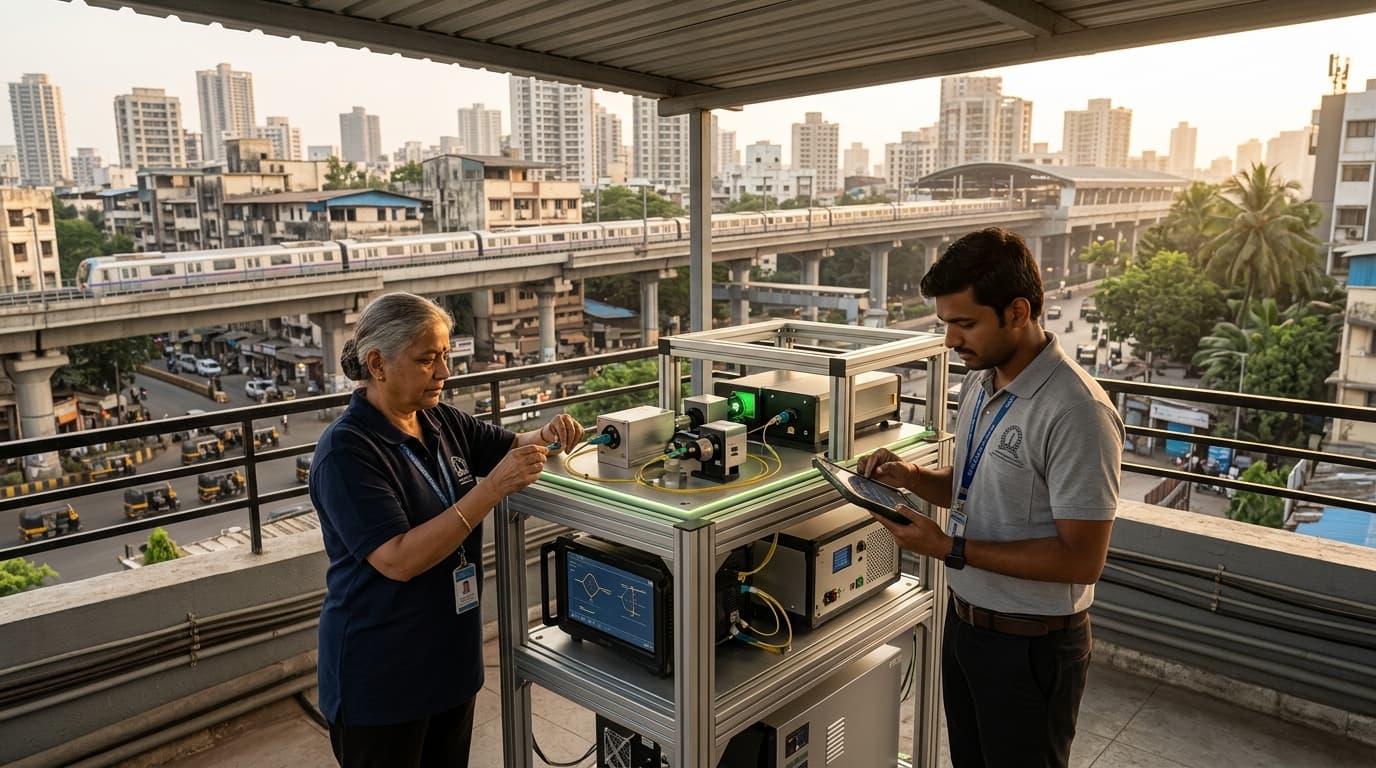
India's National Quantum Mission (NQM), approved in April 2023 with a budget of Rs 6,003.65 crore (~$730 million) over eight years, aims to build indigenous quantum computing, communication, sensing, and materials capabilities. The mission has established Quantum Computing, Communication, Sensing & Metrology, and Materials & Devices hubs across India's top research institutions — IIT Guwahati, IIT Delhi, IISc Bangalore, IIT Bombay, and TIFR Mumbai. The Quantum Computing Hub alone has Rs 653 crore in sanctioned funding, with Rs 172.70 crore released in FY 2025-26.
The mission targets intermediate-scale quantum computers with 50-1000 physical qubits by 2031, satellite-based quantum key distribution over 2000 km, and quantum sensors for navigation and medical applications. C-DAC (Centre for Development of Advanced Computing) and DIAT (Defence Institute of Advanced Technology) have collaborated to develop QSim — India's Quantum Computer Simulator toolkit — providing researchers, students, and industry professionals with tools to develop quantum algorithms without requiring access to physical quantum hardware.
India is a latecomer to the quantum race compared to the US, China, and EU, but its approach leverages existing strengths: a deep pool of theoretical physicists and computer scientists, strong mathematical tradition, and the ability to build research infrastructure at lower costs. The NQM is strategically important because quantum computing could disrupt India's $250 billion IT services industry — either as a threat (making some services obsolete) or as an opportunity (quantum-as-a-service). India's quantum research will also be critical for post-quantum cryptography, as quantum computers threaten the encryption that underpins India Stack and UPI's security.
Research this in Signals
Signals turns a topic into a sourced research record you can inspect and rerun. Your first scan is free, and this one starts with National Quantum Mission already loaded, so edit it or scan as is.