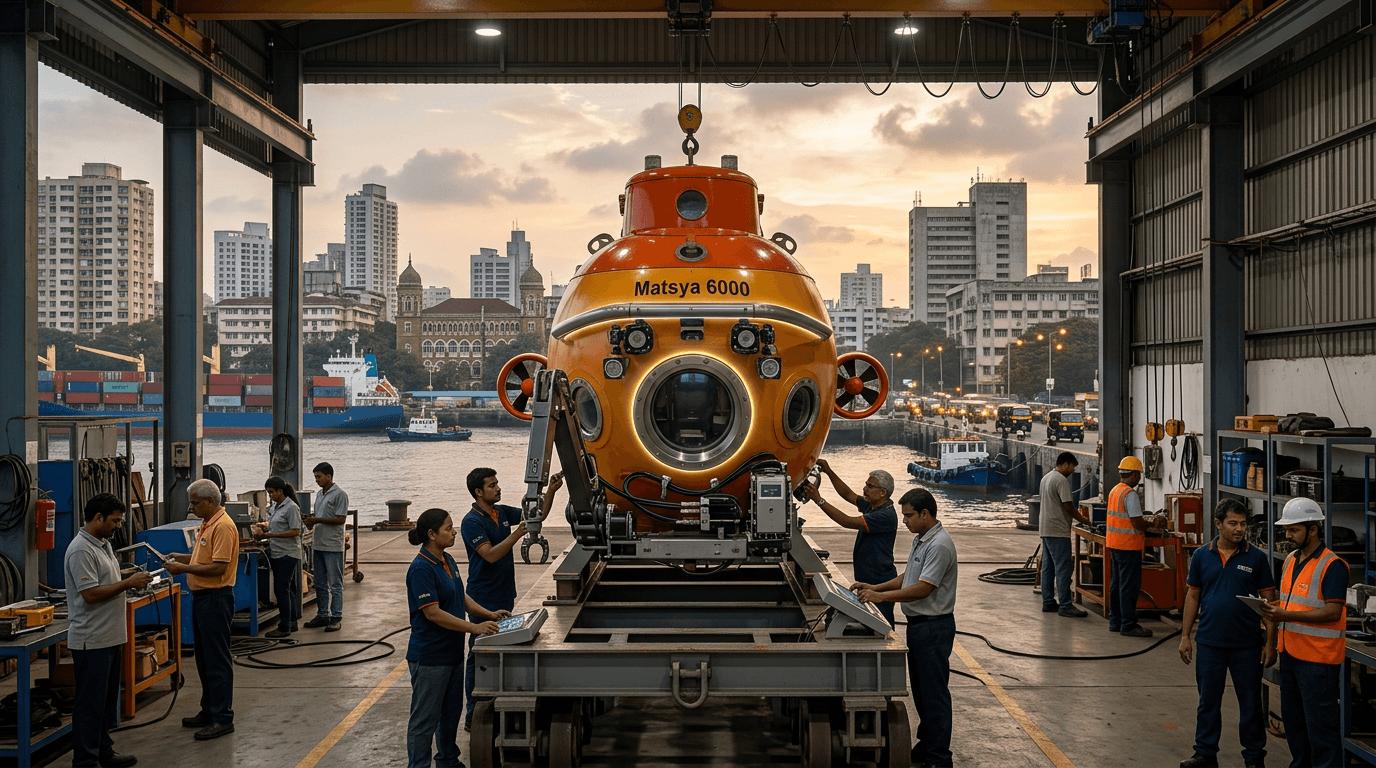
Matsya 6000 Deep Ocean Manned Submersible
Geography: Asia Pacific · South Asia · India
Matsya 6000 is India's first indigenously designed manned submersible, being developed under the Samudrayaan project as part of the Rs 4,077 crore Deep Ocean Mission. The titanium-alloy pressure hull vehicle is designed to carry three aquanauts to a depth of 6,000 meters — deep enough to reach 95% of the ocean floor. The submersible completed its first wet test at 15 meters in Chennai harbour in late 2024, with shallow water tests planned for 2025 and unmanned deep-sea tests scheduled for 2026.
The primary mission target is exploration of polymetallic nodule deposits in the Central Indian Ocean Basin (CIOB), where India holds an exclusive exploration contract from the International Seabed Authority covering 75,000 square kilometers. These potato-sized nodules contain manganese, nickel, cobalt, copper, and rare earth elements — critical minerals for batteries, electronics, and green energy technologies. India's deep ocean mining ambitions are part of a broader Blue Economy strategy covering deep-sea mining, ocean climate change advisory services, underwater robotics, and marine biodiversity surveys.
Only a handful of nations — the US, Russia, China, France, and Japan — operate manned deep-sea submersibles capable of reaching 6,000+ meters. India joining this exclusive club would give it autonomous capability to explore and eventually exploit deep-sea mineral resources, reducing dependence on China (which currently dominates critical mineral supply chains). The Deep Ocean Mission also develops complementary technologies: autonomous underwater vehicles, deep-sea sensors, and ocean thermal energy conversion systems.
Research this in Signals
Signals turns a topic into a sourced research record you can inspect and rerun. Your first scan is free, and this one starts with Matsya 6000 Deep Ocean Manned Submersible already loaded, so edit it or scan as is.