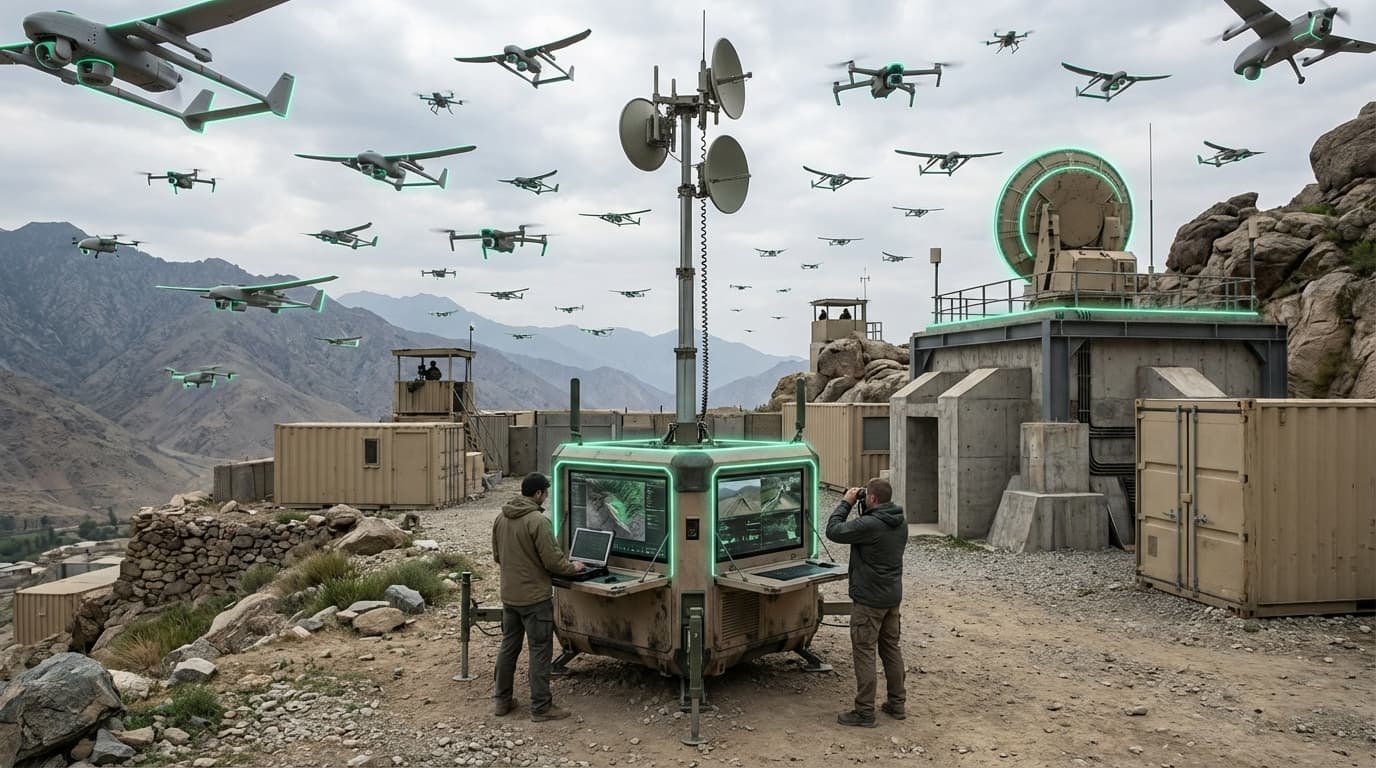
Autonomous Swarm Systems
Autonomous swarm systems represent a paradigm shift in military and security operations, leveraging distributed artificial intelligence to coordinate large numbers of unmanned aerial vehicles (UAVs) that operate as a unified, adaptive network. Unlike traditional drone operations that rely on individual pilot control or pre-programmed flight paths, swarm systems employ decentralized decision-making algorithms that allow each unit to communicate with its neighbors, share sensor data, and collectively respond to changing battlefield conditions. The technical foundation rests on mesh networking protocols that enable peer-to-peer communication between drones, combined with machine learning models that process inputs from multiple sensors—including optical cameras, infrared detectors, and electronic warfare receivers—to build a shared operational picture. Each drone in the swarm functions as both an independent agent and a node in a larger collective intelligence, capable of adapting its behavior based on the actions of nearby units and the evolving tactical environment. This distributed architecture ensures the swarm remains functional even when individual units are destroyed or disabled, as the remaining drones automatically reconfigure their coordination patterns to maintain mission effectiveness.
The strategic appeal of autonomous swarm systems lies in their ability to address fundamental challenges in modern contested environments, particularly the saturation of sophisticated air defense networks that have made traditional crewed aircraft and individual high-value drones increasingly vulnerable. By deploying dozens or hundreds of low-cost platforms simultaneously, swarm systems create a target-rich environment that overwhelms radar tracking systems and exhausts missile inventories designed to counter smaller numbers of threats. This approach fundamentally alters the cost-exchange ratio that has long favored defensive systems, as intercepting a swarm of inexpensive drones with expensive surface-to-air missiles becomes economically unsustainable. Beyond their role in penetrating defended airspace, swarm systems enable persistent intelligence gathering across wide geographic areas, with individual drones maintaining surveillance over specific sectors while sharing their observations across the network to build comprehensive situational awareness. The technology also supports rapid strike capabilities, allowing military forces to identify and engage time-sensitive targets with minimal delay between detection and action, a critical advantage in dynamic operational scenarios where traditional command-and-control cycles prove too slow.
Several nations have conducted field demonstrations of swarm capabilities, with research programs exploring applications ranging from border surveillance to contested maritime environments. Early operational concepts envision swarms conducting reconnaissance ahead of conventional forces, identifying threats and mapping terrain before human operators enter potentially dangerous areas. In naval contexts, swarm systems could provide distributed sensor coverage around carrier groups or conduct coordinated attacks against surface vessels, leveraging their numbers to penetrate layered defenses. The technology also holds implications for urban security operations, where swarms might monitor large public gatherings or search disaster zones more efficiently than individual platforms. As artificial intelligence capabilities mature and manufacturing costs decline, autonomous swarm systems are positioned to become a standard component of military force structures, fundamentally reshaping concepts of air superiority and area denial. This evolution reflects broader trends toward distributed, networked warfare where mass and adaptability increasingly complement or replace the traditional emphasis on individual platform sophistication, suggesting a future where tactical advantage derives as much from algorithmic coordination as from raw technological capability.
Research this in Signals
Signals turns a topic into a sourced research record you can inspect and rerun. Your first scan is free, and this one starts with Autonomous Swarm Systems already loaded, so edit it or scan as is.