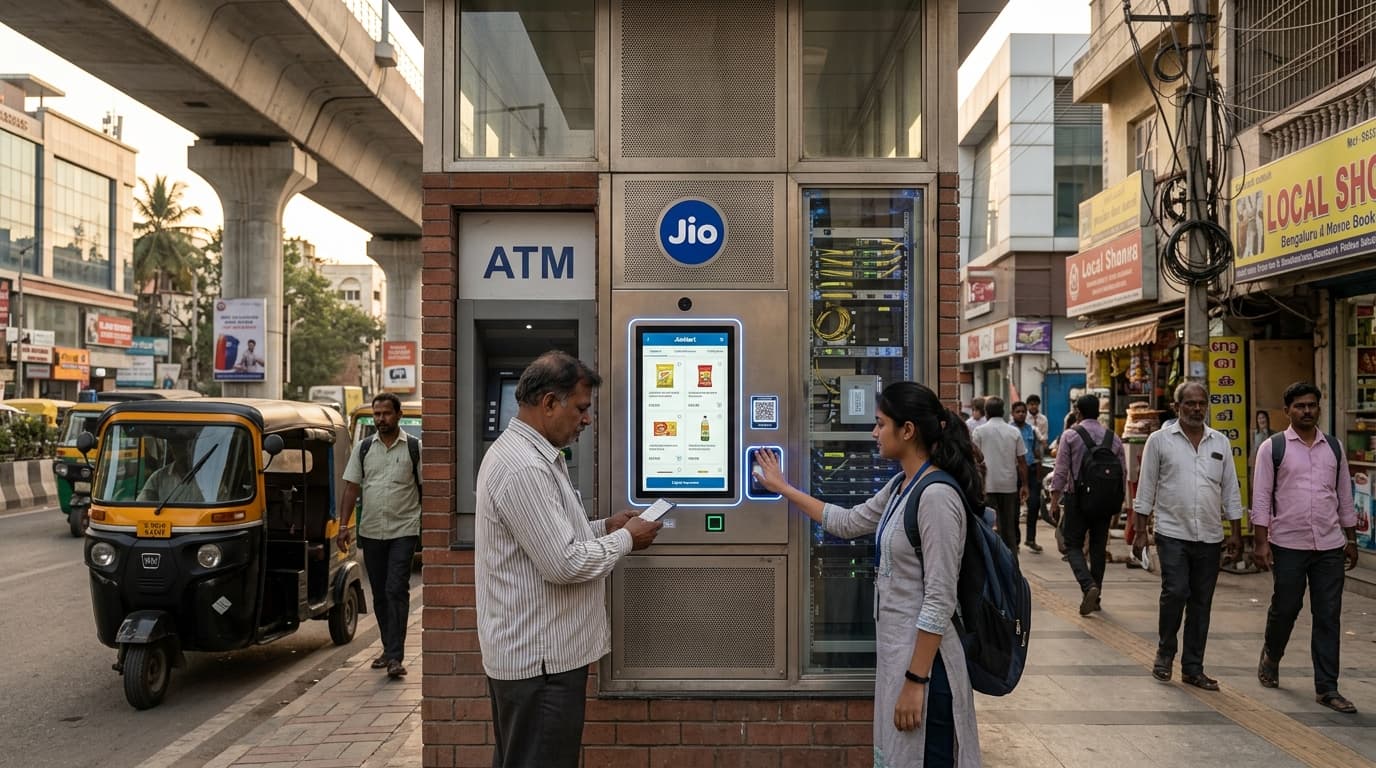
Jio as National Digital Infrastructure Platform
Geography: Asia Pacific · South Asia · India
Reliance Jio's 2016 launch is arguably the single most transformative corporate event in India's digital history. By offering free 4G data for six months, Jio collapsed India's mobile data prices from ~$3/GB to under $0.10/GB overnight, triggering a telecom consolidation from 12+ operators to three and bringing 600+ million Indians online for the first time. But Jio isn't a telecom company — it's a vertically integrated digital infrastructure play. The stack includes connectivity (Jio 4G/5G/Fiber), payments (JioPay), commerce (JioMart, partnered with WhatsApp), entertainment (JioCinema, which won IPL streaming rights), cloud (JioCloud, building hyperscale data centers), and IoT (JioThings). The $20B+ investment round from Google, Meta, Qualcomm, Intel, and KKR in 2020 valued this integration.
The Jio effect on Indian society is comparable to what electrification did a century ago. Before Jio, India's internet penetration was ~25%; by 2025 it exceeded 60%. A vegetable vendor in rural Bihar now accepts UPI payments, watches cricket on JioCinema, and orders wholesale supplies through JioMart — all on a $50 Jio phone. Jio didn't just provide connectivity; it created the economic conditions for India's entire digital ecosystem to flourish. PhonePe, Zomato, Swiggy, Zerodha, and hundreds of Indian digital companies exist at their current scale because Jio made data nearly free.
Strategically, Jio represents India's alternative to both the US model (multiple competing platforms) and the Chinese model (state-backed super-apps). It's a privately-owned, vertically integrated digital utility that functions as quasi-public infrastructure. Jio's satellite communications arm (Jio SpaceFiber) is now competing with Starlink for India's satellite internet market. The company's planned AI infrastructure investments — including NVIDIA GPU clusters and Indian-language AI models — position it as the foundational layer for India's AI future. No other single entity in any country has transformed digital access at this speed and scale.
Research this in Signals
Signals turns a topic into a sourced research record you can inspect and rerun. Your first scan is free, and this one starts with Jio as National Digital Infrastructure Platform already loaded, so edit it or scan as is.