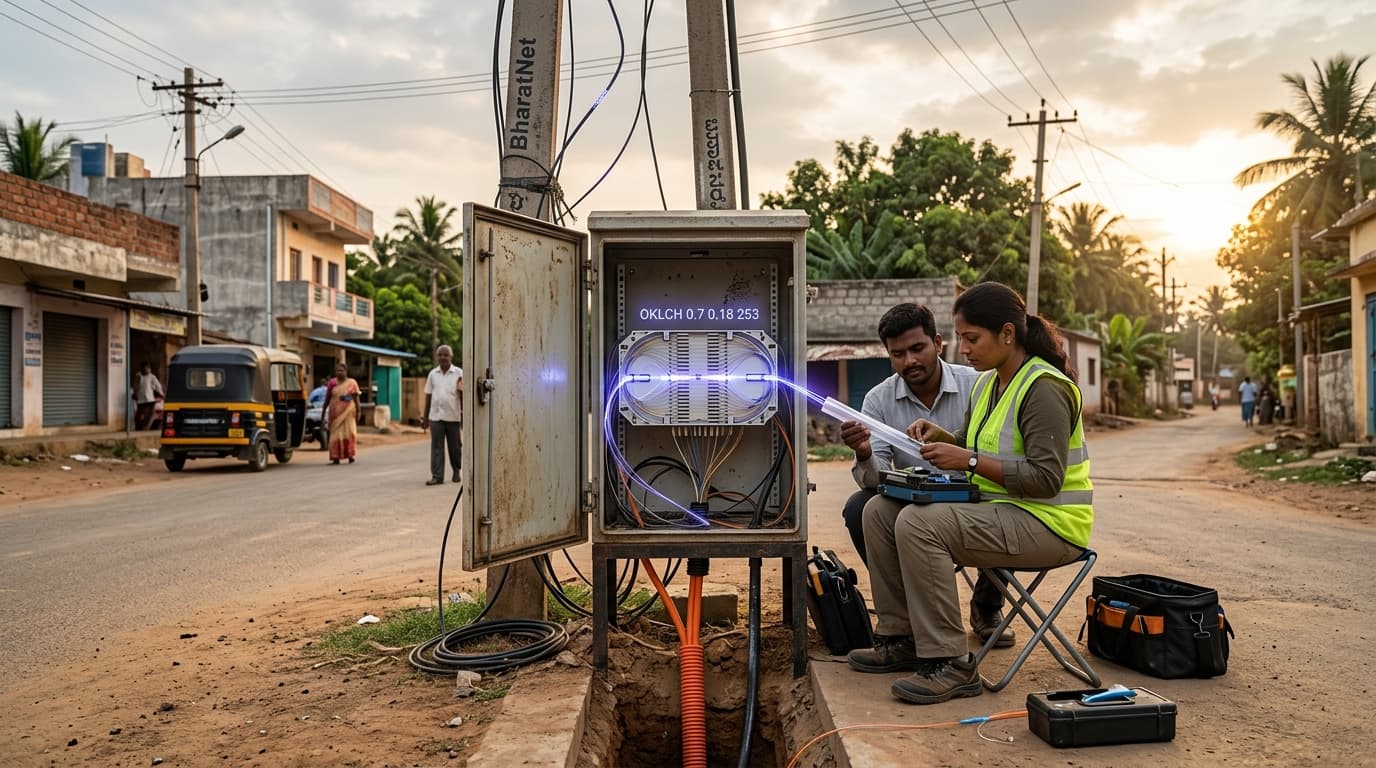
BharatNet Rural Fiber Optic Network
Geography: Asia Pacific · South Asia · India
BharatNet is the Indian government's flagship project to connect all 640,000+ villages (gram panchayats) to high-speed broadband via a government-owned fiber optic network. Managed by Bharat Broadband Network Limited (BBNL), the project has laid over 600,000 km of optical fiber cable, making it one of the world's largest rural connectivity infrastructure projects. The network provides wholesale bandwidth to telecom operators, ISPs, and government agencies, ensuring that last-mile digital infrastructure remains publicly owned rather than controlled by private telecom monopolies.
BharatNet's significance for sovereignty is often underappreciated. While India's private telecom operators (Jio, Airtel) provide excellent urban and suburban coverage, rural connectivity depends on infrastructure economics that private companies may not serve profitably. By building government-owned fiber to every village, India ensures that digital public goods — UPI, DigiLocker, e-governance services, telemedicine — can reach the entire population without private gatekeepers deciding which communities deserve connectivity.
Strategically, BharatNet complements India's digital public infrastructure stack: Aadhaar provides identity, UPI provides payments, and BharatNet provides connectivity. Together they form a sovereign digital trinity that enables inclusion at population scale. The project's Phase III expansion includes satellite-based connectivity for the most remote areas and integration with 5G backhaul, ensuring India's digital infrastructure sovereignty extends to its most challenging geographies. While execution has been slower than planned, the infrastructure being built is a permanent sovereign asset.
Research this in Signals
Signals turns a topic into a sourced research record you can inspect and rerun. Your first scan is free, and this one starts with BharatNet Rural Fiber Optic Network already loaded, so edit it or scan as is.