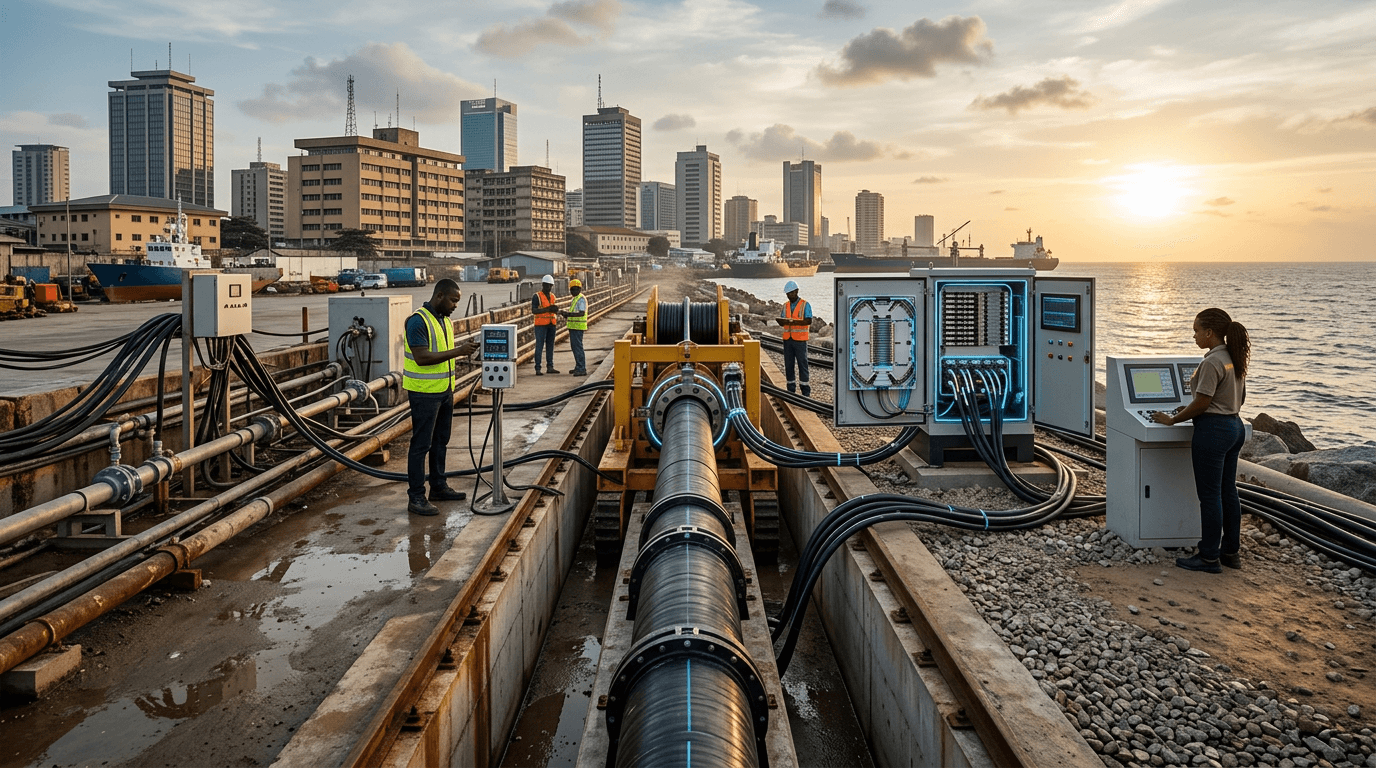
Advanced Subsea Cable Landing Infrastructure
Geography: Emea · Africa · Africa
The 2Africa subsea cable system, backed by Meta and consortium partners, was completed in November 2025 as the world's largest submarine telecommunications cable. At 45,000 km, it circles the entire African continent, connecting 33 countries to Europe and the Middle East. The cable uses advanced spatial division multiplexing (SDM) technology supporting up to 16 fiber pairs — double the capacity of older systems — and is the first 16-fiber-pair subsea cable to fully connect Africa.
Before 2Africa, Africa's international bandwidth was constrained and concentrated on a few landing points (primarily in South Africa, Nigeria, and Kenya). The new cable provides landing stations in previously underserved countries, dramatically reducing the cost and latency of internet connectivity. Combined with the Equiano cable (Google) and other new systems, Africa's international bandwidth is increasing by an estimated 20x between 2020 and 2026.
The connectivity infrastructure creates the foundation for everything else in this radar. Without bandwidth, there's no cloud computing, no streaming, no fintech, no AI. The critical question is what happens at the cable landing points — Africa needs not just international connectivity but domestic fiber networks to distribute bandwidth from coastal cities to inland populations. The 'last mile' (or last 1,000 miles) remains the continent's biggest connectivity challenge.
Research this in Signals
Signals turns a topic into a sourced research record you can inspect and rerun. Your first scan is free, and this one starts with Advanced Subsea Cable Landing Infrastructure already loaded, so edit it or scan as is.